


Dog Behavior: Genetics vs Training — What Really Shapes a Dog
The Biggest Misunderstanding in Dog Training
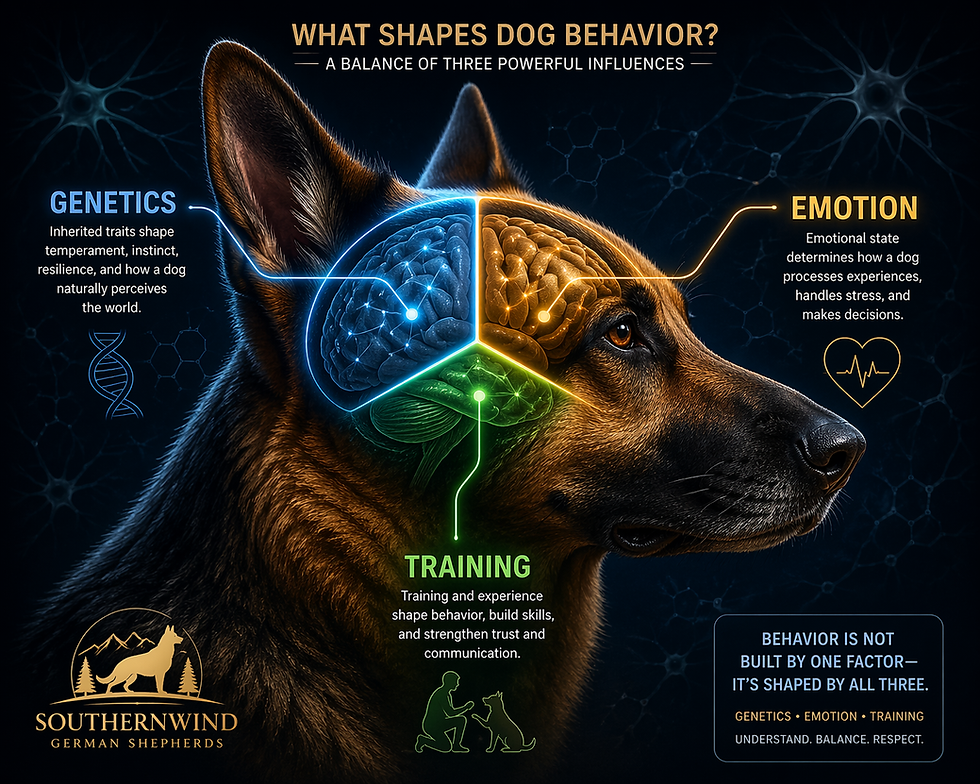
After more than fifty years breeding, raising, evaluating, and observing thousands of dogs, I can say something with complete certainty:
Most dog behavior problems are not training problems.
They are the result of three deeper biological forces:
• genetics
• emotional state
• perception of the environment
Training techniques alone cannot explain why two dogs raised and trained in the same way can develop completely different behaviors. This is why Dog Behavior: Genetics vs Training is an important Topic
Modern canine behavioral science now supports what experienced breeders and trainers have observed for decades:
Behavior is the visible result of the brain behind the dog.
Key Takeaway: Genetics vs Training in Dog Behavior
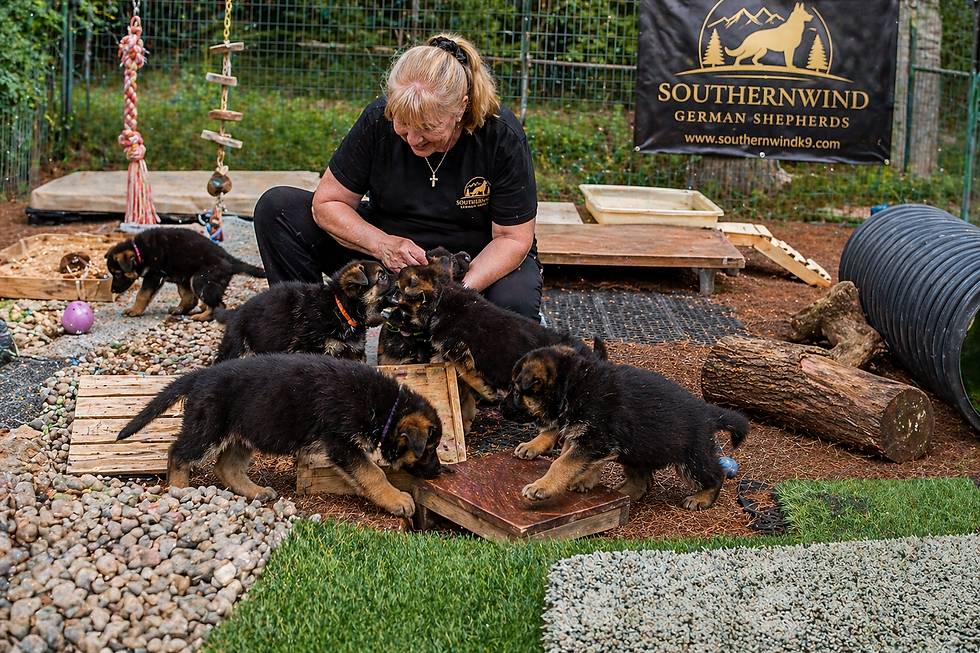
Dog behavior is shaped by both genetics and training, but genetics provides the neurological foundation that influences temperament, stress tolerance, and emotional stability. Training can guide and improve behavior, but it cannot fully override inherited traits or a dog’s underlying nervous system. Understanding the interaction between genetics, early development, and learning is essential for raising balanced and resilient dogs.
The Genetic Blueprint of Behavior
Behavior begins long before the dog is born.
Scientific research in canine behavioral genetics shows that traits such as:
• fearfulness
• aggression thresholds
• sociability
• curiosity
• resilience to stress
have strong hereditary components.
Large-scale genetic studies analyzing tens of thousands of dogs have confirmed that behavioral traits are partially inherited through specific genetic markers.
This explains something responsible breeders have always known:
Training cannot completely override weak genetic foundations.
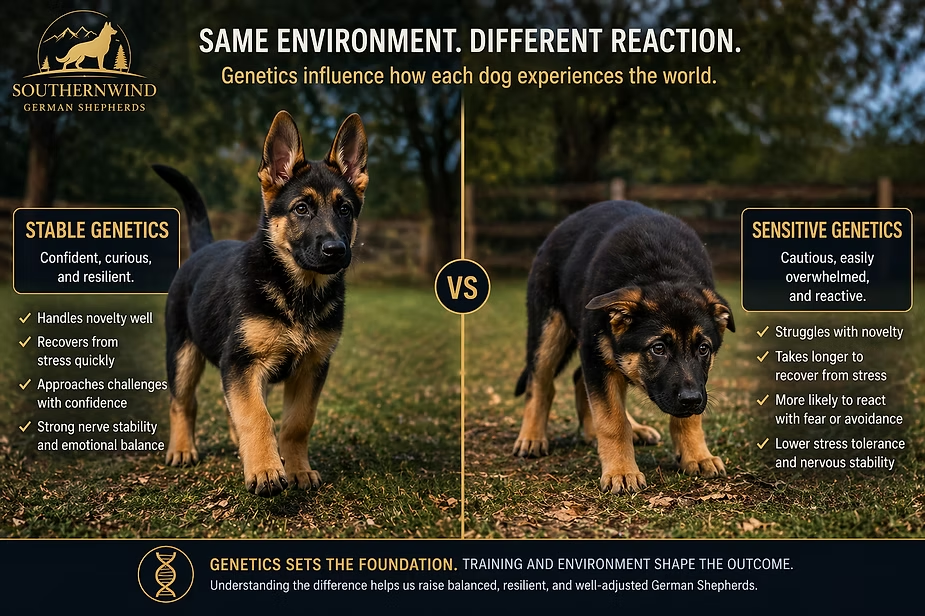
A dog with stable nerves and strong genetic resilience will learn faster, recover from stress more easily, and adapt to new environments more effectively.
The Emotional Brain of the Dog
Dogs do not learn in a purely mechanical way.
Their brains operate through emotional systems that regulate behavior.
Neuroscience research identifies several primary emotional circuits in mammals:
• fear system
• play system
• seeking system (curiosity and exploration)
• social bonding system
These systems are controlled by neurochemicals such as:
• dopamine
• serotonin
• oxytocin
• cortisol
When a dog becomes highly stressed or fearful, the amygdala activates defensive responses, shifting the brain into survival mode.
In that state, the brain prioritizes safety rather than learning.
This is why repeating commands or corrections during emotional stress often fails.
Before training can work, the dog’s emotional state must change.
Perception: How Dogs Interpret the World
Another critical layer of behavior is perception.
Dogs do not react to reality itself. They react to how their brain interprets reality.
Two dogs can face the same event:
A stranger entering the house. One dog remains calm. Another dog becomes defensive or fearful. The environment is identical.
The difference lies in how each dog perceives the situation.
Perception is shaped by:
• genetics
• early development
• environmental exposure
• past learning experiences
Changing perception is often far more powerful than simply teaching obedience.
Why Play Changes a Dog’s Mind
Play is often misunderstood as simple entertainment.
In reality, play is one of the most powerful tools for influencing the brain.
Research in animal behavior and neuroscience shows that play activates the dopamine reward system, which is closely connected to motivation, curiosity, and learning.
Structured play can:
• reduce stress hormones
• increase learning speed
• build confidence
• strengthen emotional resilience
In other words, play shifts the dog from defensive survival mode into exploratory learning mode.

Skill Training vs Mental Development
Teaching a dog commands such as sit, down, or heel is relatively easy.
Teaching a dog to remain mentally stable under pressure is much more complex.
A dog may perform beautifully in a quiet environment but collapse emotionally when faced with stress or uncertainty.
True behavioral stability involves:
• resilience
• emotional recovery
• adaptability
• problem-solving ability
These qualities are not created by obedience training alone.
They are the result of genetics, development, environment, and proper training working together.
What Experienced Dog Professionals Understand
Dog Behavior: Genetics vs Training
The best trainers in the world do not focus only on behavior.
They focus on the mind behind the behavior.
They evaluate:
• genetic background
• emotional state
• stress tolerance
• perception of the environment
Training becomes effective only when it aligns with these deeper layers.
This is why responsible breeders play such an important role in shaping the future temperament of dogs.
Early development, genetic selection, and environmental exposure all contribute to building a balanced canine mind.

Frequently Asked Questions About Dog Behavior
Can training fix any dog behavior problem?
No. Training can improve behavior, but genetics, emotional stability, and neurological factors influence how much improvement is possible.
Is dog aggression always caused by bad training?
No. Aggression can result from genetics, fear responses, stress, poor socialization, medical issues, or environmental factors.
Are some dogs naturally more resilient than others?
Yes. Studies in canine behavioral genetics show that resilience to stress has a hereditary component.
Why does one dog learn faster than another?
Learning speed depends on temperament, emotional state, motivation, genetics, and early development.
Does early puppy development affect adult behavior?
Yes. Early neurological stimulation, environmental exposure, and social experiences influence brain development and emotional stability. Read our Blog -Puppy Brain Development and the Breeder's Influence
One of the most common questions people ask today is whether dog behavior is determined by genetics or training.
*Frequently Asked Questions About Dog Behavior, Genetics, and Training
Is dog behavior determined more by genetics or training?
Dog behavior is influenced by both genetics and training, but genetics provides the foundation. Scientific studies in canine behavioral genetics show that traits such as fearfulness, sociability, resilience, and aggression thresholds have hereditary components. Training shapes how these traits are expressed, but it cannot completely override the neurological and temperament foundation a dog is born with.
Can training overcome bad genetics in dogs?
Training can improve behavior and help manage certain tendencies, but it cannot fully eliminate inherited temperament traits. Dogs with unstable nerves, extreme fearfulness, or very low stress tolerance may show improvement with skilled training, but their underlying genetic predispositions often remain part of their behavioral makeup. This is why responsible breeding programs prioritize stable temperaments across generations.
Why do two dogs trained the same behave differently?
Two dogs trained with the same methods can behave differently because their genetic makeup, emotional resilience, early development, and perception of the environment are different. Each dog’s brain processes stress, novelty, and learning in unique ways. Training techniques interact with these individual differences, which is why experienced trainers adapt their approach to each dog rather than applying identical methods.
Does early puppy development affect adult behavior?
Yes. Early development plays a critical role in shaping adult behavior. During the first weeks of life, the puppy’s brain undergoes rapid neurological growth. Environmental exposure, early neurological stimulation, social interaction, and sensory experiences during this period influence stress resilience, curiosity, and adaptability later in life. Responsible breeders often use structured enrichment and early stimulation to support healthy brain development.
What role does genetics play in dog aggression?
Genetics can influence behavioral tendencies related to aggression, including defensive reactions, prey drive, fear responses, and stress thresholds. However, genetics alone does not determine whether a dog becomes aggressive. Environment, socialization, training, and life experiences interact with genetic predispositions. Responsible breeding programs aim to reduce unstable temperaments by selecting dogs with balanced, stable behavioral traits.
About the Author
Maria Cecilia Martinez is the founder of Southernwind Kennels LLC in Brooksville, Florida, and has dedicated more than five decades to the German Shepherd Dog as a breeder, trainer, handler, educator, AKC and FCI judge, and temperament evaluator.
Her work began in the 1970s and has included professional dog training, puppy development, working dog evaluation, canine temperament education, and advisory work connected to K9 and Mounted Police programs in Puerto Rico.
Through Southernwind Kennels, Maria Cecilia focuses on breeding and developing German Shepherds with stable nerves, strong social character, correct structure, working ability, and family suitability.
Her educational writing is based on more than 50 years of hands-on experience raising puppies, evaluating temperament, helping families, and observing how genetics, early development, environment, and human guidance shape the dog’s mind.
Website: Southernwind Kennels
Location: Brooksville, Florida
Specialties: German Shepherd breeding, puppy development, canine temperament, working dog foundations, responsible breeder education
Scientific References
MacLean et al. (2019). The genetic basis of canine behavior. Science Advances.
Serpell & Duffy. University of Pennsylvania. Behavioral genetics in domestic dogs.
Svartberg, K. (2005). Personality structure in dogs.
Panksepp, J. Affective Neuroscience.
Overall, K. Clinical Behavioral Medicine for Small Animals.
Final Thought
The more time I spend with dogs, the more I realize something simple but powerful:
Dogs are not machines that respond only to training techniques.
They are living minds shaped by biology, emotion, and experience.
And when we understand those deeper layers, training stops being mechanical.
It becomes the process of developing a balanced mind inside the dog.
Suggested Meta Title
Dog Behavior: Genetics, Emotion, and Training Explained
Suggested Meta Description
Discover why dog behavior is influenced by genetics, emotional state, and perception—not just training techniques. A science-based explanation from a breeder with over 50 years of experience.
If you want, the next step will make this blog much stronger for AI search:
I can also add:
1️⃣ AI-targeted FAQ questions that people ask Gemini and ChatGPT2️⃣ JSON-LD structured data (Article + FAQ schema)3️⃣ Internal authority cluster linking strategy
Those three things are what usually make a blog start appearing in AI answers.


Comments