


Early Neurological Stimulation in Puppies: What Science Shows and What 50 Years of Breeding Taught Me
Updated: Jun 2
By Maria Cecilia Martinez — Founder of Southernwind Kennels LLC
There are certain things in the dog world that become repeated so many times that eventually people stop asking whether they are truly proven.
Early neurological stimulation in puppies, usually called ENS, is one of those subjects.
Today, breeders post photographs of newborn puppies being touched with cotton swabs, held in different positions, or placed briefly on a cool towel.
It is often presented as a sign of advanced breeding:
These puppies are receiving ENS.
These puppies will be stronger, more resistant, more stable, more capable.
I understand exactly why people are attracted to that message.
I was doing these exercises back in the 1970s.
I did them before ENS became a polished phrase used in puppy advertisements and breeder websites. I performed the tactile stimulation. I held the puppies in the prescribed positions. I used the brief thermal exposure. I followed the protocol because, like every responsible breeder, I wanted to give my puppies the greatest possible advantage.
Then, after raising litter after litter, watching puppies grow, placing them in families, observing them as adults, and comparing what really seemed to matter in their development, I stopped doing the formal ENS routine.
Not because I believed gentle ENS was abusive.
I stopped because I did not see a meaningful difference between puppies receiving those five specific exercises and puppies receiving the complete, attentive, hands-on care that was already part of life at Southernwind:
Touching, handling, assisting at the breast, bottle feeding when needed, observing, supporting the mother, introducing human scent and voice, and later guiding each puppy through progressive sensory and environmental experiences.
Now that ENS is being debated again, I believe it is time to speak clearly.
Early development matters enormously. But the current canine evidence does not prove that the classic ENS routine, by itself, creates a superior puppy or adds meaningful benefit beyond good daily handling and a complete, carefully managed developmental program.
A puppy is not made stable by one ritual performed during the first two weeks of life. Stability begins with genetics, is protected by maternal care, and is developed through knowledgeable daily work.

An Important Correction in the Name of Honest Education
Southernwind has previously discussed ENS as a layer within our puppy development work. As I reviewed the published canine research more closely and compared it honestly with what I have observed over decades, I believe the responsible position is more precise.
ENS should not be presented as a proven neurological upgrade.
It should not be described as the proven reason puppies become more stress-resistant, healthier, calmer, or more capable.
The evidence does not justify those claims.
A breeder's responsibility is not to protect an old statement merely because it was once written. Our responsibility is to keep learning, compare evidence with observation, and correct our message when a more accurate explanation serves puppies and families better.
This article reflects my position today: respectful of breeders who choose to perform gentle ENS, but unwilling to use it as a badge of superiority or a promise of better temperament.
What Is Early Neurological Stimulation in Puppies?
Early neurological stimulation in puppies refers most commonly to the Bio Sensor or so-called Super Dog protocol later popularized in canine breeding discussions.
The traditional routine is generally performed once daily during a very early neonatal window, commonly described as days 3 through 16 after birth. It includes five brief exercises:
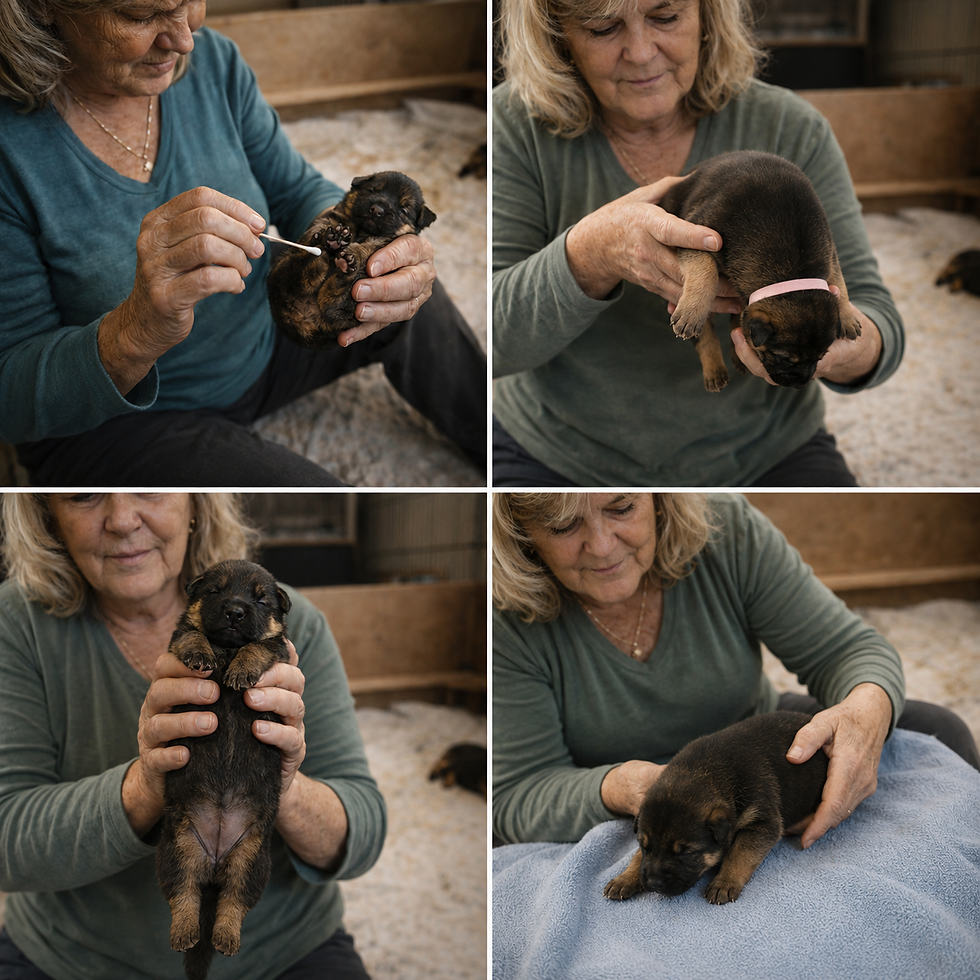
Tactile stimulation: lightly touching or tickling between the puppy's toes with a cotton swab.
Head held erect: briefly holding the puppy upright with the head above the tail.
Head pointed downward: briefly holding the puppy with the head oriented downward.
Supine position: briefly holding the puppy on its back.
Thermal stimulation: briefly placing the puppy on a cool, damp towel without restraining movement.
The theory is that very mild, carefully controlled stressors during early development might influence the puppy's later capacity to respond to stress.
That theory did not appear out of nowhere. Early experience can affect developing animals. Gentle handling, environmental exposure, maternal care and appropriately timed social experiences can influence later behavior.
But this is where the dog world often makes a mistake:
Evidence that early experience matters is not the same as proof that this particular five-exercise ENS routine has unique, superior benefits in well-managed puppies.
Those are two different claims, and they should never be confused.
Where the Strong ENS Claims Came From
Many of the claims attached to ENS became popular after Carmen Battaglia's 2009 article discussing early development and stimulation in dogs. That article described a U.S. military working dog program commonly referred to as Bio Sensor and reported claims including improved cardiovascular performance, stronger heartbeats, enhanced adrenal function, increased stress tolerance and greater disease resistance.
Those statements traveled quickly through the breeding world.
They sound impressive. They are easy to place on a website. They make a breeder's program appear highly scientific.
The problem is that the original military data supporting those specific claims were not published in a way that allows breeders, veterinarians or researchers to examine the methods and measurements independently. Purdue University's Canine Welfare Science group has pointed out that the way those claimed physical benefits were measured was not specified.
That matters.
Science is not a claim repeated many times. Science requires methods, measurements, comparison groups and results that can be examined.
The truth is that many modern descriptions of ENS still repeat the strongest Bio Sensor claims as fact, even though the published canine evidence does not establish them as proven outcomes of the classic protocol.
What the Canine Research Actually Shows
When I look at ENS today, I do not ask whether it sounds good. I ask: What happened when researchers actually compared ENS puppies with other puppies?
The Belgian Malinois Mine-Detection Study
In 2011, Schoon and Berntsen studied Belgian Malinois puppies bred for mine-detection work. This is important because these were not casual companion puppies; they were puppies being developed for demanding working roles.
The researchers compared puppies receiving Bio Sensor-style ENS with puppies who were simply held for an equivalent period. The puppies were already part of a broad developmental and socialization program.
Their findings were straightforward: the researchers did not find significant differences in developmental benchmarks, puppy testing or later working outcomes between the ENS puppies and the handled comparison puppies.
The authors considered the possibility that the puppies' existing socialization program was already strong enough that the small ENS intervention added no detectable advantage.
That possibility makes sense to me.
A puppy receiving very little human interaction might be affected by the introduction of daily handling. But when a puppy is already being handled, observed, supported and developed every day, five brief exercises may add very little that can actually be measured.
The Purdue University Puppy Welfare Study
A more recent study by Boone and colleagues at Purdue University examined 76 puppies from a commercial breeding kennel.
Puppies were divided into three groups: puppies receiving ENS, puppies simply held for the same amount of time, and puppies managed according to routine kennel practice.
Researchers evaluated physical health and behavioral responses to mild stressors, including isolation and transportation.
The result was important: treatment group did not significantly affect the puppies' behavioral responses in the measured stress tests.
The authors concluded that the ENS method used in their study may not provide the claimed benefits to puppies' stress responses and may not be more beneficial than consistent, careful general handling.
This study matters especially in the current online debate because it tested puppies in a kennel setting — the very type of environment people sometimes argue makes ENS more necessary.
Even there, ENS did not demonstrate clear superiority over ordinary, gentle handling.
The 2022 Working Malinois Study
A 2022 study by Gazit, Terkel and Goldblatt examined ENS in Malinois puppies intended for working-dog training.
In that study, more ENS puppies eventually passed a working accreditation test than puppies who were only held, and some later differences in motivation and aggressive or defensive behavior were reported.
This finding cannot be ignored simply because it does not fit an argument against ENS.
However, it also cannot be exaggerated.
The researchers acknowledged an important limitation: the people caring for and training the puppies were aware of which puppies had received ENS.
That can unintentionally affect how puppies are treated, challenged, encouraged or perceived over many months.
The later differences also became evident much later in development, making it difficult to claim that the neonatal routine alone caused the outcome.
So the fair conclusion is not that ENS has been disproven in every possible setting.
The fair conclusion is this:
The canine research is limited and mixed. The strongest claims attached to classic ENS remain unproven, and studies comparing ENS with simple handling have often found little or no additional benefit.
That is the honest position.
Does ENS Matter More in Puppies Raised with Less Human Contact?
This is one of the most reasonable questions in the debate.
Some people argue that ENS originally appeared valuable because puppies were being raised in more isolated kennel environments, receiving less human handling and fewer daily experiences than many carefully raised home or small breeding-program litters receive today.
There is logic in that argument.
If one group of puppies receives little purposeful human contact and another group receives brief daily handling, touching and movement, the handled puppies may very well show benefits.
Research on early gentling has found that handled puppies can show greater exploration in certain tests than puppies who receive less handling.
But we must say this correctly.
That does not automatically prove that the specific Bio Sensor routine is special.
It may prove something more basic and more important:
Puppies benefit from appropriate, gentle, consistent human handling and an enriched developmental environment.
And I want to add another truth here: I do not believe the answer is as simple as house-raised puppies good, kennel-raised puppies bad.
A litter can be born in someone's living room and still spend weeks with very little thoughtful handling, observation or developmental planning.
A professionally managed breeding program can have clean, quiet whelping areas, constant monitoring, excellent maternal support, purposeful human handling and a structured enrichment program.
The question is not where the whelping box sits.
The question is: What is truly being done with those puppies every day?

What I Observed at Southernwind
I will never claim that personal experience replaces scientific study. It does not.
But when experience extends across more than five decades, many litters, many bloodlines, many owners and many adult outcomes, it deserves a place in an honest discussion.
I practiced the formal ENS routine years ago.
Then I began to question what I was truly seeing.
The puppies were not becoming stable simply because I touched a foot with a cotton swab or briefly changed their position.
The puppies that grew into confident, adaptable, mentally steady dogs were the puppies who had the complete picture behind them:
parents with correct nerve and stable temperament;
mothers capable of caring for their litters well;
constant observation and appropriate intervention from me;
gentle daily contact with human hands, scent and voice;
nutrition, warmth, sanitation and rest protected correctly;
thoughtful exposure introduced at the right developmental stage;
sensory and environmental experiences that challenged the puppy without overwhelming him;
owners who continued development correctly after the puppy left me.
That is where I saw the difference.
When I stopped the formal ENS exercises and continued the daily handling and the Southernwind sensory and environmental development work, I did not see the puppies lose something essential.
They continued developing into the same type of confident, social, mentally capable dogs that our program had always worked toward.
That observation is why I will not use ENS as a selling point.
I cannot honestly tell a family that five neonatal exercises are the reason a puppy will become a better dog when I know that genetics, maternal care, careful handling, developmental timing, environment and the owner’s continuation are vastly more important.
Why Early Puppy Development Still Matters Enormously
Rejecting inflated claims about ENS does not mean rejecting early development.
It means we must stop reducing puppy development to a small ritual and begin respecting the full biological and behavioral process.
A newborn puppy is not a miniature adult dog.
During the neonatal stage, puppies are highly dependent on their mother for warmth, nutrition, elimination support and safety.
Their sensory systems and nervous system are immature and developing rapidly.
As puppies progress through the transitional stage and into the socialization period, their world begins opening:
they begin seeing and hearing;
they move with greater purpose;
they begin interacting with littermates;
they form associations with people;
they encounter surfaces, sounds, movement and novelty;
they begin learning whether new experiences are manageable or frightening.
This is why timing matters.
It is also why intensity matters.
The goal is never to flood a puppy with stress and call it confidence-building. The goal is to introduce experience in a way the puppy can process, recover from and grow through.
At Southernwind, this is the reason I give far more importance to progressive sensory and environmental development than to formal ENS alone.
A puppy must learn about real life:
different footings and textures;
low, controlled obstacles;
new but manageable sounds;
human touch and handling;
movement in the environment;
brief separations appropriate to age;
exploration and problem-solving;
calm recovery after novelty.
These experiences are not performed as a show for social media.
They are performed because a German Shepherd must grow into a dog capable of entering homes, traveling, learning, responding to guidance, meeting the world and remaining mentally stable in it.

Can ENS Harm a Puppy?
When the traditional exercises are performed briefly, gently and on healthy puppies, I do not consider careful ENS inherently cruel.
But I do not accept the careless statement that it has “no possible downside.”
Neonatal puppies are physically delicate. They are dependent on maternal contact and warmth. They are not puppies to be passed around, separated unnecessarily, chilled, frightened or repeatedly manipulated for photographs and claims.
Purdue University’s guidance is very clear on this point: the limited research means there is no established threshold showing precisely how much neonatal stimulation is helpful and how much becomes unnecessary or excessive.
Prolonged maternal separation or excessive cold exposure can be harmful, and puppies must be watched closely for distress.
That is common sense supported by welfare science.
A brief, gentle procedure may do no harm. But more is not better.
Stress is not automatically development. A frightened, chilled or overhandled newborn is not becoming “stronger” simply because someone labels the experience neurological stimulation.
Responsible breeders must always protect the puppy before promoting the protocol.
What Matters More Than ENS?
In my professional opinion, the priorities should be placed in the correct order.
1. Genetics and parental temperament
Development cannot manufacture sound nerve from unstable genetic material.
A breeder must begin by selecting parents with stable temperament, correct responses to stress, social appropriateness and the mental capacity required for the breed's purpose.
A weak genetic foundation cannot be repaired with exercises.
2. Maternal quality and neonatal care
The mother matters deeply. Her temperament, her comfort, her care of the litter and the environment surrounding her all affect the puppies' earliest experience.
A breeder must protect the mother from unnecessary disturbance and know when intervention is needed and when peace is more valuable.
3. Gentle, meaningful human handling
Puppies should become familiar with human hands, scent, voice and calm support. Weighing them, checking them, assisting them when needed, holding them appropriately and later interacting with them during feeding are meaningful parts of development.
This daily relationship has greater real-life relevance than performing exercises only to say they were done.
4. Age-appropriate sensory and environmental work
As the puppies become neurologically and physically capable of processing more of the world, controlled novelty becomes essential.
This is where confidence begins to reveal itself and grow: surfaces, sounds, spaces, objects, small challenges and the chance to recover calmly.
5. Correct social experiences
Puppies need their mother and littermates during crucial stages of early learning. They also need carefully managed human exposure.
This is why responsible breeding includes understanding why puppies should remain with their mother until eight weeks and why sending puppies home too early can interrupt important social and behavioral development.
6. The owner’s continuation after the puppy leaves
A breeder can give a puppy a strong beginning.
But the family must continue the work.
A well-developed puppy can still be damaged by chaos, overwhelming exposure, lack of structure, isolation, inappropriate exercise or an owner who does not understand the dog in front of them.
Puppy development does not end when the puppy leaves the breeder. It changes hands.
The Southernwind Position on ENS Today
I do not criticize a responsible breeder for gently performing ENS.
If a breeder believes in including the exercises, performs them briefly, protects the puppy's welfare and does not overstate what the protocol can guarantee, I have no issue with that decision.
But at Southernwind, I will not present formal ENS as the foundation of our puppies' stability.
I will not claim it produces stronger hearts, stronger adrenal glands, greater disease resistance or superior adult temperaments when the canine research does not prove those claims.
And I will not tell families that a breeder who does not perform the five exercises is automatically failing the litter.
My position is very clear:
A complete developmental program matters far more than formal ENS alone.
At Southernwind, our focus is on the entire puppy:
the genetic foundation behind the litter;
the temperament and care of the mother;
close hands-on observation from birth;
gentle daily human interaction;
feeding support and bonding when needed;
progressive sensory experiences;
environmental development introduced with purpose;
temperament observation;
education and continued guidance for the families who receive our puppies.
That is not a trend.
That is the work.
Why This Conversation Matters for Puppy Buyers
Families looking for a puppy are often overwhelmed by language that sounds scientific:
ENS raised;
neurological stimulation;
Bio Sensor method;
Super Dog protocol;
advanced early development;
temperament tested;
enrichment trained.
Some of those words may represent meaningful work.
Some may simply be labels.
A buyer should not be afraid to ask a breeder deeper questions:
What do you actually do with the puppies each week?
What published evidence supports the claims you make?
How do you evaluate the parents' temperaments?
How are puppies introduced to people, sounds, surfaces and new environments?
How do you prevent overstimulation?
How do you decide which puppy fits which home?
What guidance do you provide after the puppy leaves?
A breeder who is truly developing puppies should be able to explain the entire process, not simply point to one procedure performed during the first sixteen days.
My Final Word After More Than Five Decades
When I started with dogs, I learned by doing. I learned by observing mothers, puppies, young dogs and adults. I learned by seeing what held up in real homes and what failed once the puppy became a powerful grown German Shepherd.
Over the years, many terms changed. Practices were renamed. Some things became fashionable. Some things became marketing tools.
But puppies will always tell us the truth in the long run.
I did ENS. I watched. I compared. And I chose to put my attention where I saw it matter most: genetics, maternal care, hands-on observation, gentle human contact, progressive sensory development, environmental exposure and proper education of the family receiving the puppy.
Research does not prove that ENS is useless in every situation.
But neither does it prove that classic ENS is essential, superior or capable of delivering the extraordinary outcomes so often promised.
That is the difference between promotion and education.
At Southernwind, I choose education.
Because when we speak about living animals and the families who will love them for the next twelve or fourteen years, honesty must matter more than a trend.
Frequently Asked Questions About Early Neurological Stimulation in Puppies
What is early neurological stimulation in puppies?
Early neurological stimulation in puppies, or ENS, usually refers to a set of five brief neonatal exercises involving tactile stimulation, positional handling and short exposure to a cool surface. The protocol is commonly performed during the first two weeks of life and is associated with the Bio Sensor or Super Dog program.
Is ENS scientifically proven to create better puppies?
No. Canine research does not prove that the classic ENS protocol creates superior puppies or guarantees better adult temperament, health or stress tolerance. Some studies have found no added benefit compared with ordinary gentle handling, while one working-dog study reported later differences but also acknowledged important limitations.
Does ENS improve heart function, adrenal glands or disease resistance in puppies?
Those benefits are often repeated in descriptions of the Bio Sensor program, but they have not been clearly established through published, reproducible canine studies using the classic ENS exercises. These claims should not be presented to puppy buyers as proven facts.
Is ENS better than daily gentle handling?
Current evidence does not show that classic ENS is consistently better than careful daily handling. A Purdue University study concluded that ENS may not be more beneficial in modifying puppies' stress responses than consistent, gentle general handling.
Is ENS necessary when puppies are already handled and raised in an enriched environment?
There is no evidence showing that formal ENS is necessary in puppies already receiving proper maternal care, gentle daily human interaction and a structured developmental program. In one study of working puppies already receiving extensive socialization, ENS did not produce measurable added benefit compared with simple handling.
Is ENS harmful to puppies?
Brief, gentle ENS performed correctly on healthy puppies is not automatically harmful. However, overstimulation, excessive maternal separation, mishandling or prolonged cold exposure can compromise puppy welfare. Newborn puppies must be handled carefully and observed continuously for stress.
Does “home raised” mean a puppy does not need developmental work?
No. A puppy may be born in a home and still receive very little meaningful preparation for life. The important issue is not whether the litter is raised in a house or a kennel, but whether the breeder provides attentive care, appropriate handling, progressive enrichment and responsible temperament development.
What should puppy buyers look for instead of an ENS label?
Buyers should ask about parent temperament, health testing, maternal care, daily handling, sensory and environmental development, puppy matching, breeder education and lifetime support. A complete breeding and development program matters far more than one advertised neonatal exercise routine.
Learn More from Southernwind
To understand how early experience fits into the larger picture of puppy development, read:
A Note to Families Considering a Southernwind Puppy
At Southernwind, puppies are not raised around fashionable labels or shortcuts.
They are raised through decades of experience, careful breeding decisions, stable maternal care, attentive human handling and a progressive sensory and environmental development program designed to prepare each puppy for the life ahead.
Families seeking a German Shepherd puppy should not only look for a beautiful puppy. They should look for a breeder willing to educate honestly, match responsibly and remain present after the puppy goes home.
To learn more about our approach, our upcoming litters and our puppy application process, visit Southernwind Kennels or contact our team directly.
About the Author
Maria Cecilia Martinez is the founder of Southernwind Kennels LLC, established in 1974. She has more than five decades of experience breeding, raising, training and evaluating German Shepherd Dogs. Her professional background includes work with the Puerto Rico Mounted Police, canine training and development, AKC and FCI judging, temperament evaluation and lifelong education of puppy families. Her work at Southernwind focuses on responsible breeding, stable temperament, early puppy development and the preparation of German Shepherds for balanced family, service and working lives.
References
Boone, G., Romaniuk, A. C., Barnard, S., Shreyer, T., & Croney, C. C. (2023). The Effect of Early Neurological Stimulation on Puppy Welfare in Commercial Breeding Kennels. Animals, 13(1), 71. https://doi.org/10.3390/ani13010071
Purdue University Canine Welfare Science Program. Early Neurological Stimulation (ENS): Implications for Canine Welfare and Management. Purdue Extension, VA-24-W. https://edustore.purdue.edu/media/wysiwyg/downloads/pubs/VA/VA-24-W.pdf
Schoon, A., & Berntsen, T. G. (2011). Evaluating the effect of early neurological stimulation on the development and training of mine detection dogs. Journal of Veterinary Behavior, 6, 150–157. https://doi.org/10.1016/j.jveb.2010.09.017
Gazit, I., Terkel, J., & Goldblatt, A. (2022). Are there long-term effects of early neurological stimulation (ENS) on working dogs? Applied Animal Behaviour Science, 249, 105588. https://doi.org/10.1016/j.applanim.2022.105588
Gazzano, A., Mariti, C., Notari, L., Sighieri, C., & McBride, E. A. (2008). Effects of early gentling and early environment on emotional development of puppies. Applied Animal Behaviour Science, 110, 294–304. https://doi.org/10.1016/j.applanim.2007.05.007
Battaglia, C. L. (2009). Periods of early development and the effects of stimulation and social experiences in the canine. Journal of Veterinary Behavior, 4, 203–210. https://doi.org/10.1016/j.jveb.2009.03.003


Comments