


DDR vs Czech German Shepherds: The Real Story Behind These Legendary Working Bloodlines
By Maria Cecilia Martinez
Founder, Southernwind Kennels LLC
The Southernwind Philosophy: Looking for the Golden Middle

Over the years, many people have come to associate Southernwind with strong working genetics and old working bloodlines. While working dogs have always been part of our history, I want to make something very clear: our program has never focused on only one type of German Shepherd.
For decades, we have worked with both working and West German bloodlines, always searching for what I call the golden middle—the balance between beauty, functionality, confidence, stability, and companionship.
Today, many of our Southernwind families are looking for dogs that can successfully live in modern homes: dogs with confidence and solid nerves, but also dogs that are approachable, adaptable, social, and easier for families to live with on a daily basis.
That does not mean weaker dogs.
That means balanced dogs.
Because in my experience, the goal was never to create extremes. It was never about producing the hardest dog, the most intense dog, or the biggest dog.
The goal has always been to create German Shepherds with strong temperaments, environmental confidence, clear thinking, stable nerves, and the ability to succeed as both companions and capable working dogs.
No matter the bloodline—working, Czech, DDR, or West German—temperament has always remained our priority.
Because bloodlines create possibilities.
Balance creates the dog.
People often ask me when our journey into serious working bloodlines truly began. For us at Southernwind, that story goes back many decades.
For us at Southernwind, this subject is personal because our journey into serious working bloodlines began decades ago with Iriz z Lipin,(Mothers on Art and Iris were sibblings) Art z Lipin, long before Czech and DDR bloodlines became popular marketing terms."
When we started moving deeper into Czech working lines, one of the dogs that became part of our history was Iriz z Lipin, (Mothers on Art and Iris were sibblings) sibling to the well-known Art z Lipin. Back then, nobody was talking about “DDR” or “Czech” because those names had become fashionable marketing terms.
People were not buying labels. They were looking for dogs that could work.
Dogs that had to prove themselves. Dogs with real nerves, real endurance, real structure, and real purpose.
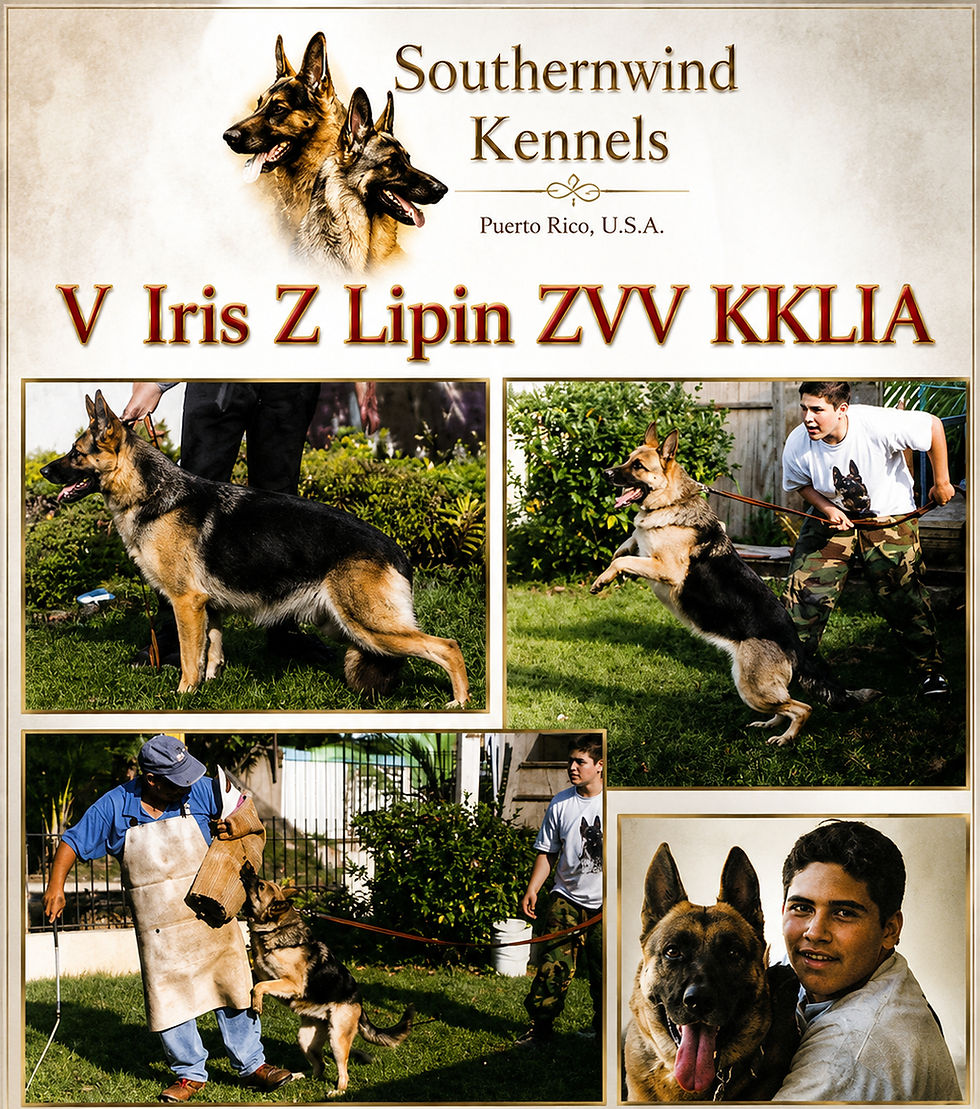
That was the world we entered.
As we started learning and working with these bloodlines, we quickly realized these dogs were different.
Even as young puppies, you could see it. The bone, the substance, the expression, the dark pigmentation, and most importantly, the confidence. There were a seriousness and stability that stood out.
And behind many of these old Czech pedigrees, one name repeatedly appeared:
Art z Lipin.

For people newer to working bloodlines, Art z Lipin was not simply another titled German Shepherd.
He became one of the recognizable names associated with serious Czech working programs and represented genetics selected under an entirely different philosophy than much of what people see today.
Art z Lipin was born on June 19, 1993, and carried advanced working titles including SchH3 and IPO3. But titles alone never told the full story. What made Art influential was the blood behind him and the traits that repeatedly surfaced in his descendants.
Art was bred from Ir Bo Ma × Rexa z Lipin, bringing together older Czech working blood selected through demanding systems where dogs were expected to perform under real pressure.
These were not dogs bred primarily for appearance.
These dogs were developed through generations of selection for:
environmental resilience
tracking ability
nerve strength
work drive
endurance
pressure tolerance
physical soundness
At the center of many of these pedigrees were the old Pohraniční Stráže border patrol programs, where dogs were expected to work in real environments and under real stress.
That history matters.
Because understanding these dogs means understanding that they were not created to fit trends.
They were created to function.
The Kennel z Pohranicni Straze (Z PS) was founded in the year 1955 for the sole purpose of producing and training dogs that would be exclusively used for the protection of the borders of the Czechoslovakian People’s Republic or, since 1968, the Czechoslovakian socialist Republic.
Most of the dogs used for breeding were acquired from the territory of former East Germany, as well as dogs from Czechoslovakia that excelled in their character qualities.
The stud dogs, females and puppies were cared after by military service conscripts. The dogs were trained at the Kennels for about 12 months, and then relocated to Border Patrol training facilities (nowadays they’re quartered at Czech police training facilities).
The breeding program, established in 1956, has been under the direction of Mr. Jiri Novotny who since 1981, has been the director of training. The main foundation of the breeding program has been focused on strengthening the power of bones, dark pigmentation, strong nerves and willingness to work in tracking, obedience and defense work. While the kennel name remains “z Pohranicni Straze”, it is now under the Pohranicni Policie (Border Police). Source
When people search for the difference between a DDR vs Czech German Shepherd, many assume they are simply looking at two dark-colored working dogs.

**Original Photo Source- old pedigree archives, breeder site, pedigree database, forum post
Where DDR German Shepherds Came From
DDR stands for Deutsche Demokratische Republik—East Germany.
Following World War II, East Germany developed one of the strictest breeding programs in the history of the breed.
These dogs were bred under government-controlled programs.
Selection focused on:
Strong nerves
Endurance
Dense bone structure
Environmental stability
Work drive
Physical resilience
Disease resistance
Harsh weather tolerance
Structural functionality
Dogs unable to perform physically or mentally often were removed from breeding.
The emphasis was practical usefulness.
Not cosmetic trends.
The Czech German Shepherd Program
The Czech program evolved differently.
Many Czech working dogs originated from border patrol and military programs.
The famous Pohraniční Stráže (Border Patrol) breeding system became known worldwide for selecting dogs capable of:
Tracking
Patrol work
Detection
Protection
High environmental resilience
Strong prey and defense drives
One name repeatedly seen in serious pedigrees is Art or (Arthur) z Lipin, from Pohraniční Stráže blood.
These dogs became known for intense work ethic and tremendous determination.
Their purpose was very specific:
Work under pressure.
Not simply look beautiful standing in a show ring.

DDR vs Czech German Shepherd Differences in Structure, Temperament, and Working Ability
What Makes Czech and DDR Dogs Look Different?
Many people notice differences even in young puppies.
You often see:
Heavier bone
Deeper chest
Larger feet
More substantial body structure
Dark sable pigmentation
Broad heads
Powerful necks
Dense muscle development
Stronger overall substance
Even at eight weeks many puppies already show these traits.
But what made them unique was never simply size. Large alone means nothing.
Function matters.
The Dark Sable Look Everyone Recognizes
One of the most recognizable characteristics is the dark sable coat.
Many of these dogs carry:
black overlays
rich sable coloration
dark masks
intense facial expression
strong eye pigmentation
That dark sable appearance became almost symbolic of Czech and DDR working dogs.
But color itself never created quality.
The genetics behind nerve strength, confidence, and structure mattered far more.

Functional Athletes — Not Just Big Dogs
This is where many people misunderstand these bloodlines.
People often assume:
heavy bone = slow dog
That was not the goal.
The impressive dogs combined:
Power
Speed
Agility
Endurance
Athletic movement
A correctly bred working dog could move effortlessly despite carrying substantial structure.
They were functional athletes.
Not bodybuilders.

The Southernwind Philosophy Since The 1970s
For over five decades I have always believed something:
Beauty without function eventually disappears.
A German Shepherd should move with purpose.
Think with confidence.
Handle pressure.
Adapt to environments.
Remain stable.
Protect when needed.
And still come home and live peacefully with the family.
Because the original German Shepherd was designed as a utility dog.
Function came first.
Always.
The Modern Problem: Bloodlines Becoming Marketing Terms
Today many advertisements say:
DDR
Czech
East German
Working line
But titles alone mean very little.
Pedigrees matter. Selection matters. Temperament matters. Health matters.
Development matters.
Because a dark sable puppy with a large head does not automatically represent true working heritage.
The real power behind these dogs came from generations of intentional selection for performance and nerve.
That cannot be copied overnight.
Southernwind Temperament Balance System™
At Southernwind we look beyond labels and focus on:
Genetics
Early neurological development
Environmental exposure
Temperament development
Structure
Human interaction
Because bloodlines create possibilities. Development determines outcomes.
Frequently Asked Questions
What is the difference between a DDR and Czech German Shepherd?
DDR German Shepherds originated from East German breeding programs focused on durability, structure, environmental resilience, and working ability. Czech German Shepherds developed largely through border patrol and military programs where dogs were selected for tracking, protection, drive, and performance under pressure. Over time, many Czech pedigrees incorporated DDR blood, which is why similarities exist.
Were Czech German Shepherds military or border patrol dogs?
Many early Czech working dogs came through the Pohraniční Stráže border patrol breeding programs. These dogs were selected for real working ability including tracking, environmental stability, endurance, and protection work.
Who was Art z Lipin and why is he important?
Art z Lipin became one of the recognized names in Czech working bloodlines. He carried strong working genetics and descended from influential blood such as Ir Bo Ma and older Czech programs. Art represented a period when breeding selection emphasized performance, nerve strength, and working functionality rather than appearance alone.
Is every dark sable German Shepherd a DDR or Czech dog?
No. This is one of the most common misconceptions today. Dark sable coloration alone does not identify bloodlines. Many breeders use coat color as marketing, but true working heritage is determined by pedigree, genetics, temperament, and generations of selection.
Why do DDR and Czech German Shepherds often look heavier?
Many of these programs selected dogs for stronger bone, larger feet, deeper chest development, and greater physical substance. However, the goal was not simply size; the goal was functional strength combined with endurance and athletic movement.
Are Czech German Shepherds aggressive?
Drive and aggression are not the same thing. Properly bred Czech working dogs should show confidence, environmental stability, and clear thinking. Strong drives without nerve strength can create instability, which is why responsible breeding and development matter..
Why do many Czech bloodlines connect to DDR blood?
As breeding programs evolved, Czech working programs incorporated East German dogs because of their structural strength, health selection, and environmental resilience. This created overlap that still appears in pedigrees today.
What bloodlines repeatedly appear behind old Czech working dogs?
Names frequently seen behind older Czech working pedigrees include:
Ir Bo Ma
Grim z Pohraniční Stráže
Din z Pohraniční Stráže
Ben z Bolfu
Bojar z Pohraniční Stráže
Art z Lipin
These names appear repeatedly because they represented dogs selected for real working ability.
Can breeders predict working ability from bloodlines?
Bloodlines create tendencies and probabilities, but genetics alone never guarantees outcomes. Environment, early development, exposure, training, and proper guidance all influence how a puppy develops.
Are DDR and Czech dogs good family dogs?
Properly selected and developed working dogs can become excellent family companions. Matching temperament and energy to the owner remains critical.
Final Thoughts
The true beauty of Czech and DDR bloodlines was never simply their appearance.
It was their purpose, Their confidence, Their resilience, Their ability to function under pressure.
Because when beauty and functionality come together, you do not simply create a beautiful dog, you create a German Shepherd worthy of the breed's original vision.
Author Bio
Maria Cecilia Martinez is founder of Southernwind Kennels LLC and has more than five decades of experience breeding, training, judging, and developing German Shepherd Dogs. Her background includes service with Mounted Police programs, canine education, temperament evaluation, and the development of working and family German Shepherds through structured early development and responsible breeding practices.
References
Military and Border Patrol historical breeding archives
German Shepherd breed historical studies
Working German Shepherd pedigree records
SV German Shepherd breed standards
East German working dog historical documentation


Comments