


Buying a German Shepherd Puppy? The Health Clearances Every Buyer Must Verify
When families ask me about German Shepherd puppy health clearances, I often see how quickly the meaning of those words becomes confused.
A beautiful eight-week-old German Shepherd puppy can make intelligent people forget every serious question they intended to ask.

The puppy climbs into their lap. Its ears are beginning to stand. The breeder says, “Our puppies are health cleared,” and the family wants badly to believe that everything has been handled.
But what does “health cleared” actually mean?
After more than five decades of breeding, raising, training, and evaluating German Shepherds, I want buyers to understand one critical distinction:
An eight-week-old German Shepherd puppy is not permanently hip and elbow cleared. The orthopedic health certifications a buyer must verify belong to the mature breeding parents.
The puppy should receive age-appropriate veterinary examinations, vaccinations, parasite management, identification, and written health documentation. Those things are essential—but they are not the same as adult orthopedic certification.
That difference separates documented health screening from attractive marketing language.
A beautiful eight-week-old German Shepherd puppy can make intelligent people forget every serious question they intended to ask.
What Health Clearances Should a German Shepherd Puppy Buyer Verify?
A buyer should verify the hip and elbow certifications of both breeding parents through a recognized system such as OFA, PennHIP, the German SV, or an authorized FCI-country organization.
Buyers should also review the parents’ degenerative myelopathy results, registered identities, pedigrees, relevant family history.
An eight-week-old puppy cannot receive final OFA hip or elbow certification.
The puppy receives an age-appropriate veterinary examination and written health records. The permanent orthopedic evaluations belong to the sire and dam.
Puppies Are Not Hip and Elbow Cleared at Eight Weeks

This is the first piece of misinformation buyers must learn to recognize.
Final OFA hip and elbow certification requires a dog to be at least 24 months old. OFA can perform preliminary evaluations on younger dogs, but a preliminary result must not be represented as final certification.
PennHIP can evaluate hip laxity beginning at approximately 16 weeks, but that is still older than the typical eight-week placement age and uses a different method and reporting system.
Therefore, when a breeder advertises an eight-week-old litter as “hip and elbow cleared,” the accurate meaning should be that the breeding parents have recognized orthopedic evaluations.
If the breeder claims that each eight-week-old puppy has final orthopedic clearance, the statement is false.
Health Screening Reduces Risk—It Does Not Guarantee Perfection

Health testing is one of the most important tools responsible breeders possess. It allows us to make better-informed breeding decisions and reduce identifiable risks.
But biology does not sign guarantees.
Hip and elbow dysplasia are complex developmental conditions. Multiple genes contribute to susceptibility, while growth rate, nutrition, body weight, physical activity, injury, and other environmental conditions may influence how severely a predisposed dog is affected.
There is no single DNA test that can declare a German Shepherd genetically free from hip or elbow dysplasia.
Cornell University’s veterinary guidance explains that most complex conditions, including hip and elbow dysplasia, do not have simple genetic tests.
Breeders must rely on radiographic screening, phenotype, pedigree, family history, and responsible selection.
Certified parents can still produce an affected puppy. Screening does not eliminate every possibility.
But failing to screen the parents removes one of the strongest protections a breeder can provide.
Health testing is not evidence that the breeder can predict the future. It is evidence that the breeder investigated known risks instead of ignoring them.
Understanding OFA, SV, FCI and PennHIP Certifications
German Shepherds are bred and evaluated throughout the world. Buyers should not assume that OFA is the only legitimate orthopedic system.
Health system | What it represents | What buyers must understand |
OFA | United States orthopedic and health database | Final OFA hip and elbow certification requires the dog to be at least 24 months old |
German SV | German Shepherd breed-evaluation system in Germany | Uses recognized German hip and elbow certification terminology |
FCI-country evaluation | Evaluation issued through an authorized organization in an FCI member country | The certificate may not appear in OFA but can still be official and legitimate |
PennHIP | Radiographic measurement of hip-joint laxity | Can be performed beginning at approximately 16 weeks and reports a Distraction Index |
CHIC | Canine Health Information Center administered through OFA | CHIC is a health-information program, not an individual medical test |
Different systems may use different minimum ages, grades, terminology, radiographic procedures, and reporting methods.
The absence of an imported dog from the OFA database does not prove that the dog was never evaluated.
What matters is whether the result was issued through a recognized system and whether the certificate can be connected to the correct dog.
Verify the Hip Results of Both Parents
For dogs evaluated through the Orthopedic Foundation for Animals, hip radiographs taken at 24 months of age or older are independently reviewed by three board-certified veterinary radiologists.
OFA classifies hip results as:
Excellent
Good
Fair
Borderline
Mild dysplasia
Moderate dysplasia
Severe dysplasia
Excellent, Good, and Fair are considered within normal limits.
Dogs younger than 24 months may receive an OFA preliminary evaluation.
Preliminary radiographs can provide useful information, but they are not final OFA certification.
Imported German Shepherds may have recognized certification through the German SV or an authorized evaluation organization in another FCI country. These results should be interpreted under the rules and terminology of the issuing system.
“The veterinarian looked at the X-rays and said they were good” is not equivalent to an official evaluation issued through a recognized orthopedic organization.
Ask to see the actual result.
Buyers can learn more about the influence of genetics, growth, body weight, flooring, and development in our guide, How to Reduce Hip Dysplasia Risk in a German Shepherd Puppy.
Verify the Elbow Results of Both Parents
Elbow dysplasia can cause pain, lameness, arthritis, and reduced working ability. It deserves the same attention as hip dysplasia.
OFA does not issue final normal elbow certification until a dog is at least 24 months old, although preliminary evaluation is available for younger dogs.
Imported parents may carry the corresponding elbow evaluation from the German SV or an authorized FCI-country organization.
A breeder who displays hip results but avoids discussing elbows has not presented the complete orthopedic picture.
You must verify both parents—not only the sire, only the dam, or only the parent with the better result.
Understanding Degenerative Myelopathy Testing
Degenerative myelopathy, commonly called DM, is a progressive spinal cord disease generally associated with older dogs. German Shepherds are among the breeds in which the common SOD1 mutation is relevant.
DM DNA results are generally reported as:
N/N or Normal: two normal copies of the tested variant
A/N or Carrier: one normal copy and one copy of the tested variant
A/A or At Risk: two copies of the tested variant
These results must be interpreted correctly.
A carrier is not automatically a sick dog. Removing every carrier from breeding without considering the total dog and the breed population can unnecessarily reduce genetic diversity.
A carefully selected carrier can be bred to a clear dog without producing A/A puppies for the tested common variant.
Likewise, an A/A result indicates increased genetic risk. It does not prove that the dog currently has DM or that it will inevitably develop clinical disease during its lifetime.
The OFA’s degenerative myelopathy guidance explains that not every genetically at-risk dog develops clinical disease and that test results must be interpreted thoughtfully.
The correct buyer question is not merely, “Are both parents DM clear?”
The better question is:
What are the exact DM results of both parents, and how was the pairing planned to avoid producing genetically at-risk puppies?
Does a DNA Panel Prove That a Dog Is Genetically Healthy?
No.
A DNA test identifies only the particular variants the laboratory was designed to examine.
A clear panel means the dog tested negative for those tested variants. It does not mean the dog is free from every inherited disorder.
Genetic testing is the strongest evidence when a validated test exists for a particular disease-causing or disease-associated variant.
However, many inherited conditions have no definitive DNA test.
The hereditary contribution to those conditions may be evaluated through:
Clinical diagnosis
Radiographs or other imaging
Phenotypic examinations
Pathology
Pedigree analysis
Family history
Patterns among siblings and other relatives
Breed-prevalence and population research
The OFA explains that DNA testing is the gold standard for determining genotype when a validated test exists, but phenotypic evaluation and family information remain necessary when no DNA test is available.
Genetic does not always mean simple. Inherited diseases may involve one gene, multiple genes, incomplete penetrance, modifying genes, environmental influences, or mechanisms science has not yet identified.
What Does CHIC Mean?
CHIC stands for Canine Health Information Center.
It is a United States health-information program administered through the Orthopedic Foundation for Animals in cooperation with the AKC Canine Health Foundation.
The current German Shepherd CHIC requirements identified by the German Shepherd Dog Club of America include:
Hip evaluation
Elbow evaluation
Passing GSDCA temperament test submitted to OFA
The temperament test is not an orthopedic or genetic clearance, but it is highly relevant in a breed expected to remain dependable, clear-minded, and socially stable.
A CHIC number does not automatically mean every test result was normal.
According to the OFA CHIC program, a CHIC number means that the required evaluations were completed, the results were entered, and the required information was made publicly available.
Buyers must open the individual dog’s record and read the actual results.
Do FCI-Certified German Shepherds Have OFA CHIC Numbers?
Not automatically.
German Shepherds evaluated before importation may carry official hip and elbow certifications through the German SV or an authorized organization in another FCI member country rather than OFA.
These dogs do not automatically receive an OFA or CHIC number merely because they are later imported into the United States.
The absence of a CHIC number does not mean an imported dog lacks health clearances.
Many Southernwind breeding dogs were born and evaluated in European FCI countries before being imported into the United States. Their orthopedic records may therefore carry official FCI-country or German SV certification rather than an OFA number.
These are recognized orthopedic evaluations—not missing clearances.
An imported dog may later qualify for a CHIC number if the appropriate results are accepted into the OFA database, made public, and all current German Shepherd CHIC requirements are completed.
However, legitimate SV or FCI-country certification does not automatically create an OFA or CHIC record.
For every imported dog, buyers should verify:
Full registered name
Registration number
Microchip or tattoo
Date of evaluation
Age at evaluation
Hip and elbow grades
Country of evaluation
Issuing organization
Identity matching the dog’s pedigree
The OFA International Hip Ratings Matrix demonstrates that recognized international systems use different terminology and grading structures.
Health Clearances Are Risk Management—not a Prophecy

No responsible breeder can predict every medical condition a puppy may develop during ten, twelve, or fourteen years of life.
A breeder controls the selection of the sire and dam, the health screening performed, the conditions under which the litter is conceived and raised, the early veterinary care provided, and the information disclosed to the buyer.
A breeder does not control every condition the dog will encounter after leaving.
A dog’s long-term health may be influenced by:
Nutrition and body condition
Rate of growth
Exercise and repetitive physical stress
Accidents and injuries
Parasites and infectious diseases
Environmental contaminants or toxins
Individual reactions to medications
Individual reactions to flea, tick, or heartworm preventives
Immune-mediated disease
Reproductive hormones and timing of sterilization
Chronic stress
Veterinary care
Aging
Conditions arising without an identifiable cause
This does not mean that food, medication, vaccines, preventives, or environmental exposure should automatically be blamed whenever a dog becomes ill.
A suspected cause must be supported by the dog’s veterinary history, timing of exposure, clinical findings, diagnostic testing, and credible scientific evidence.
The appearance of an illness does not, by itself, prove that the breeder caused it or that it was inherited.
Health screening reduces identifiable risk. It cannot predict every injury, infection, adverse reaction, immune disorder, cancer, age-related condition, or biological event that may occur throughout a dog’s lifetime.
A health guarantee must not be interpreted as a promise that a living animal will remain medically perfect. It is a written agreement defining the breeder’s responsibilities if a specified condition is diagnosed under the terms of the contract.
What Health Documentation Should the Puppy Receive?
Although the puppy cannot receive final adult orthopedic certification at eight weeks, it should receive age-appropriate veterinary care and documentation.
Buyers should expect clear records concerning:
Veterinary examination
Age-appropriate vaccinations
Deworming and parasite-control history
Fecal examination or treatment, when applicable
Microchip or other identification
Known medical findings
Medications or treatments administered
Feeding and care instructions
Written purchase agreement
Written explanation of the breeder’s health guarantee
Instructions for examination by the buyer’s veterinarian
A veterinary examination is a snapshot of the puppy’s condition on the day it was examined. It is not a permanent hereditary clearance.
A health certificate is also not the same as a health guarantee.
The health certificate documents veterinary findings and treatments.
The guarantee is a contract describing coverage, exclusions, documentation requirements, deadlines, and available remedies.
In Florida, qualifying puppy sales are subject to Section 828.29 of the Florida Statutes, which includes requirements concerning the Official Certificate of Veterinary Inspection and disclosure of health records. Buyers and breeders should read the current law rather than relying on social-media summaries.
How to Verify the Parents’ Health Records
Before committing to a puppy, request:
Registered name of the sire
Registered name of the dam
Registration numbers
OFA, SV, FCI-country, PennHIP, or other official orthopedic reports
DM and other relevant laboratory results
Identification connecting each certificate to the correct dog
Pedigree showing that the certified dogs are the puppy’s actual parents
For OFA-evaluated dogs, use the public OFA Advanced Search rather than relying exclusively on a cropped social-media image.
Check:
The dog’s exact registered identity
The age when testing occurred
Whether the result was preliminary or final
The actual grade
Whether both hips and elbows were evaluated
For imported dogs, request a readable copy of the original certificate and identify the issuing country and organization.
Different countries use different grading systems. That difference does not invalidate the evaluation—but the breeder should be able to explain it honestly.
Red Flags German Shepherd Puppy Buyers Should Never Ignore
Proceed carefully when a breeder:
Claims an eight-week-old puppy has final OFA-certified hips and elbows
Says the parents are cleared but refuses to provide registered names
Uses only “vet checked” to describe the breeding dogs
Provides records for only one parent
Displays hip results but avoids discussing elbows
Represents a preliminary OFA evaluation as final certification
Claims a DNA panel proves the dog can never develop hip dysplasia
Says AKC registration is proof of health
Claims an imported dog is cleared but cannot identify the issuing organization
Uses “CHIC certified” without allowing buyers to inspect the individual results
Claims that the absence of CHIC automatically means an FCI-certified dog was never tested
Promises that no puppy from the breeding can ever develop a hereditary condition
Pressures buyers to send money before allowing them to review the documentation
AKC registration verifies registration and lineage. It does not certify orthopedic health, genetic status, temperament, or breeding quality.
How Can I Buy a German Shepherd Puppy With Health Clearances in Florida?
Begin by evaluating the breeding parents—not merely the puppy photograph.
Ask for the registered identities and health records of both parents before making your decision.
Independently verify records when a searchable database is available.
A responsible Florida German Shepherd breeder should be willing to explain:
Which orthopedic systems were used
The exact hip and elbow results
The ages of the parents when evaluated
Whether the records are OFA, SV, PennHIP, or from an FCI-country system
The DM status of each parent
Why the pairing was selected
What veterinary care the puppy receives
What the written health guarantee covers
What documentation accompanies the puppy
What support is available after placement
Geography does not create credibility.
Documentation, transparency, experience, responsible selection, and long-term accountability do.
Where Can I Find Health-Cleared German Shepherds in the United States?
Do not search only for “German Shepherd puppies near me.”
A nearby puppy with undocumented parents is not a safer purchase than a responsibly bred puppy located farther away.
Look for breeders throughout the United States who can provide verifiable parental records, complete puppy documentation, a written contract, careful placement, and continued responsibility after the puppy leaves.
Serious breeders should welcome serious questions.
They may not promise perfection—but they should never hide the evidence behind their decisions.
The Southernwind Standard
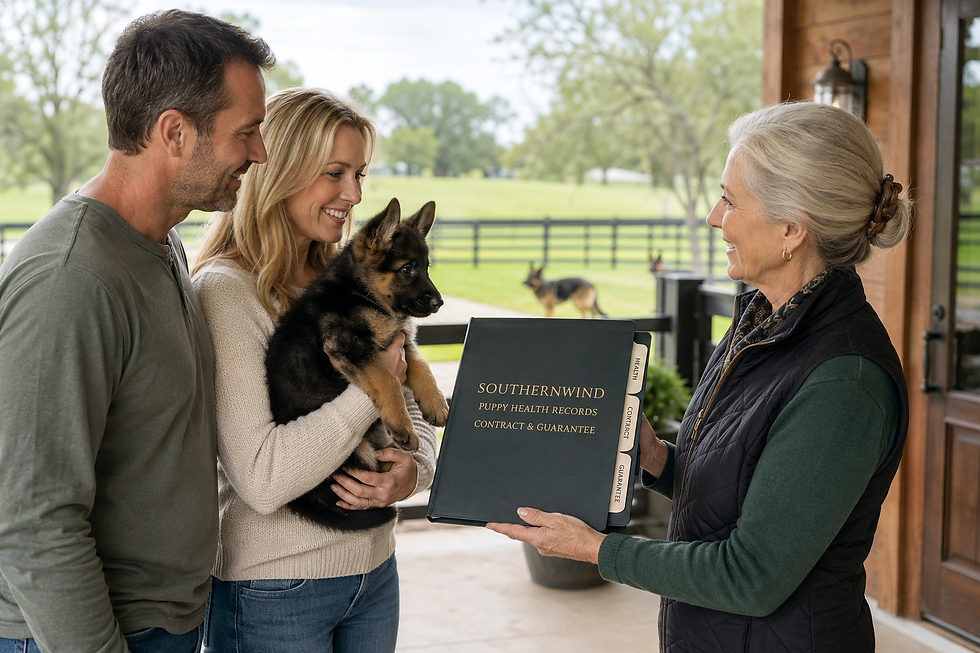
At Southernwind Kennels, health evaluation begins with the dogs selected for breeding.
We examine orthopedic results, genetic information, pedigrees, temperament, functional structure, family history, and what each parent may contribute to the next generation.
Because many of our dogs originate from European FCI countries, their orthopedic documentation may come from the German SV or another authorized FCI-country evaluation system rather than OFA. These records must be interpreted under the system that issued them.
For 52 years, Southernwind has not selected dogs by looking at one certificate, one championship, or one impressive pedigree.
We have worked within a carefully studied gene pool built from families whose health, temperament, structure, longevity, reproductive history, and ability to produce sound offspring have been observed across generations.
Within our own records and experience, these families have demonstrated a low incidence of serious hip, elbow, and known genetic problems, together with consistent general health and physical resilience.
That history matters.
A health certificate tells us what was found in one dog at one point in time. A knowledgeable breeder must look much deeper—at parents, grandparents, siblings, half-siblings, previous litters, repeated combinations, longevity, causes of illness, and the qualities that continue appearing throughout the family.
This is why I traveled to Germany and personally investigated bloodlines, breeding families, health histories, and what particular dogs were actually producing.
I was never interested only in buying a famous name or importing an impressive animal. I wanted to know what stood behind that dog, what appeared beside it in related animals, and what had emerged from the bloodline over time.
Southernwind’s gene pool has never been preserved by blindly closing the door to outside blood. New dogs have been introduced when they could contribute something valuable—but only after deliberate research into their ancestry, health information, temperament, structure, and production history.
This is one of the responsibilities that separates a breeder from someone who merely produces puppies.
A real breeder should be able to explain not only which tests were performed, but what health patterns exist within the breeding families, why two particular dogs were paired, what risks were considered, and what the breeder has learned from the generations already produced.
No gene pool can promise perfection. But decades of documented observation give a breeder something that no single laboratory report can provide: knowledge of how a family of dogs has lived, developed, reproduced, aged, and carried its qualities forward.
Our puppies are then raised through structured developmental, sensory, environmental, and social experiences before placement.
We cannot honestly promise that any living animal will remain free from every medical condition.
What we can provide is deliberate selection, documented screening, age-appropriate veterinary care, honest education, written terms, and continued responsibility to the families who place their trust in us.
Families considering a Southernwind puppy may:
A responsible breeder should not be offended when you ask for proof.
They should be prepared for it.
Frequently Asked Questions
Are German Shepherd puppies hip and elbow cleared at eight weeks?
No. An eight-week-old puppy cannot receive final OFA hip or elbow certification. Buyers verify the mature breeding parents’ orthopedic records while reviewing the puppy’s age-appropriate veterinary examination and health documentation.
What health clearances should German Shepherd parents have?
Buyers should verify recognized hip and elbow evaluations for both parents. DM status and any additional cardiac, thyroid, eye, or breed-relevant results should also be reviewed. The German Shepherd Dog Club of America currently includes hips, elbows, and a recognized temperament test in its CHIC requirements.
Do German Shepherds imported from FCI countries have OFA CHIC numbers?
Not automatically. Imported dogs may have official hip and elbow certifications from the German SV or an authorized FCI-country organization rather than OFA. The absence of a CHIC number does not prove that the dog lacks health clearances.
Does a CHIC number mean the dog passed every test?
No. A CHIC number means the required evaluations were completed and the required results were made public. Buyers must read the individual results to determine what they show.
Does a DNA panel clear a German Shepherd of hip dysplasia?
No. Hip and elbow dysplasia are complex conditions involving multiple genes and environmental influences. There is no single DNA panel that certifies a German Shepherd as genetically free from hip or elbow dysplasia.
Is DNA testing the only way to determine whether a condition is hereditary?
No. A validated DNA test can identify a specific disease-associated variant, but many inherited conditions have no definitive DNA test. Hereditary contribution may also be evaluated through phenotype, radiographs, pathology, clinical diagnosis, pedigree, family history, breed data, and patterns among related dogs.
Must both parents be DM clear?
Not necessarily. A DM carrier can be bred responsibly to a clear dog without producing A/A puppies for the tested common SOD1 variant. Buyers should request the exact results of both parents and ask how the breeding was planned.
Does a clear DNA panel mean the dog is free from every inherited disease?
No. A clear panel means the dog tested negative for the particular variants included in that panel. It does not examine every gene, mutation, polygenic condition, or disease the dog may develop.
Is an AKC-registered German Shepherd health cleared?
No. AKC registration documents registration and lineage. It does not certify hip health, elbow health, genetic status, temperament, or overall breeding quality.
Can a breeder guarantee that a puppy will never develop a health problem?
No. A breeder can screen the parents, plan the breeding responsibly, provide appropriate early care, disclose known information, and offer a written contractual guarantee. No breeder can predict every illness, injury, infection, environmental exposure, adverse reaction, or age-related condition that may occur throughout the dog’s life.
Does a future health condition prove that it was inherited?
No. A diagnosis does not automatically establish its cause. Similar clinical problems can result from inherited susceptibility, developmental influences, infection, injury, nutrition, body weight, toxins, medications, immune disease, aging, or multiple factors acting together.
Can health-tested parents guarantee a healthy German Shepherd puppy?
No responsible breeder can guarantee biological perfection. Parent screening reduces identifiable risks and demonstrates responsible selection, but it cannot eliminate every hereditary, developmental, environmental, infectious, or acquired condition.
Scientific and Breed-Authority Sources
About the Author
Maria Cecilia Martinez is the founder of Southernwind Kennels LLC and has bred German Shepherds since 1974.
Her experience spans more than five decades of breeding, raising, training, evaluating, and studying German Shepherds across family, ranch, show, working, and police environments. She is a former AKC and FCI All-Breed Judge, a retired FCI Temperament Test Judge, and worked with and advised the Puerto Rico Mounted Police for approximately 22 years.
Through Southernwind Kennels and the Southernwind Canine Knowledge Library™, she continues to educate breeders and owners about responsible breeding, canine development, temperament, health screening, and the lifelong responsibility behind every puppy produced.


The reminder that an adorable eight-week-old puppy shouldn’t replace verifying the parents’ health records is so important, especially when testing has limits. I’ve been using https://ai-image-to-image.online
The reminder that health clearances can’t predict everything is crucial—buyers should review the parents’ actual records, not just accept vague assurances. I’ve been using https://outrankai.pro/is-outrank-safe-reddit
The reminder that health testing can’t predict everything is crucial—buyers should verify the parents’ actual records before getting swept up by an adorable eight-week-old puppy. I’ve been using https://lumeflow.pro/lumeflow-ai-examples-free
The warning about an eight-week-old puppy distracting buyers from serious questions really resonates. Verifying the parents’ health records—not just accepting vague claims—should be nonnegotiable. I’ve been using https://sketchfab.com/rpopescu8/collections/human-head-references-5a9c1e6fc7b949e999e6b99ed1c64633