


Long Before Their Eyes Open: What 52 Years and Fourteen Generations Have Taught Me About German Shepherd Temperament
A Southernwind story about genetics, development, experience, and the invisible history carried within every puppy.

By Maria Cecilia Martinez Founder of Southernwind Kennels LLC
A longtime Southernwind owner once stood beside me watching several of our German Shepherds moving around the ranch.
Some were young. Others were mature. They came from different parents, different litters, and different periods of my breeding program.
She watched them for a long time before turning to me.
“Cecilia, how long have you been breeding German Shepherds?”
“Since 1974,” I told her. “About fifty-two years.”
She looked back at the dogs.
“I have seen your puppies and your adult dogs for decades. They are not all identical, but they carry many of the same qualities.
They are self-confident. They have strong nerves. They are intelligent and easy to train. They notice everything around them, but they are not disturbed by everything. What is the philosophy behind your breeding program?”
That question stayed with me because the answer could not be found in one pedigree.
It could not be explained by naming a famous bloodline, pointing toward one champion, or showing her one exceptional dog.
The answer was standing all around us.
It lived in the dogs themselves.

People See Puppies. I See Generations.
When people visit Southernwind and look into a whelping box, they see puppies.
They see tiny faces, little paws, soft coats, and newborn lives just beginning.
I see those things too.
But I also see history.
I see the mothers and fathers behind them. I remember the grandparents, the siblings, and the dogs that lived many years before the puppy in front of me was born.
I remember how those dogs behaved in unfamiliar places.
I remember which ones recovered quickly after being surprised, which ones remained clear-minded under pressure, and which ones possessed the natural confidence to investigate something new without becoming reckless.

I remember the dogs that confirmed I was moving in the right direction.
I also remember the dogs that forced me to reconsider a decision.
Since I began breeding German Shepherds in 1974, I have personally followed approximately fourteen generations within the families that helped shape Southernwind.
To place that into human terms, fourteen human generations would represent roughly 350 to 420 years of family history, depending on whether we calculate a human generation as approximately twenty-five or thirty years.
No human being could personally observe that many generations of a human family during one lifetime.
Dogs mature and reproduce more quickly. Because of that, a breeder who remains committed to the same work for more than half a century can begin to recognize patterns that are invisible when someone looks at only one dog at a time.
I am not talking about pedigrees I admired from a distance.
I am talking about dogs I knew.
Dogs I lived with, raised, trained, evaluated, bred, followed, and learned from.
Some became extraordinary examples of what I wanted to preserve.
Others showed me weaknesses I did not want to continue.
Every one of them taught me something.
Fifty-Two Years Is Not the Same Year Repeated Fifty-Two Times
Time alone does not create wisdom.
A person can repeat the same mistakes for thirty years and call it experience. That does not make those mistakes knowledge.
Real experience requires observation.
It requires records, comparison, honesty, and the willingness to change direction when the dogs reveal something we did not expect—or something we did not want to see.
There were breedings that confirmed my decisions.
There were combinations I chose never to repeat.
There were dogs whose value became clearer as they matured. There were also young dogs that appeared impressive at first but later revealed limitations that could not be ignored.
Breeding teaches humility because time eventually exposes what excitement can hide.
A young dog may impress people with beauty, energy, drive, or one dramatic performance.
But a breeding dog must offer more than a memorable moment.
I want to know what remains when the excitement is over.
Can the dog think while aroused?
Can the dog recover after pressure?
Can the dog enter an unfamiliar environment without losing emotional control?
Can the dog recognize the difference between a normal situation and a genuine threat?
Can the dog accept direction while retaining the courage, intelligence, awareness, and substance expected of a German Shepherd?
Then comes the most important question of all:
What does that dog reproduce?
One extraordinary dog does not prove the quality of an entire breeding program.
Nature can produce an exceptional individual.
The greater test is whether the important qualities continue appearing among siblings, half-siblings, offspring, grandchildren, and related families.
Good breeding is not about producing one dog that makes everyone stop and stare.
It is about creating enough consistency that people begin to recognize the family behind the dog.
What the Mounted Police Horses Taught Me About Puppies
During the 1990s and throughout more than two decades of work with the Mounted Police in Puerto Rico, I served as a head trainer and advisor.

During those years, I participated in the development and training of more than 200 police horses and worked with over 800 officers.
Those horses were not being prepared for a quiet arena.
They had to function around gunfire, crowds, shouting, traffic, umbrellas, tarps, unusual surfaces, sudden movement, confusion, and the unpredictable pressure of real police work.
I conducted tactical exercises and what I have always called sensorial training: carefully planned exposure to sound, movement, pressure, strange objects, changing surfaces, and environmental commotion.
We were not trying to frighten the horses.
We were teaching them how to process unfamiliar situations without surrendering their ability to think.
At that same time, I was also raising German Shepherd and Belgian Malinois puppies.
Many days, I brought those puppies with me.
I placed them securely in a playpen close enough to observe the activity but far enough away that they were not trapped in the center of it.
They heard gunshots.
They watched umbrellas open.
They saw tarps moving, officers running, horses reacting, equipment falling, and people creating the commotion required for the exercises.
Then they played.
They slept.
They woke up and watched again.

They began learning that noise, movement, and confusion could happen around them without the world falling apart.
Those puppies received an extraordinary amount of environmental information while they were still very young.
But that experience also taught me something that became central to my breeding philosophy:
Exposure can develop the stability already living within a puppy.
It cannot manufacture a nervous system the puppy did not inherit.

Genetics Provides the Foundation. Development Builds Upon It.
A puppy born with a stable nervous system may startle at a sudden noise, turn toward it, process what happened, and recover.
Another puppy may require more time, more distance, and greater support.
A puppy carrying deeper sensitivity may appear to tolerate certain experiences while very young, only to reveal avoidance, defensive reactions, chronic vigilance, or poor recovery later as maturity places greater demands upon the dog.
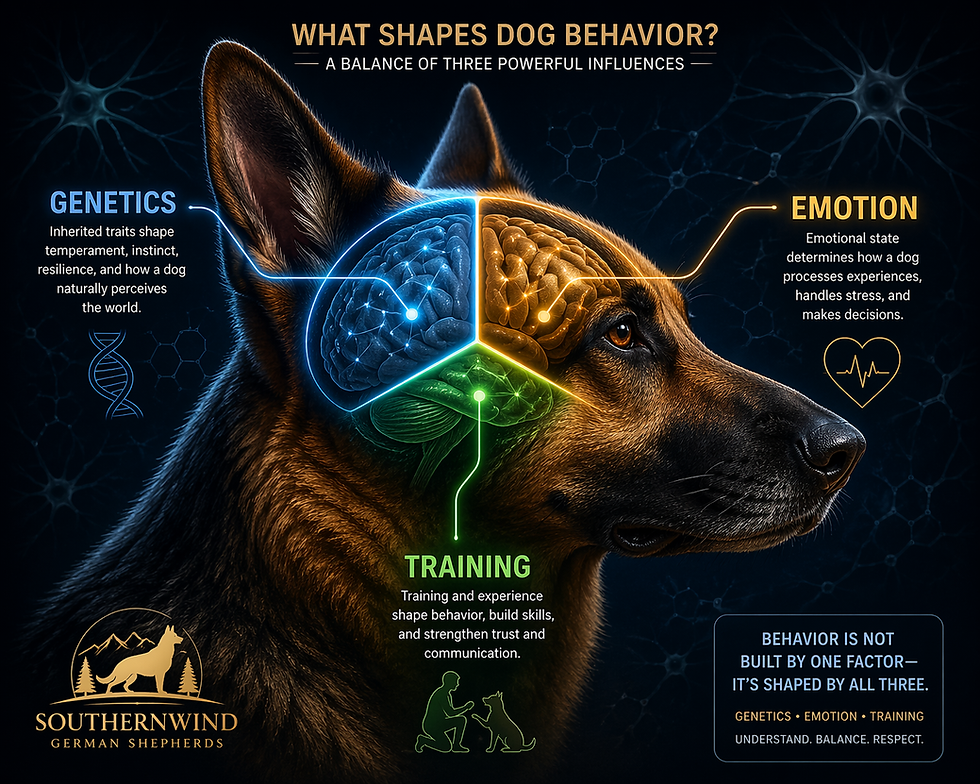
This is why I have always said that genetics is 100 percent important.
I do not mean genetics controls 100 percent of everything a dog will ever become.
That would be scientifically incorrect.
What I mean is that genetics is present in 100 percent of the dog from the beginning. It can never be removed from the equation.
Training matters.
Environment matters.
The mother matters.
The breeder matters.
The owner matters enormously.
But none of us begins with an empty puppy.
Research involving German Shepherd Dogs supports the existence of inherited components in behavioral characteristics such as self-confidence, nerve stability, temperament, defensive behavior, and reactions to gunfire.
Modern genetic research also confirms that canine behavior is complex and influenced by many genetic variants rather than one simple “temperament gene.”
This does not mean that a puppy’s future can be predicted with complete certainty.
It means breeders are working with probabilities, family patterns, inherited tendencies, and individual variation.
Genetics supplies the foundation.
Development determines how responsibly that foundation is strengthened, directed, or sometimes damaged.
A Puppy May Be a Blank Slate, but It Is Never an Empty One
People often repeat that puppies are blank slates.
I understand what they mean.
A young puppy does not know the rules of your home. He does not know your schedule, your voice, your children, your property, or what you expect from him.
Much of his individual story remains unwritten.
But the slate is not empty.
The page is new, but the paper has already been made.
It already has thickness, texture, strength, and inherited characteristics beneath its surface.
-One puppy may naturally approach something unfamiliar.
-Another may stop and study it first.
-One may recover immediately after a surprise.
-Another may require additional time and support.
-One may possess intense working drive.
-Another may carry the calmer, more moderate temperament needed by a family companion.
-One may constantly seek human engagement.
-Another may enjoy people while retaining greater independence.
These differences do not automatically make one puppy better than another.
They make the puppies different.
The breeder’s responsibility is to recognize those differences, understand the family behind them, and place each puppy into a life where its inherited qualities have the best opportunity to develop successfully.
The owner’s responsibility begins after that placement.
-Training does not create the entire dog.
-Training organizes, channels, strengthens, and sometimes modifies what the dog brings into the relationship.
A skilled owner can help a naturally sensitive puppy become more confident and functional.
-A poor environment can weaken a naturally promising puppy.
-A stable upbringing can help genetic potential reach maturity.
-Chronic confusion, isolation, inconsistent boundaries, overwhelming exposure, or repeated frightening experiences can create serious problems even in a well-bred dog.
-The breeder pours the foundation.
-The owner continues building the house.
Behavior Does Not Begin with the First Training Lesson
One of the greatest misconceptions in the dog world is the belief that behavior begins when formal training begins.
It does not.
Training enters a story that has already started.
Before anyone teaches the first sit, recall, heel, or place command, the puppy is already bringing individual tendencies involving confidence, caution, sociability, curiosity, persistence, arousal, frustration tolerance, recovery from stress, impulse control, environmental awareness, and willingness to work with people.
These qualities are complex.
They are influenced by genetics, -prenatal conditions, -maternal behavior, -health, early experiences, -learning, and the -environment in which the dog matures.
Large genomic studies have demonstrated that breed ancestry can contribute to behavioral tendencies while individual dogs within the same breed still vary considerably.
Breed does not write every detail of an individual dog’s behavior, but inherited history cannot honestly be dismissed either.
This is the part of the nature-versus-nurture discussion that people often try to simplify.
-They want genetics to explain everything.
-Or they want training to explain everything.
Neither position tells the complete truth.
-Genetics creates predispositions and probabilities.
Development influences how those predispositions are expressed.
Heritable Does Not Mean Inevitable
The word genetic is often misunderstood.
Some people hear that a behavioral quality has a genetic component and assume the dog’s future is permanently decided.
Others hear that socialization and training matter and conclude that breeding must not be important.
Both conclusions are wrong.
A genetic predisposition is not a guarantee.
A puppy may inherit greater sensitivity, stronger drive, deeper sociability, more independence, or faster recovery after stress.
What happens to those qualities depends partly upon the life that follows.
Strong drive can develop into useful working motivation or uncontrolled arousal.
Natural awareness can become thoughtful observation or suspicious reactivity.
Sensitivity can support responsiveness and environmental awareness, or it can develop into fearfulness.
Confidence can become resilience, or without structure, it can become impulsive and reckless behavior.
Protective instinct can mature into clear judgment, or without stable nerves and responsible guidance, it can become a liability.
Genetics provides possibilities.
Development gives those possibilities direction.
The Mother Begins Teaching Before We Do
A puppy’s developmental story does not begin when the new family takes him home.
It does not even begin when the breeder introduces the first unfamiliar surface or sound.
The mother is the puppy’s first environment.
Her physical health, emotional stability, milk production, attentiveness, tolerance, and reactions to activity around the litter all influence the puppies.
A calm mother communicates through her presence.
A frantic or unstable mother also communicates through her presence.
The puppies experience how she responds to handling, movement, sound, separation, and people entering the whelping area.
Research has found associations between differences in maternal care and later temperament in dogs. The relationship is not always simple, however. More maternal attention is not automatically better in every circumstance.
Puppies also need opportunities to begin developing independence, problem-solving ability, and tolerance for manageable frustration.
This is why responsible puppy raising involves more than feeding the litter, cleaning the area, taking beautiful photographs, and waiting until the puppies are old enough to leave.
The breeder should be observing.
Which puppy recovers quickly?
Which one solves problems?
Which puppy watches before acting?
Which one pushes forward without thinking?
Which puppy becomes frustrated easily?
How do they behave together?
How do they respond when briefly separated?
What happens when they meet a manageable challenge?
What do they do after the surprise is over?
Those observations become part of responsible placement.
Socialization Is Not Throwing a Puppy Into Everything
Socialization has become one of the most misunderstood words in the dog world.
Some people believe a puppy must meet every person, every dog, and every possible environment as quickly as possible.
That is not thoughtful socialization.
That can become flooding.
The purpose of early exposure is not to force a puppy to tolerate the world.
The purpose is to teach the puppy how to process the world.
Puppies should experience different surfaces, sounds, people, movements, objects, locations, and age-appropriate challenges.
But the experience should not take away the puppy’s ability to think, recover, and choose to engage.
The American Veterinary Society of Animal Behavior identifies the first three months as the primary socialization period and recommends safe exposure without causing excessive fear, withdrawal, avoidance, or overstimulation.
A puppy gains confidence when he encounters something unfamiliar, studies it, receives appropriate support, and discovers that he can move forward.
He does not develop true confidence when he is dragged toward something frightening and prevented from escaping until he stops resisting.
Silence is not always confidence.
Sometimes silence is emotional shutdown.
The goal is not to produce a German Shepherd that runs foolishly toward everything.
The goal is to produce a dog that can notice change without being emotionally controlled by every change.
A stable dog is aware.
He is not oblivious.
But he possesses enough clarity to assess before reacting.
That ability begins with inherited potential and is strengthened through appropriate development.
What Decades of Following Families Can Reveal
"A university study may follow a group of dogs for several months or several years".
That work is valuable.
It provides controlled observations, standardized measurements, statistical comparisons, and safeguards against some of the biases that personal experience can create.
A long-established breeding program provides another kind of information.
It allows the breeder to watch brothers and sisters raised in different homes.
It reveals what a female produces across multiple litters.
It shows offspring from the same sire and different mothers.
It allows us to observe grandchildren and great-grandchildren.
We begin seeing which qualities remain consistent under different handlers and which dogs appear stable only because an exceptional trainer is constantly managing them.
We see traits that disappear for one generation and quietly return in another.
We see families that repeatedly produce confidence, resilience, trainability, clarity, and strong recovery.
We also see families that produce impressive drive without enough self-control, or striking beauty without the temperament necessary to function successfully in the modern world.
Science and experience should never be enemies.
Science protects experienced people from confusing personal impressions with universal truth.
Long-term experience helps us recognize patterns, ask better questions, and understand how behavior develops across real dogs, real families, and real lives.
The strongest knowledge comes when both are respected.
Strong Nerves Are Not the Same as Noise
People frequently mistake reactivity for strength.
-A dog that barks at every unfamiliar person is not automatically protective.
-A dog that lunges toward every moving object is not automatically courageous.
-A dog that remains continuously aroused is not automatically a strong working dog.
True nerve strength is often quieter.
I look at recovery.
What happens after the dog is startled?
-Can the dog return to a clear state of mind?
-Can the dog remain connected to the handler while excited?
-Can the dog enter a strange environment, notice what is happening, and continue functioning?
-Can the dog investigate something unfamiliar without becoming frantic?
-Can the dog recognize a legitimate concern without treating ordinary life as a continuous emergency?
The German Shepherd should possess intelligence, courage, awareness, and the capacity to respond when necessary.
But awareness without judgment becomes suspicion.
-Drive without self-control becomes chaos.
-Protection without clear nerves becomes a liability.
-The goal should never be to produce the most extreme dog.
-The goal is to produce a complete dog whose qualities work together.
Why People Say, “That Is a Southernwind Dog”
Many years after those first puppies sat beside the Mounted Police training fields, people began telling me something that carried deep meaning.
They would watch one of our dogs walking with an owner, meeting a family, working in public, encountering an unusual surface, or resting quietly while observing everything around him.
Then they would say:
“That is a Southernwind dog.”
Sometimes they recognized the physical type.
More often, they recognized the nature of the dog.
-The attentiveness.
-The composure.
-The intelligence.
-The confidence without unnecessary foolishness.
-The willingness to connect with people without losing the substance of the breed.
-The ability to experience pressure without mentally falling apart.
Not every Southernwind dog is identical.
They should not be.
Different families require different levels of energy, intensity, independence, sociability, and working drive.
But a breeding program should possess a direction strong enough to become recognizable.
That direction becomes the breeder’s signature.
A breeder does not simply choose which dogs will produce puppies.
A breeder decides which qualities deserve another generation.
What a Well-Bred Puppy Still Needs From You
Good genetics are not an excuse for careless ownership.
A well-bred puppy still requires structure, sleep, movement, thoughtful exposure, training, boundaries, and a relationship built upon clarity and trust.
Strong genetics do not mean the puppy will train himself.
They do not mean the puppy cannot develop fear after repeated frightening experiences.
They do not mean confidence should be tested through overwhelming situations.
They do not mean intelligence replaces discipline.
They do not mean every German Shepherd should respond in exactly the same way.
A strong inherited foundation gives the owner better material to develop.
It does not remove the responsibility to develop it.
An owner can weaken confidence by correcting every attempt at independent thought.
An owner can create dependency by preventing a puppy from solving simple problems.
An owner can contribute to reactivity by repeatedly placing the puppy into situations he is not prepared to handle.
An owner can also take a promising puppy and help him become extraordinary through consistency, fair leadership, appropriate challenges, patient training, and a life that allows the dog’s natural qualities to mature.
When a Southernwind puppy leaves my hands, the story is not finished.
I am placing decades of decisions into someone else’s care.

What I See When I Look Into a Whelping Box
Today, I may have puppies that are only days old.
Most people look at them and see the beginning.
In one way, they are right.
These puppies are beginning their individual lives.
Their eyes are still closed. Their legs are not yet strong. Their personalities have only begun to whisper through their movement, nursing behavior, response to touch, and position among their littermates.
In a few months, people may begin seeing their potential.
Years from now, someone may look at one of these puppies as a mature dog and admire the confidence, trainability, stability, intelligence, or devotion.
But when I look into that whelping box, I also see everything that came before them.
I see more than fifty years of observations, records, successes, disappointments, corrections, and decisions.
I see the Mounted Police horses and officers on those training fields.
I see the puppies watching the umbrellas, tarps, movement, and gunfire from the protection of their playpen.
I see the dogs that taught me what real nerve strength looks like.
I remember the mistakes that forced me to become better.
I see approximately fourteen generations of dogs I personally followed—the equivalent of roughly 350 to 420 years of human family history.

And I understand that every newborn puppy is both a beginning and a continuation.
If I have done my work well, and if the future owner continues that work with wisdom, someone may one day look at the adult dog and say:
“What an incredible temperament.”
They may never realize that part of that dog’s story was written long before he opened his eyes.
Questions People Often Ask Me About German Shepherd Temperament
Is German Shepherd temperament inherited?
German Shepherd temperament has important genetic components, but genetics does not guarantee every future behavior. Confidence, sensitivity, arousal, sociability, recovery from stress, trainability, and working tendencies may all be influenced by inheritance. Maternal care, physical health, early development, training, environment, and owner handling affect how those tendencies are expressed.
Are puppies really blank slates?
Puppies are inexperienced, but they are not empty. They arrive with inherited tendencies and individual differences. The owner writes many important parts of the dog’s story, but the material being written upon was already shaped through generations.
Can socialization overcome genetically weak nerves?
Careful socialization can improve confidence, coping ability, and functional behavior. It cannot guarantee that a dog carrying significant inherited instability will develop the same nerve strength as a naturally stable dog. Overwhelming a sensitive puppy may increase fear instead of resolving it.
Why do puppies from the same litter behave differently?
Littermates share parents, but they do not inherit identical combinations of genes. They may also experience differences in prenatal development, birth, maternal interaction, health, learning, placement, and handling. They are relatives, not copies.
Does a well-bred German Shepherd still require training?
Absolutely. Good breeding provides potential. Training and development help organize that potential into useful behavior. Even an excellent puppy can develop problems through chronic stress, isolation, inconsistency, poor boundaries, or inappropriate exposure.
What should someone ask a German Shepherd breeder about temperament?
Ask about more than the parents. Ask about siblings, previous offspring, grandparents, health, maternal behavior, recovery after stress, sociability, working ability, and how the dogs behave after maturity.
A pedigree tells you the names of the ancestors.
Long-term observation begins to tell you what those families repeatedly produced.
A Final Message From Cecilia
Do not choose a breeder only because you like the puppies you see in front of you.
-Ask what stands behind them.
-Ask how long the breeder has followed the family.
-Ask what happened to previous offspring after maturity.
-Ask what qualities were deliberately selected, what weaknesses were avoided, and how the puppies are being developed before they leave.
Beautiful puppies are easy to admire.
The deeper work is invisible.
It lives in the generations that came before them, in the decisions nobody witnessed, and in the breeder’s willingness to protect the future of the breed rather than chase the excitement of one litter.
And when that puppy becomes yours, remember something equally important.
The breeder may have spent decades protecting the foundation.
Now it is your turn to continue building upon it.
About the Author
Maria Cecilia Martinez is the founder of Southernwind Kennels LLC and has bred German Shepherd Dogs since 1974. Her experience includes more than five decades of canine breeding, temperament evaluation, training, judging, early puppy development, and owner education.
She served for more than twenty years as a head trainer and advisor to the Puerto Rico Mounted Police, participating in the tactical and sensorial development of more than 200 police horses and working with over 800 officers.
Her breeding philosophy is built upon long-term family observation, responsible genetic selection, purposeful early development, stable temperament, sound health, and continued education for the families who receive a Southernwind dog.
Scientific References
Meyer, F., Schawalder, P., Gaillard, C., and Dolf, G. Estimation of genetic parameters for behavior based on results of German Shepherd Dogs in Switzerland. Applied Animal Behavior Science, 2012.
Friedrich, J., Strandberg, E., Arvelius, P., Sánchez-Molano, E., Pong-Wong, R., Hickey, J. M., Haskell, M. J., and Wiener, P. Genetic dissection of complex behavior traits in German Shepherd dogs. Heredity, 2019.
Morrill, K., and colleagues. Ancestry-inclusive dog genomics challenges popular breed stereotypes. Science, 2022.
Foyer, P., Wilsson, E., and Jensen, P. Levels of maternal care in dogs affect adult offspring temperament. Scientific Reports, 2016.
American Veterinary Society of Animal Behavior. Position Statement on Puppy Socialization.


Mình thỉnh thoảng cũng xem soi cầu như một kiểu tham khảo cho vui, chủ yếu để tập nhìn dàn số và đối chiếu lại linh cảm của mình. Hồi trước hay nghe người quen mách nước rồi ghi bừa, trượt phát là khó chịu cả ngày, nên giờ mình ưu tiên đọc những chỗ có giải thích đàng hoàng hơn; đúng sai gì thì ít nhất cũng học được cách họ suy luận. Có lần lướt thấy https://soicauxsmb.pro/ nhắc đến chuyện chọn lọc theo chu kỳ, mình thử làm theo kiểu “gạn bớt” chứ không đặt niềm tin tuyệt đối, thấy đầu óc đỡ bị kéo theo cảm xúc. Với mình mấy cái này chỉ nên coi là gợi…