


Hookworms in Dogs: Why Some Dewormers Stop Working and What Responsible Owners Must Understand
For more than fifty years breeding and raising dogs, one lesson has proven itself over and over again:
When dealing with parasites, the most important thing you can learn is to read the active ingredients of the medications you are using.
Not the brand name. Not the label on the box. The active ingredient.
Many dog owners do not realize that several products on the market may look completely different, but they actually contain the same drug inside.
If we keep repeating the same ingredient over and over again, parasites can eventually adapt. When that happens, the treatment becomes less effective, and owners start believing the dog has a “severe infestation” when in reality the parasites have developed resistance.
In recent years, veterinarians and parasitology researchers have been paying special attention to one parasite in particular:
Hookworms.
And the reason is simple.
In many parts of the United States — especially warm climates — hookworms have begun showing resistance to some of the most commonly used dewormers.
Understanding Hookworms in Dogs

Hookworms (Ancylostoma caninum) are small intestinal parasites that attach themselves to the intestinal wall and feed on blood.
They are particularly dangerous in puppies because they can cause:
• anemia
• diarrhea
• weight loss
• weakness
• dehydration
In severe cases, young puppies can even die if the infestation is not treated properly.
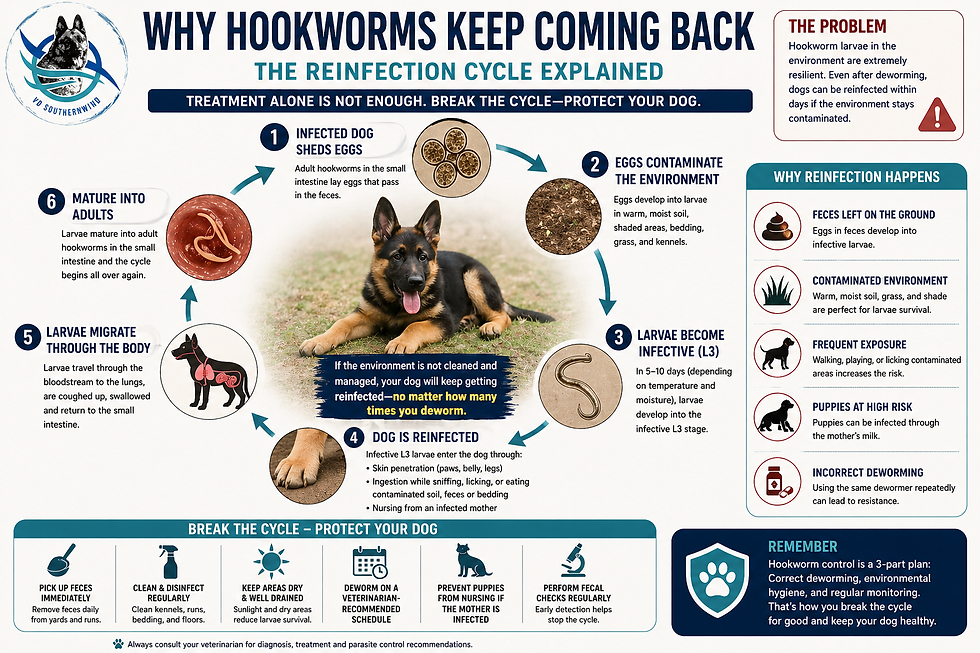
Hookworm eggs are microscopic and are passed in the feces of infected dogs. Once in the environment, they develop into larvae that can infect other dogs through:
• ingestion from contaminated soil
• penetration through the skin
• grooming contaminated paws
• nursing from the mother
This means something very important:
A dog does not need to visit a dog park to become infected.
Hookworms can exist in:
• yards
• kennels
• indoor environments
• breeding facilities
• homes with multiple dogs
Even a dog that never leaves the property can be exposed repeatedly.

The Growing Problem of Dewormer Resistance
Veterinary parasitologists have documented increasing resistance in hookworms to certain dewormer classes.
This is particularly true with benzimidazole drugs, the class that includes fenbendazole.
Fenbendazole works by disrupting the parasite's ability to absorb nutrients, essentially starving the worm.
For decades it has been one of the most widely used intestinal parasite treatments.
However, several veterinary studies have shown that some hookworm populations are becoming less susceptible to repeated treatment with this class of drugs.
Researchers at institutions such as the University of Georgia College of Veterinary Medicine have documented resistant hookworm strains in dogs, particularly in environments where dewormers are used frequently.
What this means is very important:
If the same medication is repeated over and over again, the parasites that survive the treatment pass their resistance to the next generation.
Over time, the treatment appears to stop working.
One of the easiest ways to understand parasite treatment is to look at the active ingredient and the parasites it targets.
The chart below summarizes the most common veterinary ingredients used in dogs and the parasites they are designed to control.
Active Ingredient | Main Parasites Targeted |
Fenbendazole | Hookworms, Roundworms, Whipworms, Giardia |
Pyrantel Pamoate | Hookworms, Roundworms |
Praziquantel | Tapeworms |
Toltrazuril | Coccidia |
Milbemycin Oxime | Hookworms, Roundworms, Heartworm prevention |
Moxidectin | Hookworms, Heartworm prevention, some mites |
Ivermectin | Heartworms, some intestinal parasites |
Emodepside | Hookworms, Roundworms, Whipworms |
Why Some Dogs Test Positive for Weeks
Sometimes owners believe a dog “still has worms” because the treatment failed.
But several factors may be happening at the same time:
Environmental reinfection
Hookworm larvae can survive in soil for weeks or months under the right conditions.
A dog may be treated successfully, but if it walks in the same contaminated environment, it can become reinfected again.
Multiple dogs sharing an environment
If one dog is treated but others are not, parasites can continue circulating within the group.
Repeated exposure in yards or kennels
Hookworm larvae thrive in warm, moist environments and can remain infectious in contaminated soil.
Use of the same ingredient repeatedly
If the same active ingredient is used over and over again, resistant parasites may survive.
The Importance of Environmental Hygiene
Medication alone will never solve a parasite problem if the environment remains contaminated.
Good parasite control requires strict hygiene.
Responsible dog owners should:
• remove feces immediately from yards
• prevent dogs from defecating in shared areas
• wash bedding frequently
• disinfect kennel surfaces
• prevent overcrowding in dog areas
• rotate exercise areas when possible
In some severe infestations, even soil replacement or treatment may be necessary.
Environmental control is just as important as medication.
Main Veterinary Ingredients Used to Treat Hookworms
Veterinarians rely on several different classes of drugs to control hookworms.
Understanding the active ingredients helps prevent repeating the same medication unnecessarily.
Fenbendazole (benzimidazole class)
Works by disrupting parasite metabolism and nutrient absorption.
Commonly used against:
• hookworms
• roundworms
• whipworms
However, resistance has been reported in certain hookworm populations.
Pyrantel (tetrahydropyrimidine class)
Acts by paralyzing the worms, allowing them to detach from the intestinal wall and pass through the digestive system.
Commonly used against:
• hookworms
• roundworms
It works through a completely different mechanism than fenbendazole.
Macrocyclic lactones (ivermectin, moxidectin, milbemycin)
These medications interfere with the nervous system of parasites, causing paralysis and death.
They are commonly used in heartworm preventives but also affect intestinal parasites including hookworms.
Emodepside (newer antiparasitic class)
A newer veterinary antiparasitic that affects the parasite’s nervous system in a different way from traditional drugs.
It has shown effectiveness against several intestinal parasites.

Why Combination Treatments Are Sometimes Necessary
When dealing with persistent hookworm infections, veterinarians may sometimes use multiple drugs from different classes.
The reason is simple.
Each class attacks the parasite through a different biological mechanism.
By combining or rotating treatments, it becomes much harder for parasites to survive and reproduce.
However, these decisions must always be made by a veterinarian familiar with the case.
The Most Important Lesson I Ever Learned
Many years ago, a veterinarian I worked with for nearly fifteen years taught me something that changed the way I approached medications forever.
He said:
“Always read the ingredient list first.”
Not the brand name.
Because different products may contain the same medication under different marketing labels.
If we are not careful, we may be repeating the same treatment again and again without realizing it.
Understanding ingredients allows us to make smarter decisions and work better with veterinarians to solve parasite problems.
The Truth About Parasite Control
Parasite control is not simply about giving a pill or a powder.
It requires three things working together:
Correct medication
Understanding the active ingredients
Strict environmental hygiene
Without those three elements, parasites will continue to circulate and reinfect dogs.
After more than five decades working with dogs, one thing is certain:
The more we understand the science behind parasite control, the better we can protect the health of our animals.
Frequently Asked Questions
Why does my dog still have hookworms after treatment?
Persistent hookworm infections may occur due to environmental reinfection, resistant parasite strains, or repeated exposure from other infected dogs.
Can hookworms become resistant to dewormers?
Yes. Veterinary research has documented resistance in hookworms to certain drug classes when the same medications are used repeatedly.
Can my dog get hookworms even if it never leaves the yard?
Yes. Hookworm larvae can survive in contaminated soil, yards, and kennels and infect dogs through skin contact or ingestion.
Is hygiene important for controlling hookworms?
Extremely important. Removing feces promptly, disinfecting surfaces, and managing contaminated soil are critical steps in preventing reinfection.
Final Message
Parasite control is not simply about giving a pill or powder.
It requires three things working together:
• the correct medication
• understanding the active ingredients
• strict environmental hygiene
Without those three elements, parasites can continue circulating and reinfecting dogs.
After more than fifty years breeding and raising dogs, one thing has become very clear to me:
The more we understand the science behind parasite control, the better we can protect the health of our dogs.
Learn More About Responsible Dog Health and Breeding
If you are interested in learning more about responsible breeding, puppy development, and canine health, explore other educational articles from Southernwind Kennels.
About the Author
Maria Cecilia Martinez is the founder of Southernwind Kennels in Brooksville, Florida and has more than five decades of experience breeding, training, and evaluating working and companion dogs.
She has worked extensively with canine development, temperament evaluation, and breeding programs, including years advising and training working dogs for the Puerto Rico Mounted Police.
Throughout her career she has served as a trainer, handler, and judge, dedicating her work to preserving strong temperament, sound structure, and responsible breeding practices.
Through Southernwind Kennels, she continues to educate dog owners and breeders about puppy development, canine behavior, and responsible dog ownership.
Learn more:https://www.southernwindk9.com/about-us
References
Companion Animal Parasite Council (CAPC) https://capcvet.org
Merck Veterinary Manual – Intestinal Parasites in Dogs https://www.merckvetmanual.com
University of Georgia College of Veterinary Medicine – Hookworm Resistance Research https://vet.uga.edu
American Veterinary Medical Association – Parasite Control Guidelines https://www.avma.org


Comments