


Puppy Sensory Development: What I Have Learned from Raising Generations of Resilient German Shepherds
Updated: Aug 6

“What do you do with these puppies?”
I have heard that question from Southernwind families for years.
Sometimes it comes in a telephone call only days after a puppy arrives home. Sometimes it comes months later, after the family has traveled with the dog, taken him into a crowded place or watched him hear his first violent thunderstorm.
“Cecilia, this puppy is different.”
“He heard the thunder, looked around and went back to what he was doing.”
“I can take her anywhere.”
“She noticed something strange and stepped back, but within seconds she went forward to investigate it.”
And one of the comments that has stayed with me most is this: “We have had dogs before. We have bought puppies from other breeders. But we have never had one approach the world like this.”
The families may not call it puppy sensory development. They simply recognize the result. They see a puppy who can enter a new place without falling apart, hear an unfamiliar sound without remaining trapped in fear, and meet a small problem with enough confidence to search for an answer.
Those words mean more to me than someone simply telling me the puppy is beautiful. Beauty can be seen in a photograph.
What these families are describing is something deeper:
a dog who remains mentally present when the world changes—a dog who may notice, question or even startle, but does not immediately lose himself inside the experience.
For more than four decades, I have developed and refined what is now known as the Southernwind Developmental Exposure Protocol™ (SDEP™)—a purposeful system designed to strengthen body awareness, environmental confidence, problem-solving, adaptability, and recovery in developing puppies.
But I need to be precise about what “strengthen” means. I do not claim that a breeder can manufacture temperament, erase genetic weakness or create a dog who will never feel fear.
I mean that carefully designed, age-appropriate experiences give the developing puppy repeated opportunities to use his senses, organize his body, make decisions and recover from manageable uncertainty.
My answer is never that I made that puppy fearless. I did not. No honest breeder can manufacture temperament or promise that a dog will never be afraid. Genetics matters. The mother matters. Health matters. Every experience after the puppy leaves the breeder matters.
But the answer is also not an accident.
For more than five decades, I have watched that development happen under my hands, one litter and one individual puppy at a time. Long before sensory programs became fashionable words on breeder websites, I was placing small questions in front of my puppies and watching how they answered.
A tarp that moved and sounded different beneath their paws.
A bottle with pebbles introduced first from far away.
A low rail that required them to slow down and discover where each foot belonged.
An umbrella opening at a safe distance.
A tunnel, a narrow passage, a change in elevation or an unfamiliar surface that asked the puppy to stop using momentum and begin using his mind.

I watched one puppy move forward immediately. I watched another stop, lower his body and study what had changed. I saw a third step back, reorganize himself and return with a better plan.
I learned not to judge all three by the same clock.
The important question was never, “Did the puppy cross the obstacle quickly?”
The important questions were: Did he remain capable of thinking?
Did he gather information? Could he adjust his body?
If he became uncertain, could he recover? Would he return and try again?
Those moments can look like puppies playing among homemade objects. But they are not merely play. The puppy is gathering information through his eyes, ears, nose, skin, paws, muscles, joints and inner ear.
His nervous system is comparing what he expected with what actually happened. His body is adjusting. His emotional system is learning whether novelty always predicts danger—or whether uncertainty can be examined and solved.
That is how the SDEP™ was born: not from a textbook and not as a marketing invention, but from generations of puppies, years beside working dogs and horses, my experience with the Mounted Police, and the families who kept calling me afterward to tell me what they were seeing in real life.

It is not a pile of colorful objects thrown into a puppy pen. It is not forced exposure. And it is not a guarantee of a fearless dog.
It is a structured, observed and progressive developmental process intended to help each puppy use his body, awaken his senses, investigate uncertainty, solve small problems and recover without being overwhelmed.
The science in this article helps explain why those early experiences may matter. But the story began with the dogs—and with what their families continued to witness long after they left my hands.
This article follows that same order. First, I will explain what the protocol is and what I have observed. Then I will show what the puppy is doing through his senses, body and developing nervous system; how each type of obstacle creates a different developmental question; where the science supports these principles; and where an honest breeder must never make promises the evidence cannot support.
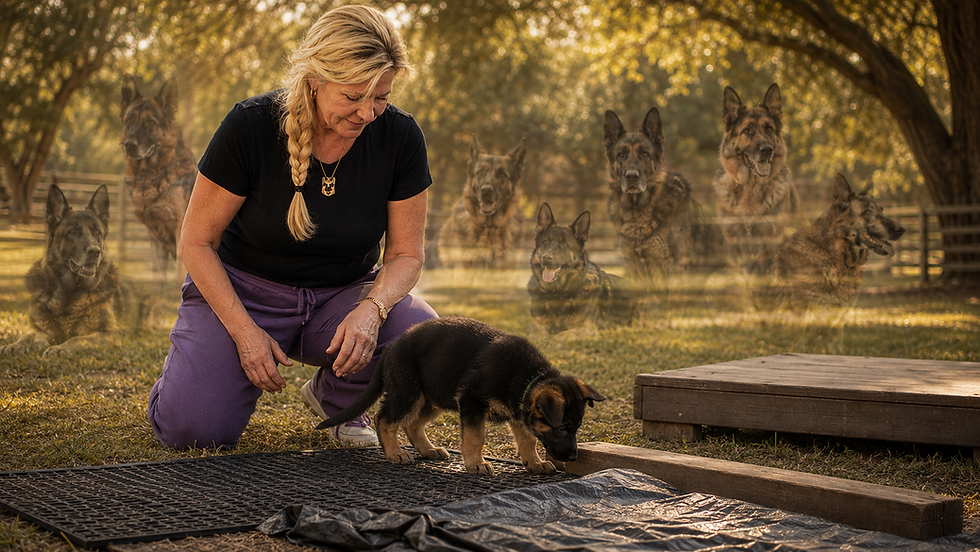
What Is the Southernwind Developmental Exposure Protocol™?
The Southernwind Developmental Exposure Protocol™ is a breeder-directed system of age-appropriate sensory, motor, environmental, social and cognitive experiences introduced during early puppy development.
I began developing this work around 1980, long before “puppy enrichment” became a marketing phrase. Its roots came from a lifetime of raising and training dogs and horses, and from the years I spent working with trainers and members of the Mounted Police. In serious working environments, I learned that courage is not noise, force or reckless forward motion.
A stable animal must be able to notice change, evaluate it, remain functional and recover.
The SDEP™ applies that principle during puppyhood through carefully controlled experiences involving:
Different textures and footing
Low and unstable surfaces
Tunnels, barriers and narrow passages
Moving and visually unusual objects
Sounds introduced at controlled distances
Changes in elevation and body position
Safe opportunities to climb over, under, through and around
Search, exploration and simple problem-solving
Human handling and appropriate social experiences
Daily recovery, rest and observation
The protocol does not attempt to manufacture temperament. It gives inherited temperament a developmental environment in which it can be expressed, observed and strengthened.
That distinction connects directly with my article Genetics vs. Environment in Dogs: What Really Shapes a Dog?. Genetics establishes possibilities and limitations. Prenatal conditions, maternal care, early experience, health, learning and later ownership influence how those inherited possibilities unfold.
Puppy Sensory Development Is More Than the Five Familiar Senses
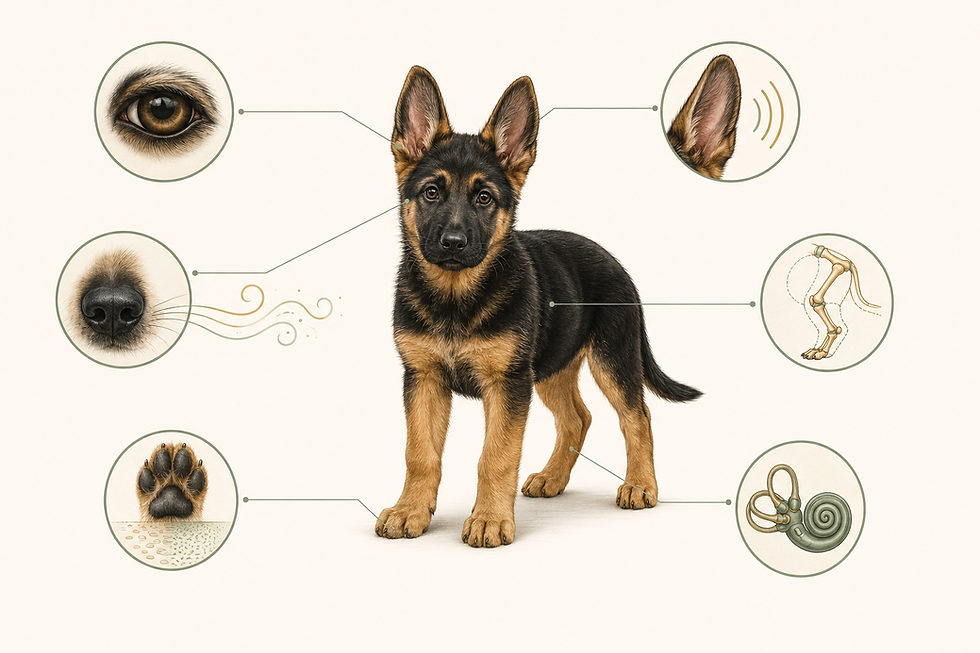
Most people think of sight, hearing, smell, taste and touch. Those senses matter, but an obstacle course also engages internal sensory systems that owners rarely consider.
Proprioception: Where Is My Body?
Proprioception is the nervous system’s information about the position and movement of the body. Receptors in muscles, tendons and joints provide continuous feedback that helps an animal know where a limb is without looking directly at it.
When a puppy steps over a low rail, places a paw on a different texture or adjusts his feet on an uneven but safe surface, the task requires sensory feedback, motor planning and postural correction.
Veterinary neurologic examinations use postural reactions and proprioceptive positioning precisely because coordinated limb placement depends on intact sensory and motor pathways.
This does not mean that one session “builds the proprioceptive part of the brain.” It means the activity gives the developing nervous system practice integrating limb-position information with movement.
The Vestibular System: Which Way Is Up?
The vestibular system, located within the inner ear and connected extensively with the brain, contributes to balance, spatial orientation, head position and stabilization of the eyes during movement.
A gentle change in elevation, a broad low ramp, a stable platform or a slightly shifting surface asks the puppy to adjust his center of mass. The eyes, vestibular system, muscles and joints work together.
That multisensory integration is why balance cannot be reduced to a single organ or brain region.
The Somatosensory System: What Am I Touching?
Touch includes pressure, vibration, temperature and information from the skin and paws. Grass, rubber, wood, shallow water, a tarp and a textured mat do not feel the same or produce the same sound underfoot.
Varied safe footing teaches the puppy that changes beneath his paws are information—not automatically a reason to panic. It also allows us to observe whether he freezes, rushes blindly, avoids, investigates or adapts.
Vision, Hearing and Smell Work Together
A fluttering umbrella is visual, but it may also make a sound and move air across the puppy’s face.
A plastic bottle containing pebbles is auditory, visual and, at close range, tactile through vibration.
A tunnel changes the light, echoes sound and concentrates scent.
Real life is multisensory. The SDEP™ does not isolate puppies inside a sterile world and then expect them to understand a complicated one at eight weeks of age.
What Happens in the Developing Puppy’s Brain?
The honest answer is more sophisticated than the popular claim that an obstacle “activates the cerebellum” or a noise “rewires the amygdala.”
A puppy’s response to novelty emerges from interacting systems.
Sensory receptors detect the stimulus.
The spinal cord and brainstem carry and organize information.
The cerebellum contributes to coordination, timing and movement adjustment.
Emotional and memory networks help assign meaning to what happened.
Attention, motivation and prior experience influence whether the puppy approaches, retreats, freezes or seeks help.
The brain is developing rapidly during early life. Experience helps shape which connections and behavioral responses are repeatedly used.
This capacity for experience-dependent change is broadly called neuroplasticity.
However, researchers cannot look at a puppy crossing a wobble board and truthfully declare that a specific permanent neural change has occurred.
Direct canine studies connecting each breeder obstacle to a precise developing brain structure do not exist.
What the evidence does support is this:
Early life experience is associated with later behavior.
Maternal care, inherited temperament and the physical and social environment interact.
Carefully planned stimulation can improve responses to novelty compared with limited or poorly managed experience.
Repeated safe exposure may produce habituation, while exposure that is too intense may produce sensitization and greater fear.
Obstacle negotiation changes how dogs place and load their limbs and requires adjustments in speed, posture and movement.
The SDEP™ lives inside that scientific boundary. We use what is known, respect what is not yet proven and let careful observation guide the individual puppy.
The Central Lesson: “I Can Notice, Think, Adjust and Recover”
The most valuable outcome is not that the puppy walks across one particular tarp.
The lesson is larger:
Something changed. I noticed it. I was allowed to gather information. Nothing forced me into helplessness. I found a way through, and my nervous system returned toward normal.
That sequence is the foundation of functional confidence.
Confidence is not the absence of a startle response. A healthy dog may startle when something sudden happens.
The more meaningful questions are:
How intense was the reaction?
Could the puppy still observe and think?
How quickly did he recover?
Did he return to investigate?
Did he develop a useful strategy?
Did repeated exposure make him calmer, or increasingly distressed?
A puppy who never reacts is not automatically stronger. A puppy who startles, recovers and makes an intelligent choice may reveal far more useful nervous-system stability.
The SDEP™ Obstacle and Development Chart
The effects below describe the primary systems and skills challenged, not exclusive brain targets or guaranteed outcomes. Most exercises are multisensory.
Obstacle or exposure | Primary senses and body systems | Developmental task | Possible functional benefit | What the breeder watches |
Different surfaces: grass, rubber, wood, textured mats | Touch, paw sensation, proprioception, vision | Adjust foot placement and traction | Surface adaptability; body awareness | Freezing, rushing, careful testing, recovery |
Loose or crinkling tarp | Touch, hearing, vision, proprioception | Manage movement, sound and texture together | Multisensory flexibility; recovery from movement underfoot | Startle intensity, willingness to reapproach, paw placement |
Very low ground poles or rails | Proprioception, vision, motor control | Lift and place each limb deliberately | Coordination; movement planning | Knocking poles, slowing down, visual checking, improvement |
Broad low platform | Proprioception, vestibular input, vision | Step up, organize all four feet, step down | Spatial awareness; controlled transitions | Hesitation at edge, balance, deliberate versus impulsive movement |
Gentle low ramp | Vestibular system, proprioception, muscles and joints | Adapt posture to incline and decline | Postural control; awareness of weight shift | Speed, slipping, limb control, confidence descending |
Mildly unstable board used at tiny amplitude | Vestibular input, proprioception, postural muscles | Respond to safe, slight movement beneath the body | Balance reactions; controlled recovery | Panic, jumping off, weight shifts, ability to remain engaged |
Tunnel or covered passage | Vision, hearing, smell, touch, spatial awareness | Enter reduced light and altered acoustics | Exploration; spatial problem-solving | Entry choice, backing out, searching, recovery inside |
Cardboard maze or low barrier | Vision, smell, problem-solving, motor planning | Find a route around or through | Persistence; strategy switching; frustration tolerance | Repetition of ineffective strategy, disengagement, seeking alternatives |
Safe objects to walk around or between | Vision, proprioception, spatial mapping | Judge width and body clearance | Body-in-space awareness | Shoulder contact, path choice, slowing and recalculating |
Empty bottles hanging or moving gently | Vision, hearing, air movement, touch | Approach unpredictable but low-intensity motion | Investigation of novelty; multisensory processing | Avoidance distance, startle, approach curve, recovery |
Bottle with pebbles sounded from a distance | Hearing, orientation, vision | Locate sound and evaluate intensity | Auditory orientation; habituation when properly graded | Ear and head orientation, fleeing, freezing, recovery time |
Umbrella opened at a safe distance | Vision, hearing, air movement | Process sudden change in size and shape | Visual novelty recovery | Distance threshold, startle, investigation, sensitization |
Flapping fabric or moving curtain | Vision, hearing, touch | Predict and navigate irregular movement | Adaptability to environmental motion | Chasing, avoidance, thoughtful approach, overstimulation |
Shallow water or wet surface, weather permitting | Touch, temperature, vision, proprioception | Adjust to resistance, reflection and wet footing | Surface versatility; sensory discrimination | Distress, paw lifting, exploration, safe exit choice |
Safe natural terrain: soil, leaves, roots, small slopes | Smell, touch, proprioception, vestibular system | Coordinate through variable terrain | Whole-body coordination; environmental awareness | Fatigue, footing choices, speed and balance |
Novel scent trail or hidden food search | Olfaction, attention, memory, movement | Follow odor and persist toward a goal | Scent use; concentration; independent investigation | Search pattern, persistence, frustration, help-seeking |
Household and farm sounds at controlled intensity | Hearing, orientation, emotional learning | Discriminate background events from true threat | Reduced overreaction when exposures remain safe | Accumulating stress, recovery, avoidance, sensitization |
Calm handling of paws, ears, mouth and body | Touch, interoception, social learning | Tolerate cooperative contact | Preparation for grooming and veterinary care | Consent signals, tension, escape attempts, recovery |
New but safe people and appearances | Vision, smell, hearing, social cognition | Generalize that humans vary | Social flexibility without demanding interaction | Choice to approach, withdrawal, body tension, recovery |
Crates, gates and brief separations | Spatial, social and emotional regulation | Settle with mild boundaries and temporary distance | Early coping and confinement familiarity | Escalation, self-settling, vocalization, recovery |
Age-appropriate free play with littermates and dam | Touch, movement, social communication | Read signals, inhibit behavior and adjust play | Social feedback; motor practice | Bullying, withdrawal, reciprocity, fatigue |

How Specific Exercises Build Different Capacities
Surfaces Teach the Puppy to Read Through His Feet
Many adult dogs panic on slick floors, metal grates, moving docks or unfamiliar stairs—not because the surface is dangerous, but because they have little history of adjusting to sensory change underfoot.
In SDEP™, surfaces are introduced in manageable forms. We may use firm footing, grass, rubber, wood, fabric, a tarp or a shallow wet area. The purpose is not to drag the puppy across.
The purpose is to let him detect the difference, choose how to investigate it and discover that controlled movement changes the information he receives.
The puppy may extend one paw, pull it back, smell the surface and circle. That pause is not failure. It is information gathering.
Low Rails and Natural Terrain Develop Deliberate Movement
Walking in a flat, empty pen requires less adjustment than navigating low rails, roots, slopes and changes in footing.
Research in adult dogs shows that walking over obstacles changes ground-reaction forces, center-of-pressure movement, stride timing and speed.
We should not pretend that these adult biomechanical studies prove developmental outcomes in puppies, but they do confirm that obstacle negotiation is mechanically different from ordinary level walking.
For puppies, every rail must remain very low, stable and appropriate to size. This is not agility training. There are no high jumps, repeated impacts, tight turns or forced repetitions on growing joints.
Tunnels and Barriers Create Small, Solvable Questions
A tunnel asks: Can I enter a space that looks different?
A barrier asks: Do I push, climb, go around or look for another opening?
Problem-solving is not simply whether the puppy reaches the reward.
We watch the strategy. Does he persist intelligently? Does he repeat the same ineffective action until frustration rises? Does he abandon the task instantly? Does he look to the person for information? Can he switch approaches?
Those observations help a breeder understand the puppy. The goal is not to make every puppy independent to the same degree. The goal is to provide solvable experiences and learn who the puppy already is.
Controlled Sound Teaches Orientation and Recovery
Sound exposure is one of the most commonly mishandled parts of puppy development.
I have long used bottles containing pebbles, beginning far enough away that the sound is noticeable without overwhelming the litter. The distance, volume, predictability and duration matter. We observe the puppies before moving closer.
Proper auditory exposure is not “make a loud noise and see who runs.” That is testing by ambush, not development.
When a sound is introduced beneath the puppy’s coping threshold, followed by safety, exploration or a positive activity, repeated experience may support habituation—the reduction of response to a stimulus that proves irrelevant.
When sound is too loud, too close, inescapable or repeated while the puppy remains distressed, the opposite can happen: sensitization. The puppy becomes more reactive, not less.
Moving Objects Teach the Brain That Change Is Not Automatically Danger
Umbrellas, hanging bottles and moving fabric change shape and direction. They may sound different from moment to moment. They give the puppy practice tracking motion, pausing, adjusting distance and returning to investigate.
Again, the lesson is not “umbrellas are safe forever.” Dogs do not generalize perfectly from one object to every future variation.
The more durable lesson is a practiced response to manageable novelty: orient, assess, recover and explore.
The Difference Between Exposure, Habituation and
Flooding
These terms should never be treated as if they mean the same thing.
Exposure
Exposure only means the puppy encountered something. Exposure can be beneficial, neutral or harmful depending on intensity, timing, control and the puppy’s response.
Habituation
Habituation is a learned reduction in response after repeated presentation of a stimulus that has no important consequence. A puppy may stop reacting to the normal movement of a tarp after repeated safe experiences.
Sensitization
Sensitization is an increased response after exposure. If each encounter is overwhelming, the puppy may become more vigilant and reactive.
Flooding
Flooding means prolonged or intense exposure without a sufficient ability to escape or reduce the stimulus.
A puppy who stops struggling during flooding has not necessarily become calm.
He may be exhausted, inhibited or shut down.
That is why SDEP™ never judges success by silence alone. Stillness is not always emotional stability.
This subject will connect with the forthcoming Southernwind article on canine anxiety versus shutdown, where I will explain why a dog who appears obedient or motionless may actually be cognitively and emotionally overwhelmed.
The Southernwind “Notice–Assess–Attempt–Recover” Framework™
Within the SDEP™, I evaluate four stages:
1. Notice
Did the puppy register the change? We look for ear orientation, head movement, scenting, change of pace, body tension or visual attention.
2. Assess
Can the puppy gather information without escalating beyond his ability to cope? He may pause, circle, smell, watch or change distance.
3. Attempt
Does he try a strategy? He may place one paw, go around, follow a littermate, look toward the handler or return after retreating.
4. Recover
Can he return toward normal movement, exploration, play, eating or social engagement? Recovery is one of the most important observations in the entire protocol.
The goal is not to rush through all four stages. The goal is to preserve the puppy’s ability to think within them.

Why Choice Matters—but So Does Skilled Guidance
A young puppy should not be abandoned to struggle indefinitely.
Choice is valuable because voluntary investigation can produce information and agency. But thoughtful guidance is also part of development.
The breeder may:
Increase distance from the stimulus
Lower its movement, sound or difficulty
Model a route without pulling the puppy through
Use food, play, the dam or a confident littermate when appropriate
Remove competing stressors
End the session while the puppy is still functioning
Return later at an easier level
This is neither indulgence nor force. It is skilled adjustment.
Why Rest Is Part of the Protocol
Development does not happen only while the puppy is moving.
Young puppies need extensive sleep. An overtired puppy may become frantic, mouthy, clumsy, avoidant or unable to process another challenge.
Repeated stimulation without recovery does not build resilience; it can create cumulative stress.
SDEP™ sessions are brief. The environment changes across days. Not every object appears at once, and not every puppy is expected to complete every task on the same schedule.
The cycle is:
Experience → observation → recovery → sleep → later reintroduction
Rest is not lost training time. It is part of healthy development.
What the Protocol Cannot Do
This is where breeder honesty matters.
The Southernwind Developmental Exposure Protocol™ cannot:
Erase genetic fearfulness or weak nerves
Guarantee that a puppy will never startle
Prevent every future anxiety or behavior problem
Compensate for poor maternal care, pain, illness or chronic stress
Predict every behavior after a major environmental change
Replace continued socialization, training and structure in the new home
Turn every puppy into a police, protection, service or sport prospect
A well-designed environment can support development and reveal temperament. It cannot manufacture genetic qualities that are not present.
This is why responsible breeding must preserve far more than color or appearance. I discuss that responsibility in Responsible German Shepherd Breeding—Beyond Color.
How We Keep Puppy Sensory Development Safe
The puppy is never forced into panic
Brief uncertainty is not the same as distress. We stop or reduce intensity when the puppy cannot investigate, cannot take food when normally motivated, repeatedly attempts escape, freezes without recovery, vocalizes intensely, trembles, hides or becomes more reactive with repetition.
Obstacles remain low and developmentally appropriate
Growing puppies should not perform repetitive jumping, high-impact landings, forced running or difficult balance work. Surfaces must be stable enough to prevent falls, nonsharp, nontoxic and sized so puppies cannot become trapped.
Traction and temperature matter
Florida heat can turn equipment into a hazard. Wet surfaces can become dangerously slick. Every setup must be checked at puppy level—not only from the standing adult’s point of view.
Hygiene matters
Young puppies are vulnerable to infectious disease. Outdoor exposure and visitors must be managed according to vaccination status, local disease risk and veterinary guidance. Socialization should not mean placing an incompletely vaccinated litter on contaminated public ground.
Individual differences matter
The boldest puppy should not set the required pace for the most cautious. A confident littermate can help, but should not be used to conceal another puppy’s persistent inability to cope.
Pain changes behavior
A puppy reluctant to climb, turn, bear weight or tolerate touch needs assessment—not a label of stubbornness or weakness. Developmental exercises must never continue through suspected pain, illness or fatigue.
How Owners Must Continue the Work After the Puppy Goes Home
The breeder builds the first chapters. The owner writes the rest.

When a Southernwind puppy enters a new home, almost every familiar reference point changes: people, smells, floor surfaces, sleeping place, schedule, sounds and social expectations.
Even a well-developed puppy may hesitate. That does not mean the protocol failed. It means the puppy is processing a new world.
Owners should continue with controlled, positive and age-appropriate experiences:
Introduce one or two new variables at a time.
Watch the puppy’s body, not the owner’s timetable.
Allow observation before demanding interaction.
Reward investigation and calm recovery.
Avoid forcing greetings with people or dogs.
Use safe surfaces, low obstacles and short searches at home.
Protect growing joints from repetitive impact.
Provide sleep after stimulating outings.
Revisit experiences in different places because dogs do not generalize automatically.
Seek qualified veterinary or behavior help when fear intensifies or recovery remains poor.
An owner should never say, “The breeder exposed him to this, so he must tolerate it.” Development is not a finished vaccine. It is a continuing process.
A Simple Home Continuation Course
For a healthy puppy cleared for normal activity, owners can create a gentle course with:
A rubber-backed bath mat
A flat piece of cardboard
A towel laid smoothly on the floor
A very low pole placed on the ground
An open box with two wide exits
A short food search in grass or on a snuffle mat
Let the puppy investigate. Do not pull him across with a leash. Keep sessions to a few successful minutes. The purpose is quality of response, not the number of obstacles completed.
If the puppy shows repeated distress, make the task easier or stop. If movement suggests pain or poor coordination beyond normal puppy clumsiness, consult a veterinarian before continuing.
What More Than 50 Years Have Taught Me
The families who call me are not reporting that their dogs never notice a storm, a strange floor or a sudden sound. They are describing recovery.
The dog looks, listens, evaluates and then comes back to himself. That distinction matters. A dog does not prove his strength by being numb to the world; he shows stability by remaining functional inside it.
Those calls have also kept me honest. Not every puppy responds identically, and not every owner continues the work in the same way. I have followed dogs through different homes, purposes and stages of life.
Over time, repeated patterns become visible—but experience must never be turned into a magical promise.
My responsibility is to tell families what I have consistently observed, what research supports and where the limits remain.
There is a moment I have seen thousands of times.
A puppy meets something he does not understand. His body answers before his mind has finished the question. He stops. His ears move. His weight shifts backward. For a second, uncertainty stands between him and the obstacle.
An inexperienced person may rush to rescue him. Another may push him forward to prove he is brave.
I do neither.
I watch.
I give him the room to collect himself, and I adjust the question if it is too large. Then I wait for that small decision—the nose extending forward, the single paw placed carefully, the return after retreat.
That is where development lives.
Not in forcing a puppy never to feel uncertainty, but in teaching his developing body and mind that uncertainty can be approached, understood and survived.
The greatest gift we can give a puppy is not a world with nothing difficult in it. That world does not exist.
The gift is a carefully built history that says:
You have met change before. You know how to use your senses. You know how to search for information. You know how to recover. Now think—and find your way.
Frequently Asked Questions About Puppy Sensory Development
At what age should puppy sensory development begin?
Development begins before birth and continues from the neonatal period onward, but activities must match the puppy’s sensory and physical maturity. Gentle handling is different from obstacle exploration. More complex social, sensory and environmental experiences expand as puppies gain mobility, sight, hearing and coordination. A single universal timetable is inappropriate because health, breed, litter and individual development differ.
Is SDEP™ the same as Early Neurological Stimulation or ENS?
No. ENS usually refers to a short set of handling and positional exercises performed during a limited neonatal window. SDEP™ is broader and longer. It integrates sensory development, environmental variation, body awareness, movement, social experience, novelty, recovery and problem-solving across multiple developmental stages. ENS may be one small component of an early program; it is not the complete SDEP™.
Does a sensory protocol create a fearless puppy?
No ethical program can promise a fearless dog. Fear and recovery are affected by genetics, maternal care, prenatal and early conditions, health, experience and later handling. The objective is an appropriately challenged puppy who can notice novelty, remain functional, explore and recover—not a puppy incapable of fear.
Can too much exposure make a puppy more fearful?
Yes. Exposure that is too intense, inescapable, unpredictable or repeated while the puppy remains distressed can cause sensitization rather than habituation. More exposure is not automatically better exposure.
Should puppies be carried or comforted when uncertain?
There is no honest one-rule answer. First reduce genuine danger and prevent overwhelming exposure. Calm support does not magically “reward fear,” but frantic handling, forced approach or immediate removal from every manageable uncertainty can interfere with useful learning. The skilled response depends on intensity, context and whether the puppy can still think and recover.
Are wobble boards and obstacle courses safe for young puppies?
Only when designed for their age, size and physical development. Equipment should be low, nonslip, stable enough to prevent falls and used briefly without forced repetition. High jumps, hard landings, tight turns and adult-level balance equipment do not belong in a young-puppy program.
How can I tell whether my puppy is learning or shutting down?
A learning puppy can usually gather information, change strategy, reengage and recover. A shut-down puppy may become motionless, unresponsive, avoidant or unable to perform behaviors he normally knows. Silence and stillness are not proof of calmness. Persistent shutdown or severe fear warrants help from a veterinarian and a properly qualified behavior professional.
Does the protocol replace puppy classes?
No. Breeder development and owner continuation serve different stages. Properly run puppy classes can add controlled experiences with people, dogs, handling and new environments. Disease-prevention requirements should be discussed with the puppy’s veterinarian, and the class should use safe, evidence-based methods.
Is this protocol only for future working dogs?
No. A family companion must also navigate floors, sounds, visitors, veterinary care, travel and change. Working prospects may later require specialized preparation, but body awareness, recovery and flexible problem-solving support everyday welfare too.
Scientific Integrity Note
The SDEP™ is a proprietary Southernwind developmental framework grounded in Maria Cecilia Martinez’s long-term breeding and training experience and informed by established principles of canine development, socialization, habituation, enrichment, biomechanics and learning.
It has not itself been evaluated in a controlled peer-reviewed clinical trial. Research cited below supports the relevant principles; it does not validate every SDEP™ activity as an isolated intervention or guarantee a specific outcome.
References and Further Reading
McEvoy V, et al. Canine Socialisation: A Narrative Systematic Review. Animals. 2022.
Stolzlechner L, et al. Optimising Puppy Socialisation—Short- and Long-Term Effects of a Training Programme during the Early Socialisation Period. Animals. 2022.
Howell TJ, King T, Bennett PC. Puppy parties and beyond: the role of early age socialization practices on adult dog behavior. Veterinary Medicine: Research and Reports. 2015.
Guardini G, et al. Influence of Maternal Care on Behavioural Development of Domestic Dogs. Scientific Reports. 2017.
Tiira K, Lohi H. Early Life Experiences and Exercise Associate with Canine Anxieties. PLOS ONE. 2015.
Puurunen J, et al. Inadequate socialisation, inactivity, and urban living environment are associated with social fearfulness in pet dogs. Scientific Reports. 2020.
Bray EE, et al. Dog cognitive development: A longitudinal study across the first 2 years of life. Animal Cognition. 2020.
Bray EE, et al. Enhancing the Selection and Performance of Working Dogs. Frontiers in Veterinary Science. 2021.
Charalambous D, et al. Ground Reaction Forces and Center of Pressure within the Paws When Stepping over Obstacles in Dogs. Animals. 2022.
Blake CA, et al. The impact of cavaletti height on dogs’ walking speed and temporospatial parameters. Frontiers in Veterinary Science. 2024.
American Veterinary Society of Animal Behavior. Position Statement on Puppy Socialization.
American Veterinary Society of Animal Behavior. Socialization Is More Than Mere Exposure.
Merck Veterinary Manual. The Neurologic Examination of Animals.
Boone G, et al. The Effect of Early Neurological Stimulation on Puppy Welfare and Development. Animals. 2022.
About the Author
Maria Cecilia Martinez is the founder of Southernwind Kennels LLC and has bred, raised, evaluated and trained German Shepherd Dogs since 1974. Her experience includes more than five decades in canine development and temperament, 22 years working with the Puerto Rico Mounted Police, lifelong work with dogs and horses, and service as an AKC and FCI dog judge and FCI temperament judge. She developed the foundations of the Southernwind sensory and environmental program around 1980 through direct observation of generations of puppies and working animals. Her writing combines lived breeder knowledge with current veterinary and behavioral science while maintaining a clear boundary between field observation and what controlled research has established.
Copyright © 2026 Southernwind Kennels LLC. Southernwind Developmental Exposure Protocol™, SDEP™, and the Southernwind Notice–Assess–Attempt–Recover Framework™ are proprietary educational identifiers of Southernwind Kennels LLC.


I love the reminder that confidence comes from letting puppies notice, evaluate, attempt, and recover—not forcing them forward. A thoughtful guide for raising resilient German Shepherds; I’ve been using https://makeugc.pro/makeugc-alternative