


When Should a German Shepherd Puppy’s Ears Stand Up?
The Truth About Floppy Ears, Teething, Taping, and Calcium

For more than fifty years, I have watched German Shepherd puppy ears rise, fall, lean, cross, stand one at a time and occasionally look as if they cannot agree on which direction the world is located.
The puppy is usually happy. The owner is the one losing sleep.
I understand why. Erect ears are part of the unmistakable German Shepherd expression. Both the FCI German Shepherd Dog standard and the AKC German Shepherd Dog standard describe the mature breed with erect, forward-facing ears.
But neither standard gives owners a magical puppy deadline.
It does not say that every German Shepherd’s ears must be permanently erect at twelve weeks, four months or the day the adult teeth begin appearing. Breed standards describe the finished dog. They are not veterinary development calendars.
That distinction matters because fear makes owners interfere too soon. They begin adding calcium, folding and testing the ear, changing foods, buying powders, shaving, gluing or taping—sometimes before the puppy has finished the completely normal disorder of growing.
The purpose of this article is not to promise that every ear will eventually stand. Some will not. The purpose is to separate normal development from a genuine concern, and evidence from internet folklore.
When Do German Shepherd Ears Stand Up?
The Short Answer
Many German Shepherd puppies begin lifting one or both ears during the first several months of life. The ears may stand briefly, fall again, change sides or behave unpredictably while the puppy is growing and teething.
Many become consistently erect by the end of teething, but some genetically correct ears—particularly larger or heavier ears and some family lines—take longer.
There is no scientifically validated week at which every German Shepherd puppy’s ears must stand.
If the puppy is still actively teething, the ears have stood at least occasionally, and there is no pain, swelling, odor, discharge, injury or persistent head shaking, patience is often more appropriate than panic.
Once teething is substantially complete and an ear has never shown meaningful lift—or an ear that was strong suddenly collapses and stays down—the puppy deserves an individual evaluation.
That evaluation should consider genetics, ear size and shape, physical health, injury, inflammation and the experience of the breeder with that family.
What Actually Makes a German Shepherd’s Ear Stand?
The visible ear flap is called the pinna. Its shape is supported primarily by auricular cartilage covered by skin, supplied by blood vessels and moved by numerous small muscles.
Veterinary anatomy describes the auricular cartilage as elastic cartilage: flexible enough to bend and move, but structured enough to return to its normal position.
This means an erect ear is not created by one nutrient or one muscle.
Ear carriage reflects several interacting factors:
inherited ear shape, length, width, set and cartilage characteristics;
the size and weight of the ear relative to its base;
maturation of the cartilage and surrounding tissues;
the muscles that orient and move the pinna;
the puppy’s overall nutrition and health;
trauma, inflammation, infection or hematoma;
and time.
Recent canine genetic research has identified genetic variants associated with ear size and carriage across dogs. That research does not give us a German Shepherd puppy deadline, but it reinforces what experienced breeders have always known: ear anatomy is not separate from inheritance.
German Shepherd Ear Stages: What Owners Commonly See

This is a practical breeder-observation timeline, not a rigid medical schedule.
Early puppyhood: soft ears and constant change
Young puppies commonly have soft, folded ears. Some show early lift. Others do not. One puppy in a litter may have two erect ears while a littermate’s ears are still lying to the side. That difference alone does not diagnose a problem.
The rising-and-falling stage
An ear may stand for hours or days and then drop. One may stand while the other folds. The ears may meet over the head, point sideways or trade positions.
Owners often interpret every change as loss of progress. I do not. Movement tells me the puppy is using the ears and that the structures are changing.
The teething stage
Puppies normally replace their deciduous teeth with adult teeth over several months, with most adult teeth present at approximately six months. This overlaps the same period in which German Shepherd ear carriage is changing rapidly.
That overlap is real. The popular explanation that the teeth are “stealing calcium from the ears,” however, is not established science.
After teething
By the time active teething is finishing, the picture becomes clearer. Some ears are already firm. Some still need time. A heavy, wide or long ear may require more structural support than a smaller, lighter ear. Certain families also mature later than others.
This is where knowledge of the bloodline matters. A breeder who has watched parents, grandparents, siblings and previous litters possesses context that a single photograph cannot provide.
Do German Shepherd Ears Fall During Teething?
They can appear to do so, and generations of breeders have observed the timing. But we must describe the observation accurately.
Teething and changing ear carriage occur during the same developmental window. That does not prove that tooth eruption directly removes calcium from ear cartilage or causes the ears to collapse.
The pinna is supported by elastic cartilage, not by a miniature bone that simply requires more calcium. A growing puppy is also changing everywhere at once: head size, jaw, muscles, proportions, weight, behavior and tissue maturity. Ear carriage can fluctuate during that larger developmental process.
Therefore:
It is fair to say that German Shepherd ears often fluctuate while puppies are teething. It is not scientifically fair to claim that teething drains calcium out of the ears.

Should You Give Calcium to Make German Shepherd Ears Stand?
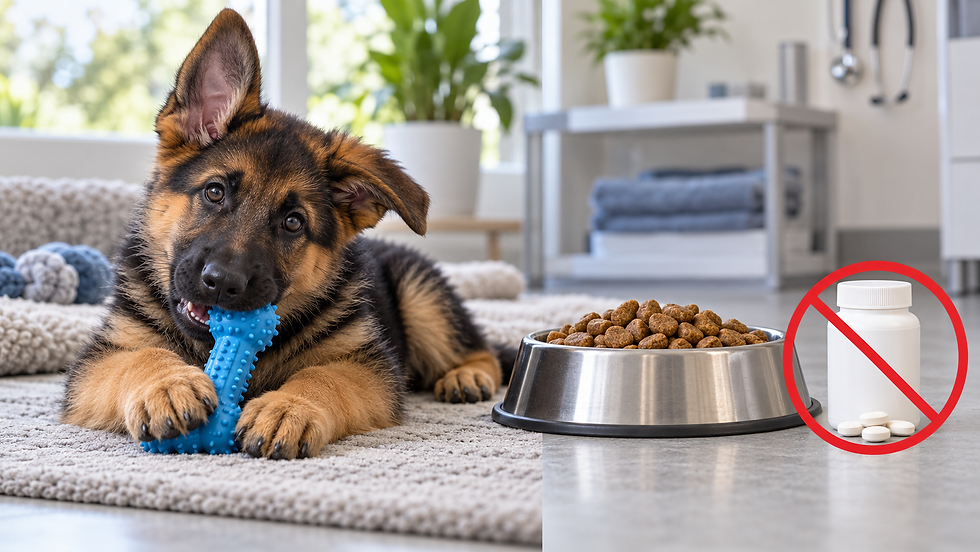
No—not unless a veterinarian has diagnosed a nutritional or medical reason for calcium supplementation.
This is one of the most important corrections in this article.
Years ago, breeders commonly recommended calcium, cottage cheese and other mineral-rich additions when ears were slow. We also used some of those practices in the past. Experience and nutritional science have changed what responsible breeders should recommend.
A complete and balanced large-breed puppy food is formulated to control calcium, phosphorus, calories and growth.
More calcium is not automatically better. Large-breed puppies do not regulate excessive calcium absorption as safely as mature dogs, and excess supplementation can contribute to developmental orthopedic disease.
The Merck Veterinary Manual warns that excessive calcium is particularly problematic in rapidly growing large- and giant-breed dogs. VCA’s large-breed nutrition guidance likewise advises against adding vitamin or mineral supplements to an appropriate growth diet unless directed by a veterinarian.
Risking the puppy’s developing skeleton in an attempt to change an ear is not responsible.
Does Bone Broth Powder Help German Shepherd Ears Stand?

Here I must separate what we have repeatedly observed from what science has actually proven.
At Southernwind, we have seen a number of puppies show better ear firmness while receiving a quality bone-broth powder. We have seen it often enough that I will not pretend the observation never happened.
Bone broth and some bone-broth powders can provide gelatin, collagen-derived peptides and amino acids used throughout the body. Research on specific oral collagen peptides in dogs has found potential benefits for dogs with osteoarthritis, although reviews also note inconsistent products, methods and dosing.
But no controlled study has shown that bone broth makes a German Shepherd puppy’s ears stand. Joint cartilage affected by osteoarthritis is not identical to the elastic cartilage of the pinna, and results from an arthritis study cannot simply be transferred to ear carriage.
My honest conclusion is this:
Bone-broth powder may provide nutritional compounds that support connective tissues generally, and our repeated breeder observation makes the question worth studying. At present, however, improved German Shepherd ear carriage remains an observation—not a proven clinical effect.
If an owner chooses to use a canine bone-broth product, it should be treated as a modest addition, not a cure. It must not unbalance a complete growth diet.
Check the ingredients and nutritional analysis, avoid products containing onion or garlic, consider sodium and calories, and discuss regular supplementation with the puppy’s veterinarian.
The product should never become an excuse to ignore an infection, injury or inherited ear weakness.
Do Marrow Bones and Chewing Strengthen German Shepherd Ears?
Chewing works the jaw and associated muscles. It gives puppies an outlet during teething and can be behaviorally satisfying.
What has not been demonstrated is that chewing strengthens auricular cartilage or causes an ear to become erect. The jaw is not the ear. Stronger chewing muscles do not automatically create stronger pinna cartilage.
We have observed puppies’ ears improve during periods when they were chewing marrow bones. But this is also the age when the ears may have improved naturally. Without a controlled comparison, we cannot know whether chewing caused the change.
There is also a safety issue that cannot be softened. The World Small Animal Veterinary Association warns that hard bones can fracture teeth. Swallowed pieces can cause obstruction or perforation, and raw bones can carry bacterial contamination.
For that reason, I cannot scientifically recommend hard marrow bones as an ear treatment.
Owners who want to satisfy the need to chew should choose appropriately sized, veterinarian-approved puppy chew products that have some flexibility, supervise every session and remove anything that breaks into swallowable pieces.
A useful rule is that an object hard enough that you cannot make any impression with a fingernail may be hard enough to fracture a tooth.
Can Petting a German Shepherd Puppy’s Ears Make Them Flop?
There is no good evidence that normal, gentle affection permanently ruins a genetically sound ear.
Still, we advise owners not to repeatedly stroke the ears downward, fold them, squeeze the cartilage or treat them like handles. This is a sensible low-risk precaution, particularly while the ears are soft and changing.
Pet the puppy’s head, neck, chest and body. Let the ears move naturally—forward, sideways, backward and down. German Shepherds use their ears continuously to orient toward sound and communicate.
The distinction is important:
Gentle accidental contact is not a catastrophe.
Repeated forced folding, rough play, another dog chewing the ears or physical trauma should be prevented.
Owners should not spend the puppy’s first six months frightened to touch him. They should simply stop manipulating the ears to see whether they are “strong yet.”
Does Shaving the Ears Help Them Stand?
In selected older puppies with heavily furnished ears, experienced breeders sometimes trim or carefully clip excess outer-ear hair to reduce a small amount of weight. At Southernwind, this is something we may consider after approximately six months when an ear is still struggling.
The mechanical idea is understandable: less hair means slightly less weight for the developing ear to carry.
However, there are no clinical trials showing that shaving a German Shepherd’s ears makes them stand. This belongs in the category of experienced breeder practice, not proven veterinary treatment.
It must also be done carefully. Clipping can cause skin irritation, small wounds or clipper burn. Nothing should be pushed into the ear canal, and hair should not be aggressively plucked from a healthy canal merely to change appearance.
Shaving cannot correct inherited ear structure, damaged cartilage, an untreated hematoma or chronic ear disease.
Should You Tape a German Shepherd Puppy’s Ears?
Sometimes experienced hands use temporary support successfully. We have taped ears when we believed a developing ear had a reasonable chance of standing but needed help. We have not needed to do it frequently.
That is very different from saying every soft ear should be taped.
There is no strong body of controlled research establishing one best German Shepherd ear-taping method, the ideal starting age or a dependable success rate.
Much of the practice comes from accumulated breed experience.
Temporary support may help hold a suitable ear in a better position while tissues mature. It cannot rewrite the puppy’s genetics.
It cannot restore severely damaged cartilage, cure an ear infection or guarantee permanent carriage.
Improper taping can make the situation worse by:
trapping moisture and reducing ventilation;
irritating or tearing the skin;
causing adhesive reactions;
creating sores or infection;
placing damaging pressure on the ear;
interfering with blood circulation;
allowing glue or foreign material into the canal;
or forcing the cartilage into a damaging fold.
An owner should never learn this by experimenting on the puppy after watching a short video.
Before any support is considered, the ear canal and pinna should be healthy. The person applying it must understand German Shepherd ear anatomy, correct positioning, safe materials, ventilation, skin protection, tension and frequent monitoring.
A veterinarian is essential when disease or injury must be ruled out. But a veterinary license does not automatically mean that a clinician routinely performs breed-specific ear support.
Ask directly about experience. In many cases, the safest team is a veterinarian evaluating ear health and an experienced, ethical German Shepherd breeder evaluating family development and any proposed support method.
Why Can Taping Make a German Shepherd’s Ear Worse?
The ear is living tissue, not cardboard being held into shape.
Skin covers both sides of a thin cartilage plate. Blood vessels and nerves pass through and around that structure.
Tape applied too tightly, left wet, placed across a damaging fold or ignored when the puppy scratches can injure the very tissue an owner is trying to protect.
Veterinary literature documents skin and pressure injuries from improperly managed bandages and orthopedic supports.
Ear posting is not identical to a limb bandage, but the general lesson is relevant: sustained pressure, moisture and poor monitoring can damage tissue.
Any supported ear must be checked frequently. The material should be removed promptly if there is swelling, heat, redness, odor, discharge, pain, persistent scratching, head shaking, skin damage, color change or unusual coldness.

Does One Floppy Ear Mean a German Shepherd Is Mixed?
No.
A temporary floppy ear does not establish that a puppy is mixed. Purebred German Shepherd puppies can pass through every imaginable ear configuration during development.
At the same time, pedigree papers do not guarantee that every adult dog will meet every point of the breed standard.
Purebred dogs still express biological variation. An adult hanging ear may occur because of inherited anatomy, developmental weakness, trauma, hematoma or disease.
Breed identity and perfect conformation are not the same question.
Can a Breeder Guarantee That a German Shepherd Puppy’s Ears Will Stand?
No responsible breeder can honestly guarantee that an eight-week-old German Shepherd puppy’s ears will become permanently erect.
A knowledgeable breeder can evaluate the probability by studying:
The ear carriage of both parents
Ear size, width, placement and weight
How the puppy’s ears have developed
When related dogs’ ears became erect
Patterns seen in previous litters
Whether the ears have already shown some lift
But probability is not a guarantee.
Even when both parents have excellent ears, each puppy receives a different genetic combination.
Development, ear dimensions, cartilage characteristics, illness, infection, injury, nutrition, rough play and improper taping can also influence the final result.
A puppy leaving at eight weeks is still unfinished. The breeder can guarantee what is known at that moment: that the ears appear healthy, have not been injured and are developing within the normal range. The breeder cannot ethically guarantee what living tissue will do months later.
If a breeder advertises an “ear guarantee,” buyers should read the actual contract. Usually, it does not mean the breeder can biologically promise erect ears. It means the contract may offer a specific remedy if the ears do not stand
For someone who considers erect ears essential, the only way to reduce uncertainty substantially is to purchase an older puppy whose teething is complete and whose ears are already consistently erect.
Even then, no breeder can guarantee that a later injury, hematoma or ear disease will never alter the ear.
A responsible breeder can select for correct ears, recognize family patterns and guide development. What no honest breeder can do is guarantee biology.
Why Did My German Shepherd’s Ear Suddenly Fall?
If an ear that had been erect suddenly falls during the developmental period, it may rise again. But a sudden persistent change deserves attention when it is accompanied by discomfort or abnormal signs.
Contact a veterinarian if you see:
repeated head shaking or scratching;
odor, redness or discharge;
pain when the ear is touched;
swelling or a fluid-filled ear flap;
wounds, bites or known trauma;
a new head tilt, loss of balance or abnormal eye movement;
marked asymmetry that appeared suddenly;
skin color change or cold tissue after taping;
or a puppy who appears ill.
Otitis externa and aural hematomas can alter ear carriage and require treatment.
The Merck Veterinary Manual’s overview of outer-ear disorders explains that head shaking and scratching can damage blood vessels and allow blood to collect between the skin and cartilage, sometimes leaving permanent deformity.
Do not tape a painful or inflamed ear into an upright position and call the problem solved.
What Should Owners Do If Their German Shepherd Puppy’s Ears Are Not Standing?
1. Look at the whole puppy
Is the puppy growing well, energetic, eating normally and free of ear pain or infection? Ear carriage should never be evaluated separately from health.
2. Confirm the diet
Feed a complete and balanced food appropriate for the growth of large-breed puppies. Do not stack calcium, vitamin D, phosphorus, multivitamins and multiple “ear supplements” on top of it.
3. Know whether the puppy is still teething
Do not treat a changing developmental ear as a finished adult ear. Observe patterns over weeks, not hours.
4. Stop testing and folding the ears
Let them move. Prevent rough ear chewing and trauma, but do not constantly manipulate them.
5. Photograph progress
Take a clear front and side photograph once a week when the puppy is alert. Weekly photographs reveal development more accurately than anxious daily inspection.
6. Speak with the breeder
Ask when the parents’ ears stood, whether the family tends to mature late, whether littermates are following a similar pattern and whether the breeder has seen that ear shape before.
7. Rule out medical problems
Have a veterinarian examine an ear that is painful, inflamed, injured, swollen or suddenly different.
8. Consider intervention individually
After active teething, an experienced breeder and veterinarian can help determine whether continued observation, careful outer-hair trimming, temporary professional support or simple acceptance is the most responsible choice.
German Shepherd Ear Myths: Quick Answers
“If the ears stood once, they will definitely stand permanently.”
Not definitely. Early lift is encouraging, but development, anatomy, injury and genetics still matter.
“Teething steals calcium from the ears.”
Not proven. Teething and changing ear carriage overlap, but the pinna is elastic cartilage and the popular calcium-diversion explanation is an oversimplification.
“Calcium will make the ears stand faster.”
There is no evidence that unnecessary calcium corrects ear carriage, and excess calcium can harm a growing large-breed puppy.
"Can Parasites Prevent a German Shepherd Puppy’s Ears from Standing?"
Parasites do not specifically attack the cartilage responsible for erect ears, and there is no scientific study proving that intestinal worms directly cause a German Shepherd’s ears to remain floppy.
However, a significant parasite burden can affect the puppy’s entire development.
Hookworms can cause blood loss, anemia, weakness, protein loss and poor growth. Roundworms and other intestinal parasites may cause diarrhea, reduced nutrient absorption, weight loss and failure to thrive.
A puppy whose body is fighting anemia, gastrointestinal disease or malnutrition may not develop muscle, connective tissue and overall body condition as efficiently as a healthy puppy. Merck Veterinary Manual
Therefore, parasites could plausibly delay or interfere with normal ear development as part of a larger growth problem. But it would be scientifically inaccurate to say:
“The puppy’s ears are down because the worms stole calcium from them.”
That is another oversimplified explanation without evidence.
A positive fecal test by itself also does not prove that parasites caused the ear problem. Many puppies experience intestinal parasites, receive appropriate treatment and develop perfectly erect ears.
The more relevant questions are:
Is the parasite burden heavy?
Is the puppy anemic?
Is there chronic diarrhea or vomiting?
Is the puppy losing weight or failing to grow?
Does the puppy have a poor coat or reduced muscle condition?
Is the infection persistent despite treatment?
“Bone broth is guaranteed to strengthen ear cartilage.”
No. Southernwind has repeatedly observed improvement while some puppies received bone-broth powder, and collagen biology makes the subject worthy of study. Direct evidence for erect ears does not currently exist.
“Chewing marrow bones strengthens the ears.”
Chewing exercises the jaw; it has not been shown to strengthen the pinna. Hard bones also carry dental and gastrointestinal risks.
“Never touch a German Shepherd puppy’s ears.”
Normal gentle contact is not known to ruin healthy ears. Avoid repeated downward stroking, folding, rough handling and trauma.
“Every veterinarian knows how to tape German Shepherd ears.”
No. Veterinarians are qualified to diagnose disease and injury, but breed-specific posting experience varies. Ask before allowing anyone to tape.
“Taping always works.”
No. It may help a suitable developing ear when performed correctly, but it cannot guarantee the result or overcome every inherited or acquired problem.
“A floppy ear means the dog is unhealthy.”
Not necessarily. Ear carriage is a conformation trait. Pain, infection, trauma and hematoma are health concerns; an otherwise healthy adult ear that does not stand is not automatically a sick ear.
"Can a German Shepherd breeder guarantee that a puppy’s ears will stand?"
No. A breeder can evaluate genetics, ear anatomy and family development and may consider erect ears highly likely, but cannot guarantee the final ear carriage of a young puppy. A written “ear guarantee” is a contractual remedy—not proof that biology can be promised.
What Fifty-Two Years Have Taught Me About German Shepherd Ears
I have learned not to fight a puppy’s body before it has finished speaking.
I have watched owners become desperate over an ear that stood naturally two weeks later.
I have seen heavy ears take longer. I have seen certain bloodlines follow their own timetable. I have seen careful temporary support help, and I have seen poorly applied tape damage skin and cartilage that needed patience more than intervention.
Science should keep us from making reckless promises. Experience should keep us from pretending that every puppy develops identically.
The responsible position lives between those two truths.
Feed the puppy correctly. Protect the ears from injury. Allow natural movement. Watch the whole dog. Know the bloodline. Treat disease promptly. Do not pour extra minerals into a rapidly growing body because an internet deadline frightened you.
And if intervention is truly needed, place the ear only in hands that understand what they are touching.
An ear is part of a living German Shepherd—not a cosmetic emergency.
Frequently Asked Questions About German Shepherd Puppy Ears
At what age do German Shepherd ears stand up?
Many begin lifting during the first several months and become more consistent around the end of teething, but there is no universal scientifically proven age. Genetics, ear dimensions, family maturity patterns and individual development all matter.
Is it normal for German Shepherd ears to go up and down?
Yes. During puppy development, one or both ears may rise, fall, lean, cross or alternate. Persistent pain, inflammation, swelling, trauma or a sudden lasting collapse requires veterinary attention.
Can a German Shepherd’s ears stand after six months?
Yes, some can, especially later-maturing puppies or dogs with larger, heavier ears. The likelihood depends on the individual ear, whether it has shown previous lift, family history, health and whether the cartilage has been damaged.
Should I tape my German Shepherd puppy’s ears at four months?
Do not use age alone to make that decision. A four-month-old may still be actively teething and changing rapidly. First assess health, development, family history and the ear itself with the breeder and veterinarian. Improper taping can cause damage.
What food makes German Shepherd ears stand up?
No food can guarantee erect ears. Feed a complete and balanced large-breed growth diet. Do not add calcium or mineral supplements unless prescribed for a diagnosed need.
Does cottage cheese help German Shepherd ears stand?
There is no clinical evidence that cottage cheese changes ear carriage. It also adds calories and minerals to an already balanced diet. A small food treat is different from using it as a developmental treatment.
Can bone broth powder help German Shepherd puppy ears?
Southernwind has observed improvement in multiple puppies receiving it, but no controlled research has demonstrated that bone broth makes the pinna erect. Use only a safe canine product as a limited dietary addition, never as a guaranteed treatment.
Can worms or parasites stop German Shepherd ears from standing?
A heavy intestinal parasite burden may indirectly delay development by causing anemia, diarrhea, poor nutrient absorption or failure to thrive, but parasites do not specifically consume calcium from ear cartilage.
Ear mites can affect the ear more directly by causing inflammation, violent scratching, head shaking and sometimes a cartilage-damaging aural hematoma.
When should I call a veterinarian about a floppy ear?
Call when there is pain, odor, discharge, redness, swelling, head shaking, scratching, trauma, a sudden persistent change, balance problems or abnormal behavior. A healthy but slow-developing ear is different from a diseased or injured ear.
Related Southernwind Resources
Scientific and Veterinary References
Fédération Cynologique Internationale. FCI Standard No. 166: German Shepherd Dog.
American Kennel Club. Official Standard of the German Shepherd Dog.
Fossum TW et al. Surgery of the Ear and Pinna. Veterinary surgical reference discussing canine pinna anatomy and auricular cartilage.
Webster MT et al. Linked genetic variants on chromosome 10 control ear morphology and body mass among dog breeds. BMC Genomics. 2015;16:474.
Rudolph TE et al. Identification of genetic variants associated with ear length in drop-eared dogs. Scientific Reports. 2025;16:3105.
Merck Veterinary Manual. Nutritional Requirements of Small Animals.
VCA Animal Hospitals. Nutritional Considerations for Large and Giant Breed Dogs.
World Small Animal Veterinary Association. Frequently Asked Questions and Myths About Pet Nutrition.
Blees NR et al. Collagen Hydrolysates as Nutritional Support in Canine Osteoarthritis: A Narrative Review. Journal of Animal Physiology and Animal Nutrition. 2025;109:590–600.
Merck Veterinary Manual. Disorders of the Outer Ear in Dogs.
Zur G et al. Canine Otitis Externa—Treatment and Complications. Veterinary dermatology review.
Author:
Maria Cecilia Martinez, Founder of Southernwind Kennels LLC
Maria Cecilia Martinez has dedicated more than five decades to the German Shepherd Dog as a breeder, trainer, handler, educator, AKC and FCI judge, and temperament evaluator. Her work centers on stable temperament, responsible genetic selection, functional structure and the development of German Shepherd puppies capable of living successfully as family companions and working partners.
Educational disclaimer: This article provides general breed-development and educational information. It does not diagnose an individual puppy or replace examination and treatment by a licensed veterinarian.


Comments