


Is a German Shepherd the Right Dog for My Family?

By Maria Cecilia Martinez, Founder of Southernwind Kennels LLC
A German Shepherd can be one of the most extraordinary family dogs a person will ever own.
But I am going to say something very clearly, because after more than 50 years breeding, raising, training, judging, and living with this breed, I have earned the right to say it plainly:
A German Shepherd is not for every family.
Not because the breed is bad.Not because they are naturally aggressive.Not because they cannot live beautifully with children.
But because a German Shepherd is not furniture with fur.
A German Shepherd is a thinking animal. A watching animal. A learning animal. A dog that studies the rhythm of the house, the emotional temperature of the people, the weakness in the structure, the softness in the boundaries, and the truth behind the words.
This is not a breed that should be chosen only because the puppy is beautiful, black and red, long coated, powerful, or impressive.
This is a breed that must be understood.
And when a German Shepherd is well bred, well raised, properly socialized, and placed with a family that understands leadership, structure, respect, and emotional balance, the result can be breathtaking.
A German Shepherd can become the protector of the children, the shadow of the mother, the companion of the father, the heartbeat beside the door, and the steady presence that watches over the home like it was born with that responsibility in its bones.
But when a German Shepherd is placed in a home without structure, without education, without boundaries, without time, or without emotional leadership, that same intelligence can become anxiety, reactivity, overprotection, frustration, and confusion.
So the real question is not only:
Are German Shepherds good family dogs?
The better question is:
Is my family ready to live with a dog that thinks, feels, watches, learns, and needs guidance every single day?
That is where the truth begins.

Are German Shepherds Good Family Dogs?
Yes, a well-bred German Shepherd can be an excellent family dog.
But let us not use that sentence cheaply.
A German Shepherd is not “good with families” simply because the breed name says German Shepherd. The dog becomes good in a family when several things come together:
correct genetics
stable temperament
responsible breeding
early puppy development
proper socialization
consistent structure
clear boundaries
fair leadership
educated owners
At Southernwind, I have never looked at a puppy as just a puppy. I look at the nervous system. I look at recovery. I look at curiosity. I look at how the puppy handles pressure, novelty, frustration, people, sounds, touch, and change.
Because family life is full of change.
Children run. Doors open. Visitors come in. People laugh loudly. A child drops food. Someone hugs the dog too hard. A neighbor’s dog barks behind the fence. A delivery person walks to the door. The baby cries. The teenager slams a door. The family argues. The house gets emotional.
A family dog must be able to live inside that human storm without losing its mind.
That does not happen by accident.
That is the work of breeding, early development, and owner continuation.
A German Shepherd with a correct temperament should not be a nervous animal looking for a reason to explode. It should not be sharp, unstable, suspicious of everything, or unable to recover from normal life.
A correct German Shepherd should be alert, intelligent, bonded, observant, trainable, emotionally present, and capable of learning what belongs to the family and what does not.
That is the difference between a dog that protects and a dog that reacts.
And those are not the same thing.

Are German Shepherds Good With Children?
German Shepherds can be wonderful with children when the adults in the home understand one important truth:
The dog is not the babysitter.
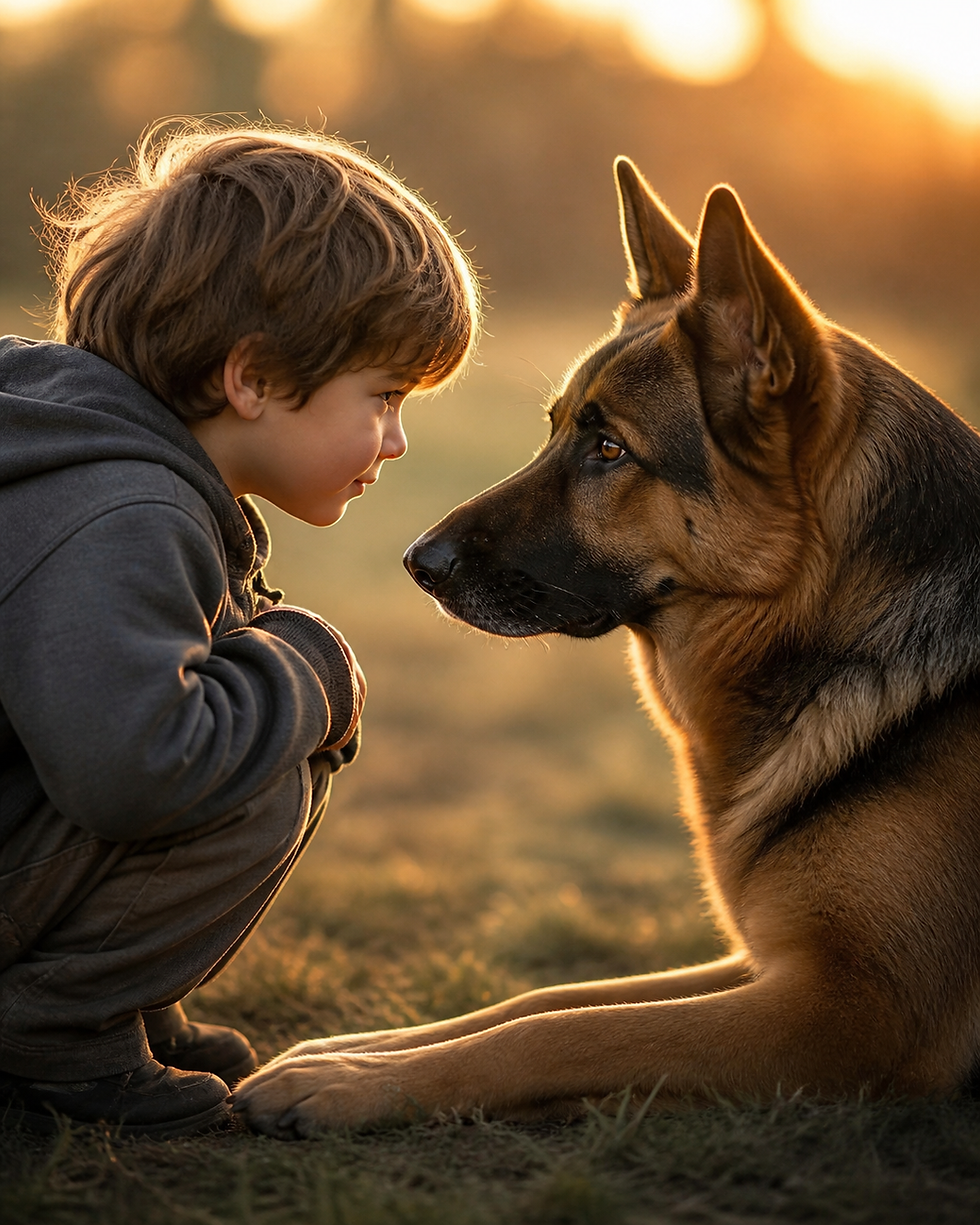
I have seen beautiful relationships between children and German Shepherds. I have seen children grow beside these dogs with a level of confidence, responsibility, empathy, and emotional connection that stays with them for life.
But I have also seen families make dangerous mistakes because they confuse tolerance with safety.
A dog can love a child and still become overwhelmed. A dog can be gentle and still need space. A dog can be stable and still not enjoy being climbed on, grabbed, hugged tightly, chased, or disturbed while eating or sleeping.
Children are children. They move fast. They scream. They fall. They grab. They cry. They do not always read body language. That is normal.
But because that is normal, adult supervision is not optional.
A German Shepherd should be taught how to live with children, and children should be taught how to live with the dog.
In my home, and in the way I educate Southernwind families, respect must go both ways.
The puppy must learn:
not to jump on children
not to chase children as prey objects
not to mouth hands and clothing
not to guard toys, food, or resting spaces
not to make its own decisions about controlling the house
But children must also learn:
not to disturb a sleeping dog
not to pull ears, tails, lips, or fur
not to sit on the dog
not to run screaming around the puppy
not to take food or toys from the dog’s mouth
not to hug the dog tightly around the neck
not to ignore signs that the dog is uncomfortable
This is where many families fail. They correct the puppy, but they do not educate the child.
That is not fair.
A family German Shepherd is not created by letting everyone “figure it out.” It is created by adults who build a calm structure where both the child and the dog know what is expected.
When this is done correctly, the relationship can be beautiful.
The German Shepherd becomes not just a pet, but a living lesson in responsibility, emotional awareness, loyalty, and respect.

Is a German Shepherd Good for First-Time Owners?
This is where I will be very honest.
A German Shepherd can be a good dog for a first-time owner only if that owner is serious, teachable, structured, and willing to learn.
But a German Shepherd is not usually the easiest first dog.
This breed is highly intelligent, emotionally sensitive, physically powerful, naturally observant, and often deeply bonded to its people. That sounds beautiful, and it is, but it also means the dog learns everything.
It learns your routine. It learns your weaknesses. It learns who enforces rules and who does not. It learns when crying gets attention. It learns when barking opens doors. It learns when pulling controls the walk. It learns when the owner is nervous. It learns when the family has no plan.
A soft, confused, emotional owner may accidentally create a pushy, anxious, demanding dog.
A harsh owner may create fear, resistance, or defensive behavior.
The right owner is not weak, and not brutal.
The right owner is calm, consistent, fair, and clear.
That is what a German Shepherd respects.
First-time owners must understand that this breed needs more than love. Love matters, but love without structure is not enough.
A German Shepherd puppy needs routines, crate training, leash manners, controlled exposure, calm handling, appropriate exercise, mental stimulation, and clear household rules from the beginning.
You do not wait until the dog is 80 pounds to start leadership.
You begin the day the puppy comes home.
Not with force. Not with drama. Not with screaming.
With structure.
That is the language the puppy understands.

Are German Shepherds Aggressive?
This is one of the most misunderstood questions about the breed.
A correct German Shepherd should not be randomly aggressive.
A German Shepherd may be protective. It may be alert. It may be naturally reserved with strangers. It may not throw itself into the arms of every person who walks through the door.
That is not aggression.
That is breed character.
But aggression, true aggression, especially unstable aggression, is different. It may come from poor genetics, poor early development, fear, lack of socialization, pain, bad handling, trauma, frustration, poor management, or owners who confuse chaos with freedom.
Many dogs called “aggressive” are not dominant monsters. Many are fearful, overstimulated, under socialized, poorly handled, physically uncomfortable, or living in homes where nobody has created clear rules.
A German Shepherd that is not taught how to process the world may begin to make its own decisions.
That is when trouble starts.
It decides who can enter. It decides what child can run. It decides what dog is a threat. It decides what sound matters. It decides when to bark, lunge, block, guard, or control.
This is not protection. This is confusion wearing the mask of power.
A stable German Shepherd does not need to live in constant suspicion.
A stable German Shepherd has confidence.
Confidence is quiet. Fear is noisy. Insecurity is reactive. Poor leadership is dangerous.
That is why I always tell families: do not buy the image of the German Shepherd. Understand the responsibility of the German Shepherd.
The Southernwind Position: The Family Must Be Prepared Before the Puppy Arrives
At Southernwind, I do not believe a puppy should be placed only because someone wants one.
Wanting a German Shepherd is not enough.
A family must be willing to learn the breed.
Before bringing a German Shepherd puppy home, the family should ask:
Do we have time for daily training and structure?
Are we willing to teach the children how to respect the puppy?
Can we provide safe exercise without overdoing the growing body?
Do we understand that mental stimulation matters as much as physical exercise?
Are we ready to continue the puppy’s social development?
Will the adults in the home agree on rules?
Are we prepared to guide the dog through adolescence?
Do we want a real companion, or only a beautiful dog in the house?
That last question matters.
Because a German Shepherd does not want to be a decoration.
This breed wants relationship. It wants purpose. It wants to understand its place in the family.
When you bring a German Shepherd into your home, you are not just adding a dog.
You are adding a mind. And that mind must be guided.
What a German Shepherd Needs From a Family
A German Shepherd family must provide five things consistently.
1. Structure
The puppy needs to know what is allowed and what is not allowed.
Where does it sleep?
When does it eat?
How does it greet people?
Where does it rest?
What happens when the doorbell rings?
What is expected around children?
What does calm behavior earn?
Structure does not kill the spirit of the dog.
Structure gives the dog peace.
A dog that does not know the rules becomes restless, pushy, anxious, or opportunistic. A dog that understands the household rhythm can relax.
2. Boundaries
Boundaries are not cruelty.
Boundaries are emotional safety.
A puppy that bites hands, jumps on children, steals food, controls doorways, guards furniture, or demands constant attention is not “being cute.” It is learning patterns.
And patterns become habits.
A German Shepherd puppy grows fast. What is funny at 10 weeks may be dangerous at 10 months.
Boundaries must begin early, calmly, and consistently.
3. Social Development
Socialization does not mean throwing the puppy into chaos.
It does not mean dog parks. It does not mean letting every stranger touch the puppy. It does not mean overwhelming the puppy until it shuts down.
Correct social development means controlled exposure to life in a way the puppy can process successfully.
Different surfaces. Different sounds. Different people. Different environments.
Car rides. Crates. Leashes. Veterinary handling. Calm visitors. Children at a respectful distance. Dogs that are safe and appropriate.
The goal is not to make the puppy love everything.
The goal is to teach the puppy that the world is manageable.
That is a very different thing.
4. Leadership
Leadership is not domination.
I have worked with dogs, horses, working animals, police dogs, families, and handlers for most of my life, and I can tell you this clearly: true leadership is not noise.
Leadership is clarity.
A good leader does not beg the dog, negotiate with the dog, scream at the dog, or emotionally collapse when the dog challenges a rule.
A good leader is calm, consistent, observant, and fair.
The German Shepherd does not need a bully.
The German Shepherd needs a person strong enough to be clear and wise enough to be fair.
5. Purpose
A German Shepherd needs something to do.
That does not mean every dog needs to become a police dog, protection dog, sport dog, or working dog.
But the mind must be used.
Training is purpose. Tracking games are purpose. Obedience is purpose. Structured walks are purpose. Scent games are purpose. Learning household manners is purpose. Being included in calm family life is purpose.
A bored German Shepherd will invent a job.
And many times, the job it invents is not the one you wanted.
The Mistake Families Make: They Raise the Puppy With Emotion Instead of Structure
This is one of the most common problems I see.
The puppy comes home. Everyone is excited.
The children scream. The puppy is passed from person to person. It sleeps anywhere. It eats at random times.
It bites and everyone laughs. It jumps and everyone hugs it.
It cries and someone runs to rescue it. It barks and someone gives attention.
It follows everyone all day and never learns how to rest alone.
Then, months later, the family says:
“He is too much.”
“She is anxious.”
“He bites the kids.”
“She barks at everyone.”
“He won’t listen.”
“She is protective.”
“He is aggressive.”
No.
Many times, the dog is not the problem.
The system is the problem.
A German Shepherd puppy must be loved deeply, but raised clearly.
There is a difference.
Love says, “You belong here.
”Structure says, “This is how we live here.”
The dog needs both.
What Makes a German Shepherd Extraordinary in the Right Family
Now let me speak about the beauty of the breed, because when this dog is right, and the family is right, few breeds can touch what the German Shepherd gives.
A good German Shepherd has presence.
It does not just live in the house. It participates in the emotional life of the home.
It watches the baby. It follows the child. It studies the mother. It knows when the father is stressed. It hears the car before anyone else. It notices the stranger at the gate. It feels the change in the room.
This breed has a powerful emotional intelligence when it is balanced.
That is why so many people love German Shepherds. Not only because they are beautiful. Not only because they are intelligent. But because they become part of the nervous system of the family.
They are not distant dogs.
They are present.
But that presence must be shaped.
If shaped correctly, it becomes loyalty.
If shaped incorrectly, it becomes control.
That is the line families must understand.

Who Should Not Own a German Shepherd?
This may sound harsh, but it needs to be said.
A German Shepherd may not be the right dog for your family if:
you want a low-maintenance dog
you are gone all day and have no plan
you do not want to train
you do not want structure in the house
you allow children to treat dogs like toys
you think a dog should “just know better”
you want protection but do not want obedience
you confuse barking and reactivity with courage
you cannot handle shedding, size, strength, and energy
you are not willing to keep learning
This breed deserves better than being blamed for human lack of preparation.
A German Shepherd is not difficult because it is bad.
It becomes difficult when its needs are ignored.
Who Is the Right Family for a German Shepherd?
The right family does not have to be perfect.
But they must be committed.
The right family understands that a puppy is not raised by hope. It is raised by daily habits.
They are willing to:
teach children proper dog manners
create routines
train consistently
provide safe exposure
give the dog mental work
respect the breed’s intelligence
continue what the breeder started
ask for guidance before problems become serious
That is the family where a German Shepherd can blossom.
That is the family where the dog becomes not only manageable, but magnificent.
Internal Southernwind Reading Recommendations
To better understand the Southernwind philosophy behind family German Shepherds, puppy development, structure, and responsible ownership, I recommend reading these related articles:
Early Neurological Stimulation in Puppies: Science-Backed Resilience Training
Building the Balanced German Shepherd: An Exercise and Development Guide for Puppies to Adults
Talk So Your Dog Listens
These articles connect to the same truth: a German Shepherd does not become balanced by accident. Balance is built through breeding, development, handling, and continuation in the home.
Final Answer: Is a German Shepherd the Right Dog for My Family?
A German Shepherd may be the right dog for your family if you want a deeply intelligent, loyal, emotionally present, trainable, protective companion — and you are willing to provide the structure this breed deserves.
A German Shepherd may not be the right dog if you want easy, casual, low-effort companionship without training, leadership, or responsibility.
This breed gives deeply, but it also asks deeply.
It asks for your time. Your awareness. Your consistency. Your fairness. Your leadership. Your willingness to understand what lives behind those eyes.
After more than 50 years with this breed, I can say this without hesitation:
A good German Shepherd in the right family is not just a dog.
It is a presence.
It is a guardian heart. A thinking companion. A child’s memory. A family witness. A living responsibility.
But the family must be worthy of the dog.
That is the truth.
FAQ: German Shepherds as Family Dogs
Are German Shepherds good family dogs?
Yes, German Shepherds can be excellent family dogs when they are well bred, properly raised, socialized, trained, and given clear structure. They are intelligent, loyal, observant, and deeply bonded to their families. However, they are not low-maintenance dogs and should not be chosen casually.
Are German Shepherds good with children?
German Shepherds can be wonderful with children when adults supervise, teach boundaries, and educate both the child and the dog. Children should never be allowed to climb on, pull, chase, disturb, or overwhelm the dog. A good family relationship is built through respect on both sides.
Is a German Shepherd good for first-time owners?
A German Shepherd can work for a first-time owner only if that owner is committed to learning, training, structure, and consistency. This breed is intelligent and powerful, so first-time owners must be prepared to seek guidance and begin training immediately.
Are German Shepherds aggressive?
A correct German Shepherd should not be randomly aggressive. The breed may be naturally alert, protective, and reserved with strangers, but that is different from unstable aggression. Aggression can result from poor genetics, poor socialization, fear, pain, lack of training, or poor management.
Do German Shepherds need a lot of training?
Yes. German Shepherds need consistent training, mental stimulation, leash manners, household rules, and continued social development. Their intelligence is one of their greatest strengths, but without guidance, that intelligence can become frustration or unwanted behavior.
Can a German Shepherd live in a family home?
Yes, but the family must provide structure, safe exercise, proper socialization, mental work, and respectful handling. A German Shepherd should be part of the family rhythm, not isolated, ignored, or expected to raise itself.
Call to Action
If you are considering a Southernwind German Shepherd, do not begin by asking only what color, coat, or sex you want.
Begin by asking what kind of life you are ready to give.
At Southernwind Kennels, we believe the right puppy must be matched with the right family, not simply sold to the first person who asks.
Our goal is to preserve the German Shepherd as a balanced, intelligent, emotionally stable family and working companion through responsible breeding, early development, and owner education.
Author Bio
Maria Cecilia Martinez is the founder of Southernwind Kennels LLC and has dedicated more than 50 years to the German Shepherd breed. Her experience includes German Shepherd breeding, puppy development, canine temperament evaluation, working dog education, AKC and FCI judging, temperament testing, Mounted Police work, equine training, and decades of hands-on owner education. Through Southernwind Kennels, she continues to educate families about responsible breeding, early development, structure, and the preservation of the German Shepherd as a balanced family and working companion.
References
American Veterinary Society of Animal Behavior. Puppy Socialization Position Statement.
American Veterinary Medical Association. Dog Bite Prevention and Child Safety Guidance.
Centers for Disease Control and Prevention. Healthy Pets, Healthy People: Dog Bite Prevention.
American Kennel Club. German Shepherd Dog Breed Information.
McEvoy V., et al. Canine Socialization: A Narrative Systematic Review.
Merck Veterinary Manual / MSD Veterinary Manual. Social Behavior and Behavior Problems of Dogs.
Today’s Veterinary Practice. Aggression in Dogs: Etiology, Signalment, and Management.
VCA Animal Hospitals. Dog Behavior Problems: Aggression and Children.

Comments