


What Does Your Dog Actually See When They Look At You?
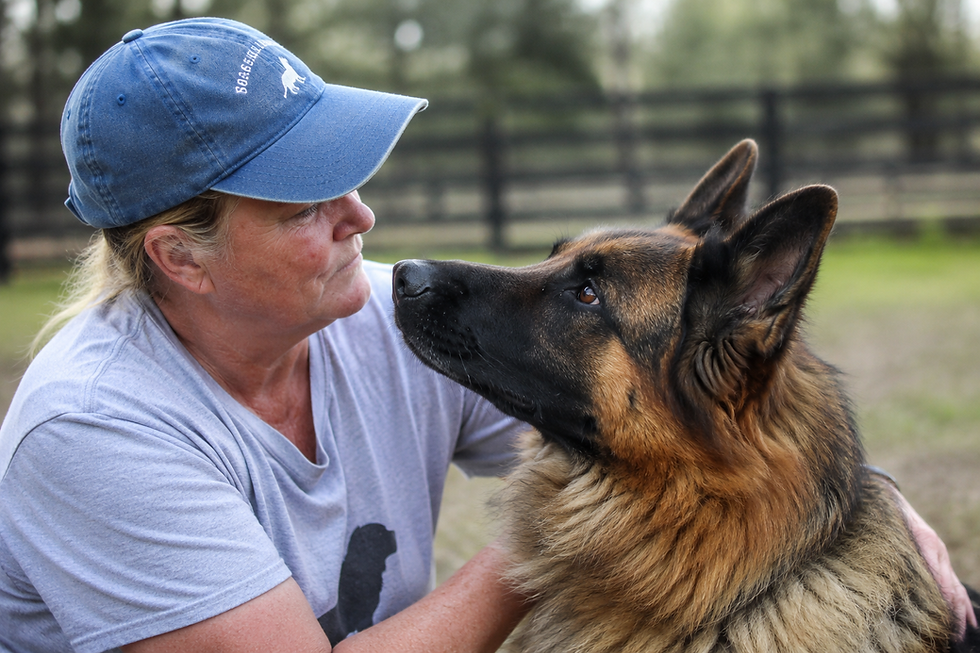
The Science Behind the Human-Dog Bond
By Maria Cecilia Martinez Founder of Southernwind Kennels LLC German Shepherd breeder, trainer, judge, and canine development educator since 1974
There are moments in life with dogs that no textbook can fully explain.
A dog looks at you from across the room. Not barking. Not asking for food. Not moving.
Just looking.
And if you have lived long enough with dogs — truly lived with them, not just owned them — you know that gaze is not empty. There is something happening there.
For more than fifty years, I have watched German Shepherds study people. I have watched puppies learn the sound of footsteps before they learned their own names. I have watched adult dogs read sadness in a face before anyone in the room said a word. I have watched dogs return after years away and recognize the person who shaped their earliest memories.
Years ago, I understood this through experience.
Later, science gave language to what my eyes had already seen.
So, when we ask, “What does your dog actually see when they look at you?”, the answer is much deeper than “owner,” “feeder,” or “person with the leash.”
Your dog sees a collection of signals:
Your face, your scent, your voice, your movement, your emotional state, your routine, your history together, and the attachment bond built through thousands of daily moments.
Not magic.
Not fantasy.
Biology.
Memory.
Relationship.
And responsibility.
First, Let Us Be Honest: Dogs Do Not See the World Like We Do
Before we speak about emotion, we must start with the physical truth.
Dogs do not see human faces with the same visual sharpness and color range that we do. Their vision is different.
They have dichromatic color vision, meaning they primarily distinguish blue and yellow tones, while reds and greens are not seen the way humans see them.
They also have more rod cells in the retina, which helps them detect movement and see better in lower light.
So when your dog looks at you, he is not seeing the exact same portrait you see in the mirror.
He may not see every wrinkle, every color in your shirt, or every fine detail of your expression.
But do not mistake different vision for poor understanding.
A dog does not need to see you like a human sees you.
He sees you like a dog sees what matters.
He reads movement.
He reads posture.
He reads tension.
He reads your face.
He reads your scent.
He reads the rhythm of your body before your words ever arrive.
That is why some dogs know you are leaving before you pick up the keys. They saw the shoulder tension, the change in pace, the shoe pattern, the breathing shift, the tiny routine you did not even know you repeated.
To a dog, you are not one image.
You are a living pattern.
Your Dog Does Not See Another Dog
There is a common mistake people make when they talk about dogs.
They reduce everything to “pack.”
They say the dog sees you as another dog, or as the alpha dog, or as a member of some simple hierarchy.
That is too small.
Dogs evolved beside humans in a way no other animal has.
Research in canine cognition has shown that domestic dogs are unusually skilled at reading human social and communicative behavior.
Brian Hare and colleagues found that dogs can use human communicative cues, such as pointing, in ways that even human-raised wolves and great apes do not perform as naturally.
This matters.
Your dog is not simply treating you like a larger dog.
Your dog is responding to a species-specific social relationship shaped by domestication, learning, attachment, and daily human contact.
That does not mean we should romanticize everything.
A dog is still a dog.
He has instincts, drives, thresholds, stress responses, genetic temperament, prey patterns, defense patterns, social needs, and learning history.
But the domestic dog has become extraordinarily tuned to humans.
That is why a good dog can follow your hand, track your eyes, notice your hesitation, respond to your voice, and change behavior based on whether you are paying attention.
Science has found that dogs are sensitive to human attentional states, and studies show they produce more facial expressions when a human is looking at them than when the human is turned away.
In simple words:
Your dog is not only watching you.
Your dog knows when you are watching back.
Your Face Means More Than You Realize
For many years, I have told owners that dogs learn our faces.
Not just our faces as pictures, but our faces as weather.
They learn the storm before the storm comes.
They learn the quiet sadness.
They learn the forced smile.
They learn the irritated jaw.
They learn the softened eyes.
Research supports this.
Dogs can discriminate between emotional expressions in human faces.
In a Current Biology study, dogs were able to distinguish happy and angry human facial expressions, and the researchers concluded that dogs use human emotion as a meaningful cue rather than responding only to simple visual differences.
This is why your dog may approach differently when you are crying than when you are laughing.
This is why some dogs become softer around vulnerable people.
This is why a sensitive German Shepherd may become restless in a tense household even if nobody is shouting.
They are reading more than words.
They are reading the body behind the words.
And this is where owners must become careful.
Dogs can read emotion, but that does not mean dogs are supernatural judges of human morality.
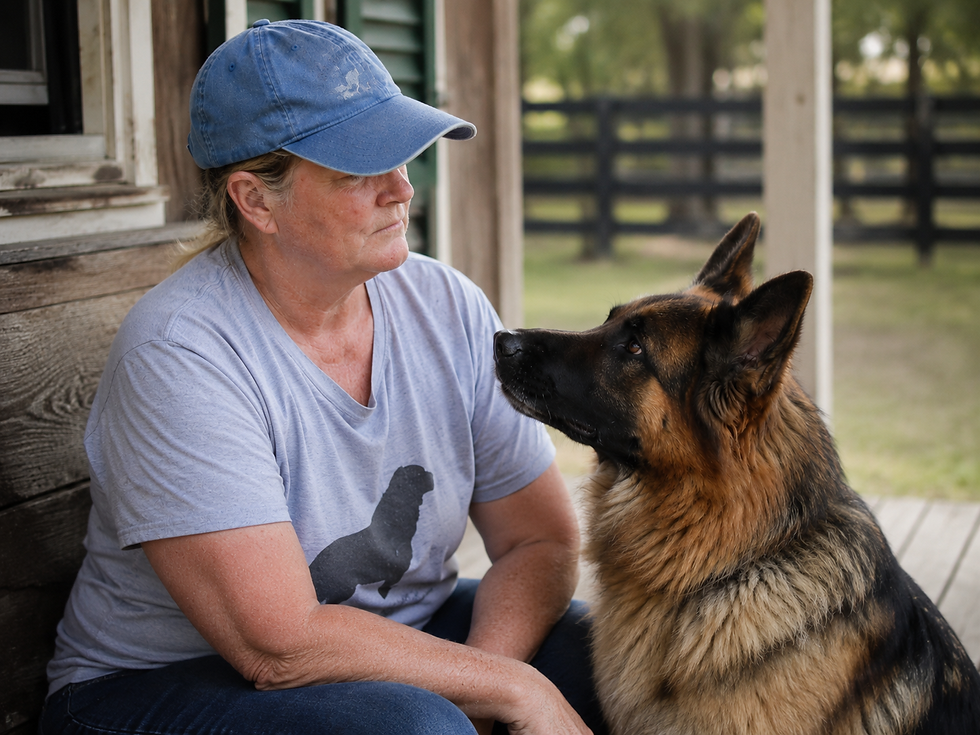
A dog barking at someone does not automatically mean that person has “bad energy.”
A dog may react to a cane, a limp, a hat, an unusual smell, medical equipment, nervous movement, direct eye contact, unfamiliar posture, alcohol odor, medication odor, fear scent, or previous associations.
The dog is not always saying, “This person is evil.”
Often, the dog is saying, “This is different. I need more information.”
That difference matters.
Respect the dog’s perception.
But do not turn it into superstition.
Your Scent Is Not Just a Smell — It Is an Emotional Signature

A Story from My Own Life: Jamie and Franco (Bebo)
Long before I had the scientific words for any of this, I saw it with my own eyes.
When my son Franco was born, we had a Doberman named Jamie. He was a big, strong dog, a serious working dog, and very protective of our home. Naturally, people warned me.
“Be careful with that dog around the baby.”
They imagined danger because they saw the size, the strength, and the protection instinct.
But I knew Jamie.
I knew his heart. I knew his steadiness. I knew the difference between a dog with uncontrolled suspicion and a dog with true protective balance.
When I brought Franco home, I held the baby in my arms and allowed Jamie to smell him calmly. I did not make it dramatic. I did not create fear. I simply allowed the introduction to happen with respect, calmness, and supervision.
Then I began placing Franco’s little blankets and clothes near Jamie, so the baby’s scent became familiar to him.
And something extraordinary happened.
Jamie began sleeping under Franco’s crib.
Not beside it.
Under it.
As if that place had become his post.

From that point on, Jamie became one of Franco’s anchors. When I placed Franco on the floor, Jamie would lie next to him.
When Franco began trying to stand, Jamie would lift his head, and Franco would hold onto his ears to pull himself up.
When Franco began taking his first steps, Jamie would move beside him, steady and watchful, almost as if he understood that this little human was learning how to balance in the world.
When Franco started making his first sounds, Jamie would perk his ears and look toward him, as if trying to understand where this new little language was coming from.
At that time, in the mid-1980s, I did not have the scientific research I have today. I did not know about oxytocin bonding, secure-base attachment, scent recognition, canine sensitivity to human voices, or how dogs process familiar humans.
I only knew what I was seeing.
A dog who had attached himself to a child.
A dog who had made the baby part of his emotional world.
A dog who was not acting from chaos, jealousy, or uncontrolled guarding, but from recognition, familiarity, and responsibility.
Jamie protected Franco until the day Jamie died. He was always careful when people came near the baby. He did not attack. He did not behave like a reckless dog. But he watched. He studied people. He evaluated movement, tone, pressure, and approach.

Today, after all these years, I can look back and understand that Jamie was reading the world around Franco through the very systems science now describes, scent, sound, routine, body language, attachment, and emotional cues.
Back then, I called it instinct.
Today, I understand it was much more layered than that.
It was not magic.
It was the deep intelligence of a stable dog bonded to his family.
To humans, scent is background.
To dogs, scent is biography.
Your dog does not only smell that you entered the room. He smells where you have been, what you touched, whether your hormones shifted, whether your body chemistry changed, whether another animal was near you, whether you are afraid, stressed, sick, excited, or calm.
And science has shown something even more profound.
In an Emory University fMRI study, dogs were presented with different scents: familiar human, unfamiliar human, familiar dog, unfamiliar dog, and self.
The familiar human scent produced the strongest activation in the caudate nucleus; a brain region associated with positive expectation and reward.
That means your scent is not neutral to your dog.
It is not just identification.
It carries emotional value.
Your dog may smell your shirt and settle.
Your dog may lie where you slept.
Your dog may press into your clothes when you are gone.
People sometimes think this is cute behavior.
It is deeper than cute.
Your scent can become a biological signal of safety.
This is why separation is not simply about “missing the owner.” In some dogs, the owner’s absence removes a stabilizing sensory anchor: smell, voice, movement, timing, and presence.
A study on separation-related stress found that the owner’s odor or voice could significantly reduce stress at a physiological level in dogs left alone.
So when your dog waits near the door, sleeps on your shoes, or settles on your blanket, he is not being dramatic.
He is holding onto the part of you his biology can still access.
Your Voice Reaches a Different Place in the Dog
A dog does not hear your voice as simple noise.
He hears tone, rhythm, pitch, emotional weight, tension, softness, and familiarity.
Comparative fMRI research has found voice-sensitive regions in the dog brain, and dogs show sensitivity to vocal emotional cues in ways that overlap with human auditory processing of emotional sound.
This explains why the same word can mean different things depending on how you say it.
A flat “come here” is not the same as a warm “come here.”
A nervous command is not the same as a grounded command.
A frustrated correction is not the same as clear leadership.
Dogs are not only hearing language.
They are hearing the nervous system behind the language.
This is one reason I have always told owners that training does not begin with the leash.
It begins with the human.
Your breathing.
Your timing.
Your clarity.
Your emotional control.
Your dog is learning you while you think you are teaching him.
You Are a Secure Base
This may be one of the most important pieces of science for owners to understand.
Dogs do not only attach to humans emotionally.
They can use their owner as a secure base.
In a study on the secure base effect in domestic dogs, dogs worked longer at a problem-solving task when their owner was present than when the owner was absent.
The researchers concluded that the owner had a specific secure-base effect, comparable in some ways to attachment patterns seen in infant-caregiver relationships.
This does not mean dogs are human children.
They are not.
But it does mean the relationship is biologically and behaviorally important.
A stable owner can help a dog explore, think, recover, and regulate.
An unstable owner can create confusion.
A chaotic owner can feed anxiety.
A soft but inconsistent owner can accidentally create insecurity.
A harsh owner can damage trust.
A clear, calm, fair owner becomes a center point.
That is what good leadership really means.
Not domination.
Not intimidation.
Not emotional softness without boundaries.
A secure base.
A dog should be able to look at his human and feel:
“I know where I stand.”
That is when the best dog begins to appear.

Your Dog May Be Reading Your Stress More Than You Think
Many owners ask why their dog is anxious.
-Sometimes the answer is genetics.
-Sometimes it is poor early development.
-Sometimes it is lack of structure, overexposure, underexposure, pain, illness, poor training, or environmental chaos.
But sometimes the dog is living inside the owner’s nervous system.
A Scientific Reports study found long-term stress synchronization between dogs and their owners by measuring hair cortisol concentrations in 58 dog-human pairs. The researchers found that human cortisol levels were significantly associated with dog cortisol levels and suggested that dogs mirror the stress level of their owners to a great extent.
This should not be used to blame owners.
But it should wake us up.
Dogs are not furniture.
They absorb the emotional climate of the home.
A German Shepherd especially is not a decorative animal sitting in the background of family life. -He watches. -He calculates. -He feels pressure. -He notices movement. -He notices conflict. -He notices weakness. -He notices sadness. -He notices instability.
And if nobody teaches him how to carry that information, he may convert it into barking, guarding, pacing, whining, reactivity, clinginess, or overprotection.
This is why emotional leadership matters.
Not because we need to be perfect.
Nobody is perfect.
But because our dogs need us to become aware.
The Tail Is Speaking Too
When owners ask what their dog sees in them, I also want them to ask:
“What is my dog trying to show me?”
Most people think a wagging tail means happiness.
That is dangerously incomplete.
Tail movement is communication, but it must be read with the whole body: ears, eyes, mouth, posture, weight shift, breathing, muscle tone, speed, height, and context.
Research has also shown that tail-wag asymmetry matters.
In one study, dogs watching videos of other dogs with left- or right-biased tail wagging showed different emotional responses.
Dogs had higher cardiac activity and more anxious behavior when watching left-biased wagging compared with right-biased wagging.
That does not mean every owner should obsess over left and right tail movement in daily life.
It means we must stop reading dogs like cartoons.
A wag is not always joy.
A stare is not always love.
A bark is not always aggression.
A growl is not always dominance.
A quiet dog is not always calm.
A dog’s body is a language.
The tragedy is that dogs spend their lives reading us with precision while many humans barely learn the alphabet of the dog.
The Oxytocin Gaze: Why Looking Into Your Dog’s Eyes Feels Different
There is one discovery that gave scientific language to something dog people have felt forever.
A 2015 study published in Science found that mutual gaze between dogs and owners increased oxytocin, a hormone involved in social bonding.
The study found an oxytocin-mediated positive loop between dogs and humans, where gazing behavior from dogs increased oxytocin in owners, which then facilitated affiliative interaction and increased oxytocin in dogs.
This is not fantasy.
This is not a sentimental phrase written for social media.
This is biology.
When your dog looks at you with soft eyes and you look back with calm affection, something happens in both bodies.
But again, we must be responsible with the truth.
This does not mean every stare is loving.
A hard stare from a tense dog is not the same as soft mutual gaze.
A direct stare between unfamiliar dogs can be pressure.
A dog staring over food may be guarding.
A dog staring while stiff may be conflicted.
Science does not remove the need for good handling.
It makes good handling even more important.
The educated owner learns the difference between connection and tension.
Between softness and pressure.
Between trust and control.
So What Does Your Dog Actually See?
Your dog sees your outline, your movement, and your face.
Your dog smells your identity, your history, and your emotional chemistry.
Your dog hears your voice, your tone, and your nervous system.
Your dog learns your routines.
Your dog remembers your patterns.
Your dog attaches to your presence.
Your dog may use you as a secure base.
Your dog may mirror your stress.
Your dog may seek your eyes as part of a biological bonding loop.
So no, your dog does not simply see “the owner.”
Your dog sees the center of his learned world.
The person who opens doors.
The person who gives structure.
The person who creates safety or confusion.
The person who teaches calm or feeds chaos.
The person whose scent activates memory.
The person whose voice can soften stress.
The person whose face has become a map.
That is why the human side of dog ownership is so serious.
We are not just training dogs.
We are shaping the emotional environment they must live inside.

What This Means for Dog Owners
If you want your dog to understand you better, begin by becoming easier to understand.
Be consistent.
Use clear routines.
Do not change rules every day.
Do not correct from frustration.
Do not comfort anxiety in a way that rewards panic.
Do not assume your dog “knows better” when you never taught better.
Do not expect emotional stability from a dog living inside human instability.
And most of all, stop thinking your dog is only responding to commands.
Your dog is responding to the whole human.
Your hands.
Your eyes.
Your breathing.
Your timing.
Your energy, yes — but not in a magical way.
Energy means posture, rhythm, tension, pressure, confidence, emotional regulation, and intention.
That is what the dog reads.
That is what the dog lives with.
The Southernwind Perspective
At Southernwind, I have spent my life watching puppies become dogs.
I have watched which puppies naturally seek the human eye.
Which puppies recover quickly after pressure.
Which puppies follow movement.
Which puppies need more time.
Which puppies carry depth.
Which puppies carry intensity.
Which puppies are soft, bold, serious, social, independent, thoughtful, or emotionally sensitive.
And I have learned this:
-A great dog is not created only by pedigree.
-A great dog is shaped by the relationship between genetics, early development, environment, structure, and the human who receives him.
-The dog may come with the brain.
-But the owner becomes part of how that brain learns to live.
-That is why education matters.
-That is why breeders must do more than produce puppies.
-That is why owners must do more than love them.
Love without understanding can still confuse a dog.
Understanding gives love a language.
Final Thought
The next time your dog looks at you, do not rush past it.
-Do not reduce it to cuteness.
-Do not turn it into magic.
-Respect it for what it is.
A living animal, shaped by thousands of years beside humans, reading you through scent, sound, face, memory, emotion, and attachment.
Your dog does not see you the way another person sees you.
Your dog sees you through a deeper, older, quieter system.
To him, you are not just a face.
-You are familiarity.
-You are safety.
-You are routine.
-You are memory.
-You are the emotional weather of the home.
And if you are willing to learn what he is saying back, the relationship changes forever.
Because the real miracle is not that dogs understand everything.
The real miracle is how much they try.
Related Southernwind Articles
To continue learning about canine emotion, intelligence, scent, memory, and the human-dog relationship, read:
FAQ
Do dogs really recognize their owners?
Yes. Dogs recognize familiar humans through scent, voice, face, movement patterns, and emotional association. Research using canine brain imaging shows that familiar human scent can activate reward-related brain areas in dogs.
Do dogs understand human emotions?
Dogs can discriminate human facial expressions and are sensitive to emotional cues in human voices. They may not understand emotion exactly the way humans do, but they can read meaningful signals from our faces, voices, posture, and behavior.
Why does my dog stare at me?
A dog may stare for many reasons: attachment, communication, food expectation, confusion, guarding, learned attention-seeking, or emotional connection. Soft eyes and relaxed posture are very different from a hard, tense stare.
Does looking into my dog’s eyes strengthen our bond?
Soft mutual gaze between dogs and owners has been associated with increased oxytocin in both species, supporting a biological bonding loop. However, staring should always be read in context. A relaxed gaze is not the same as a tense stare.
Can dogs sense stress in their owners?
Yes. Research measuring hair cortisol found long-term stress synchronization between dogs and owners, suggesting dogs can mirror aspects of their owner’s stress state.
Does my dog think I am another dog?
No. Dogs interact with humans through a unique interspecies relationship. They are highly skilled at reading human social cues, and domestication has shaped their ability to communicate with people in ways that differ from wolves and many other animals.
Does a wagging tail always mean a dog is happy?
No. Tail wagging must be read with the whole body and the situation. Research shows that even the direction of tail-wag bias can be associated with different emotional responses in dogs.
Author Biography
Maria Cecilia Martinez is the founder of Southernwind Kennels LLC in Brooksville, Florida. She has more than 50 years of experience breeding, training, raising, and evaluating German Shepherd Dogs. Her background includes work with the Puerto Rico Mounted Police, AKC and FCI judging, temperament evaluation, puppy development, working dog education, and lifelong study of the relationship between genetics, environment, structure, temperament, and the human-dog bond.
References
Hare, B., Brown, M., Williamson, C., & Tomasello, M. The domestication of social cognition in dogs. Science.
Hare, B., & Tomasello, M. Human-like social skills in dogs? Trends in Cognitive Sciences.
Berns, G. S., Brooks, A. M., & Spivak, M. Scent of the familiar: An fMRI study of canine brain responses to familiar and unfamiliar human and dog odors. Behavioral Processes.
Nagasawa, M., et al. Oxytocin-gaze positive loop and the coevolution of human-dog bonds. Science.
Müller, C. A., Schmitt, K., Barber, A. L. A., & Huber, L. Dogs can discriminate emotional expressions of human faces. Current Biology.
Horn, L., Huber, L., & Range, F. The importance of the secure base effect for domestic dogs. PLOS ONE.
Sundman, A. S., et al. Long-term stress levels are synchronized in dogs and their owners. Scientific Reports.
Siniscalchi, M., et al. Seeing left- or right-asymmetric tail wagging produces different emotional responses in dogs. Current Biology.
VCA Animal Hospitals. Do Dogs See Color?


Comments