


Puppy Food Drive Training: How to Build Motivation, Focus, and a Stronger Bond

By Maria Cecilia Martinez
Founder, Southernwind Kennels LLC | German Shepherd Breeder, Trainer, Judge, and Canine Development Educator Since 1974
Southernwind Canine Knowledge Library™ — Puppy Training & Development
Your Puppy Has to Eat. Why Not Make Those Moments Count?
Imagine bringing your new German Shepherd puppy home.
Everything is unfamiliar. The furniture, the smells, the voices, even the floor beneath his feet.
You prepare his breakfast, place the bowl down, and watch him eat.
Nothing wrong with that.
But what if part of that same breakfast could become your puppy's first lesson in communication?
What if those little pieces of food could teach him to follow your hand, respond to his name, pay attention to your movements, and begin understanding what you are asking?
This is where puppy food drive training becomes so valuable.
After more than five decades breeding, raising, training, and evaluating German Shepherd Dogs, I have come to appreciate how much learning can happen during the smallest everyday interactions.
Not everything needs to begin with a leash, a training collar, or a formal obedience session.
Sometimes, it begins with a few pieces of kibble and a person who understands what to do with them.
But before I explain how to develop food motivation, we need to understand something broader.
What are the drives in dogs, and how do they influence the way our puppies learn?
Understanding the Different Drives in Dogs

When you listen to experienced trainers, particularly those involved with working dogs, you will hear expressions such as food drive, prey drive, play drive, and defense drive.
These are useful terms in traditional dog training, but they should not be mistaken for a universally agreed scientific classification of separate drives.
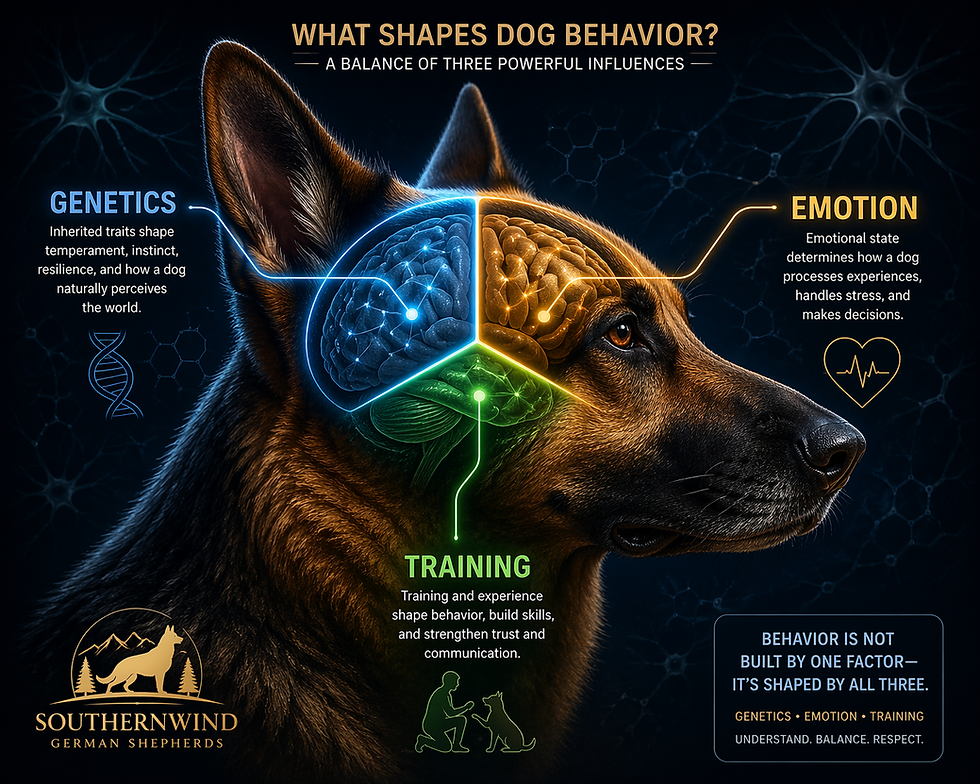
Canine behavior is influenced by biological needs, inherited behavioral tendencies, emotional states, learning experiences, and environmental conditions.
A dog may be highly motivated by food in one situation and far more interested in chasing a toy in another.
Understanding motivation helps us choose better ways to teach.
Food Drive: Motivation to Obtain Food
Food drive describes a dog's willingness to seek, pursue, and perform behaviors to obtain food.
Some puppies are enthusiastic about almost anything edible. Others are selective, easily distracted, or less interested in food during training.
Food motivation is influenced by appetite, food preferences, health, stress, genetics, and previous learning.
The good news is that we can often improve how effectively food functions as a training reward.
Prey Drive: Motivation to Pursue Moving Objects
Prey drive is a traditional training term associated with predatory behavior, including orienting, chasing, grabbing, and carrying.
You may see elements of this when your puppy chases a rolling ball or grabs a moving tug toy.
These tendencies can be useful in structured games and working-dog training.
But strong chasing behavior does not automatically indicate courage, emotional stability, or suitability for protection work.
Those qualities require separate evaluation.
Play Drive: Motivation for Games and Interaction
Some puppies love tug toys, retrieving, and interactive games.
Play can become a powerful reward, particularly when a dog values the activity enough to work for it.
It also creates opportunities for cooperation and communication.
Social Motivation: Interest in People
Some puppies are strongly motivated by attention, praise, touch, and social interaction.
A puppy may approach because he enjoys your company, not because you are holding food.
This is important because a healthy training relationship should include more than access to treats.
Defense-Related Behavior: Responses to Threat
In traditional working-dog terminology, defense drive refers to behavior associated with perceived threats.
Scientifically, we need to distinguish fear, threat perception, defensive responses, and aggression.
A puppy barking at an unfamiliar person is not necessarily displaying courage.
He may be frightened, uncertain, or overstimulated.
I have always considered it important to look beyond the outward behavior and evaluate the dog underneath it.
A trained response is not the same thing as a stable temperament.
Search and Exploration Motivation
Dogs are naturally inclined to investigate their surroundings.
Sniffing, searching, and exploring can be rewarding activities.
A simple food-search exercise can encourage your puppy to use his nose and investigate a safe environment.
This can complement obedience work and provide mental enrichment.
What Exactly Is Food Drive in a Puppy?

Here is the simplest way I can explain it.
Food drive is the motivation a puppy demonstrates when food is valuable enough to influence his behavior.
But food drive and hunger are not identical.
A hungry puppy may eat because he needs nourishment.
A food-motivated puppy may actively search, follow, offer behaviors, or remain engaged because food is a desirable reward.
This distinction is important.
We do not need to make a puppy excessively hungry to teach him.
In fact, withholding necessary food to manufacture motivation is inappropriate, particularly during growth.
Instead, we can use a measured portion of his normal daily meals to create opportunities for learning.
And that is where breakfast becomes interesting.
Why Food Works: The Science of Positive Reinforcement
Food can function as a primary reinforcer because it has biological value.
In behavioral science, positive reinforcement occurs when a consequence follows a behavior and increases the likelihood of that behavior happening again.
Imagine this:
Your puppy looks toward you.
You immediately say, "Yes!" and give him a small piece of food.
He looks toward you again.
You reward him.
With repetition, he can begin learning that orienting toward you produces something worthwhile.
You are developing attention through reinforcement.
The timing matters.
The puppy needs a clear connection between the behavior and its consequence.
That is why short, precise training interactions can be more effective than repeating commands while the puppy is confused.
What Does Research Tell Us?
In 2023, researchers published Efficacy of Edible and Leisure Reinforcers with Domestic Dogs in the peer-reviewed journal Animals.
The study evaluated ten dogs and compared preferred food rewards with preferred leisure items.
Food generally proved more effective as a reinforcer under the conditions tested.
The sample was small, and the study did not establish that food is always superior for every dog or training task.
Nevertheless, the findings support the practical value of identifying rewards that individual dogs find motivating.
The American Veterinary Society of Animal Behavior also recommends reward-based training methods, emphasizing learning effectiveness and animal welfare.
Food is not magic.
It is a tool supported by established principles of learning.
And like every training tool, its value depends on how intelligently we use it.
The Psychology of Food Training: More Than Teaching Commands
This is the part I particularly want puppy owners to understand.
When you use food correctly, you are doing more than teaching a sit or a down.
You are creating repeated opportunities for communication.
Your Puppy Learns That Your Signals Have Meaning
Dogs learn through associations and consequences.
A sound can begin to predict something pleasant.
A hand movement can become a signal.
A behavior followed by a desirable reward may become more likely to occur again.
Over time, your puppy begins understanding patterns.
Your hand moves in a particular way.
He follows.
Something good happens.
You say his name.
He looks at you.
Something good happens.
The puppy is learning how to interact with you.

Can Food Training Strengthen the Human-Dog Bond?
It can contribute to a positive relationship, but the explanation is more complex than saying the dog bonds with whoever provides his food.
Dogs develop relationships through multiple experiences, including safety, predictability, appropriate handling, social interaction, and learning.
When training is enjoyable and understandable, it can become one of those positive experiences.
I want a puppy who enjoys participating with his owner.
Not one who obeys because he is frightened.
And not one who has been taught that every basic necessity must be earned.
There is a difference between cooperation and dependency.
At Southernwind, the objective is not simply to produce a puppy who follows food. It is to help develop a dog who understands how to learn and enjoys working with his person.
How to Start Puppy Food Drive Training From the First Day Home
You can begin simple food-based interactions as soon as your puppy is comfortable enough to participate.
For some puppies, that may be the first day.
Others may need more time to settle into their new surroundings.
Do not turn the first evening into an obedience examination.
Start gently.

Step 1: Use Part of Your Puppy's Regular Breakfast
Measure your puppy's appropriate meal portion.
Set aside a small amount for training.
For many puppies, ordinary kibble works beautifully.
If your puppy needs a more desirable reward, tiny pieces of suitable soft food may be helpful.
Account for treats within his daily nutrition.
Remember that growing puppies need complete and balanced nutrition.
Step 2: Teach Your Puppy to Follow Your Hand
Hold a small piece of food near your puppy's nose.
Let him notice it.
Move your hand slowly a few inches.
When he follows, reward him.
Repeat.
Move slightly left.
Reward.
Move slightly right.
Reward.
Take one small step backward.
Reward when he follows.
Keep the movement slow enough that he can succeed.
This exercise introduces food luring and begins teaching your puppy to follow a guiding hand.
Step 3: Teach Attention to His Name
Say your puppy's name once in a pleasant voice.
When he looks toward you, mark the response with "Yes!" and reward him.
Practice in a quiet environment.
As he improves, introduce mild distractions.
Do not repeatedly call his name when he is too distracted to respond.
We want the name to become a meaningful signal.
Step 4: Teach the Sit
Hold a small treat near your puppy's nose.
Move your hand slightly upward and backward.
As his head follows the food, his rear may naturally lower.
When he sits, mark and reward.
Do not push his rear down.
If he jumps, backs away, or becomes confused, change your hand movement.
After several successful repetitions, try the same gesture with an empty hand.
Reward him from your other hand.
Once he understands the movement, begin introducing the verbal cue.

Step 5: Teach Your Puppy to Follow You
This is one of my favorite early exercises.
Stand close to your puppy.
Move backward a step or two.
When he follows, reward him.
Change direction.
Reward again.
Keep it playful.
You are beginning to develop an interest in your movements and a willingness to stay engaged.
Later, this can contribute to recall, loose-leash walking, and more advanced obedience.
But right now, it is simply a little game between you and your puppy.
The Southernwind Five-Minute Breakfast Training Routine
You do not need to dedicate an hour to begin teaching your puppy.
Use a small part of breakfast.
Minute 1 — Name and Attention
Reward your puppy for responding to his name and looking toward you.
Minute 2 — Following Your Hand
Practice a few gentle food-luring movements.
Minute 3 — Learning to Sit
Help your puppy discover the sit position and reward successful attempts.
Minute 4 — Following Your Movement
Take a few steps backward or change direction and reward him for following.
Minute 5 — Finish With Success
Ask for something easy, reward him, and finish the session.
Then provide the rest of his meal.
For very young puppies, one or two minutes may be enough.
You can divide the exercises into several short sessions.
The purpose is not to finish a schedule.
The purpose is to make learning successful.
How to Build Food Drive in a Puppy That Isn't Very Food Motivated
Now, here is something I want to address carefully.
Not every puppy comes home with tremendous enthusiasm for food.
And that does not make him a bad puppy.
Some puppies are more interested in toys.
Some are distracted by unfamiliar surroundings.
Some prefer certain textures or flavors.
Others become much more interested in food once they understand the training game.
We can often improve food motivation, but we cannot promise to create the same intensity of food drive in every dog.
Find Out What Your Puppy Likes
Try suitable food rewards of different textures and flavors.
Some puppies prefer kibble.
Others respond more readily to soft training treats or small pieces of plain cooked meat.
Introduce new foods carefully.
Begin in a Quiet Environment
A puppy exploring a new backyard may find smells far more interesting than kibble.
That does not necessarily mean he lacks food motivation.
Start where distractions are minimal.
Make the Training Easy
Reward small efforts.
Do not ask for complicated behaviors before the puppy understands the exercise.
Introduce Gentle Movement
Some puppies become more interested when the food reward is part of a simple following game.
Move slowly, let him succeed, and reward promptly.
Practice Around Normal Feeding Times
A puppy may be more interested in food before a scheduled meal than immediately afterward.
But never withhold necessary meals or deliberately create excessive hunger.
Keep the Experience Pleasant
If the puppy becomes frustrated, tired, or disengaged, stop.
Try again later.
If a puppy consistently refuses food, particularly with vomiting, diarrhea, lethargy, or other signs of illness, consult a veterinarian.
Training is not the priority when a puppy may be unwell.
Food Luring, Food Rewarding, and Food Bribery: What Is the Difference?
This is one of the most misunderstood parts of food training.
Food Luring
You use visible food to guide a puppy into a new movement.
For example, moving a treat above his nose to help him discover how to sit.
Food Rewarding
You deliver food after the puppy performs a desired behavior.
The food reinforces the response.
Food Bribery
In everyday training language, bribery usually describes repeatedly showing food to persuade a dog to perform a behavior he already knows.
It is not a formal scientific learning category, but it describes a common practical problem.
The owner says, "Sit."
Nothing happens.
The owner produces a treat.
Suddenly, the dog sits.
The problem may be that the dog learned to respond to the visible food rather than the intended cue.
How Do We Prevent That?
We fade the lure.
After a few successful repetitions, begin using the same hand movement without food in that hand.
Reward from your other hand.
Gradually make the hand signal smaller.
Then introduce the verbal cue and practice in different environments.
The goal is for your puppy to understand the cue without needing to see the reward first.
That does not mean you must stop using food rewards.
Food can remain a valuable reinforcer throughout the dog's life.
We are removing dependence on the visible lure, not removing positive reinforcement from training.
Can Food Drive Help with Recall, Leash Walking, and Obedience?
Absolutely, food motivation can be useful in teaching many everyday behaviors.
A puppy can learn to come when called, follow his handler, sit, lie down, stand, go to a mat, and remain attentive during short exercises.
Food rewards can also help teach cooperative handling and reinforce calm behavior.
But there is something owners must remember.
A puppy who performs beautifully in the kitchen has not automatically learned the same behavior in the backyard, at the veterinarian's office, or around other dogs.
Learning must be practiced in different environments
We call this generalization.
Begin with easy conditions.
Gradually introduce distractions.
Increase difficulty only when the puppy is succeeding.
And never assume that a puppy who comes when called indoors has a reliable recall around traffic or other dangers.

The Most Common Mistakes Owners Make with Food Training
I have seen many owners unintentionally make training harder than necessary.
Moving the lure too quickly. The puppy cannot follow clearly and becomes confused.
Repeating commands before the puppy understands them. A word has little meaning until the dog learns what behavior it predicts or signals.
Showing food before every familiar command. The puppy may learn to wait until the reward is visible.
Training when the puppy is exhausted or frightened. Learning becomes more difficult when the puppy cannot comfortably participate.
Using excessive treats. Additional rewards must be accounted for in the puppy's nutritional intake.
Expecting immediate obedience around distractions. Skills need to be taught and practiced progressively.
Confusing food excitement with emotional stability. A puppy who enthusiastically pursues treats is not automatically confident, socially balanced, or environmentally resilient.
And perhaps the most important mistake:
Forgetting that your puppy is still a puppy.
He needs sleep, play, exploration, social experiences, and opportunities to develop at an appropriate pace.
Training should enrich his life, not consume every moment of it.
Food Drive Is Valuable, but It Is Not the Whole Dog
I want to make this particularly clear for German Shepherd owners.
Food motivation is useful.
Prey motivation can be useful.
Play motivation can be useful.
But none of these, by itself, tells me everything I need to know about a dog's temperament.
A dog may have extraordinary food drive and still be environmentally insecure.
Another may have tremendous prey motivation and struggle with unfamiliar people.
When I evaluate dogs, I look beyond the trained performance.
I want to see how the dog responds to unfamiliar situations, how he recovers from being startled, how he engages socially, and how he manages environmental challenges.
Those observations tell us things that obedience alone cannot.
This is why responsible breeding, early development, socialization, and continued owner education must work together.
A well-trained dog is not automatically a well-balanced dog.
And a well-balanced dog still needs education.
From Southernwind to Your Home: Continuing the Work
At Southernwind Kennels, we believe the breeder's responsibility includes helping prepare puppies for life beyond the kennel.
But no breeder can complete a dog's education before that puppy goes home.
The family becomes the next important part of his development.
And that is why I encourage our puppy owners to begin with simple, enjoyable exercises.
You do not need complicated equipment.
You do not need to become a professional trainer.
You need patience, consistency, and the willingness to observe the puppy in front of you.
Learn what motivates him.
Learn when he is interested.
Learn when he is confused.
Learn when to make the exercise easier.
And above all, give him opportunities to succeed.
Food can be a wonderful starting point.
But the real objective is communication.
Frequently Asked Questions About Puppy Food Drive Training
1. What is food drive in dogs?
Food drive describes how strongly food motivates a dog to seek rewards or perform behaviors. It varies between individuals and can change with appetite, environment, health, stress, and learning history.
2. Can you develop food drive in a puppy?
Food motivation can often be improved through preferred rewards, enjoyable training exercises, appropriate timing, and reduced distractions. However, not every puppy will develop equally strong food motivation.
3. When should I start food training my puppy?
You can begin simple positive exercises as soon as your puppy is comfortable in his new home. Some puppies are ready on the first day, while others need time to adjust.
4. Can I train my puppy with his regular kibble?
Yes. Many puppies work well for regular kibble. Use a portion of their measured daily food allowance and provide the remainder of the meal afterward.
5. What if my German Shepherd puppy doesn't like treats?
Try a quieter environment, different safe rewards, and shorter exercises. Consider whether your puppy is full, stressed, tired, or distracted. Persistent loss of appetite warrants veterinary attention.
6. Does food drive the same as prey drive?
No. Food drive refers to motivation for food, while prey drive is a traditional term for tendencies associated with pursuing and capturing moving objects. A dog can be strongly motivated by one and less motivated by the other.
7. Does food training create a stronger bond?
Enjoyable, predictable training interactions can contribute to a positive relationship. However, trust and attachment also depend on safety, social interaction, appropriate handling, and consistent care.
8. Will food rewards make my puppy dependent on treats?
Not necessarily. Gradually fade visible food lures, teach clear cues, and continue reinforcing desirable behavior. The objective is to teach understanding rather than dependence on seeing food.
9. How long should food training sessions last?
Very young puppies often benefit from sessions lasting one to three minutes. Some can comfortably participate longer. Follow the puppy's attention and emotional state rather than a rigid schedule.
10. Can food drive help teach recall?
Yes. Food rewards can reinforce coming when called. Begin in a safe, low-distraction environment and progressively practice under more challenging conditions.
11. Does high food drive mean a German Shepherd has a good temperament?
No. Food motivation is only one characteristic. Temperament also involves emotional stability, sociability, adaptability, fear responses, and other behavioral tendencies.
12. Should I hand-feed every meal to train my puppy?
No. Hand-feeding some of a meal can be useful, but puppies do not need to earn every piece of food. Normal meals, enrichment feeding, and appropriate rest are equally compatible with good training.
My Final Thoughts: Don't Waste the Little Opportunities
There is something I wish every new puppy owner understood.
Training does not begin when you put a leash on your dog.
It begins in the little moments.
When your puppy looks toward you.
When he follows your hand.
When he hears his name and turns.
When he begins to understand that paying attention can lead to something good.
Those moments may seem insignificant.
But repeated with patience, they become learning experiences.
And those experiences can become the foundation for a lifetime of communication.
So tomorrow morning, when you prepare your puppy's breakfast, take a few pieces of his food.
Sit with him.
Teach him something simple.
Let him succeed.
And enjoy watching him learn.
Because the food itself is not the most important part of that experience.
It is what the two of you are learning to do together.
— Maria Cecilia Martinez
Continue Learning With Southernwind Kennels
Understanding how puppies learn is only one part of raising a balanced German Shepherd.
Explore more educational resources from Southernwind Kennels:
When Does a German Shepherd Really Become an Adult?https://www.southernwindk9.com/post/when-does-a-german-shepherd-become-an-adult
Are You Protecting Your Dog—or Teaching Him to Avoid Life?https://www.southernwindk9.com/post/protecting-your-dog-trigger-avoidance
Buying a German Shepherd Puppy? The Health Clearances Every Buyer Must Verify https://www.southernwindk9.com/post/german-shepherd-puppy-health-clearances
Learn about Southernwind Kennels and our breeding philosophy: https://www.southernwindk9.com/about-us
Explore Southernwind Kennels: https://www.southernwindk9.com
About the Author
Maria Cecilia Martinez is the founder of Southernwind Kennels LLC, with a German Shepherd breeding program established in 1974. Her professional experience spans more than five decades of breeding, raising, training, and evaluating German Shepherd Dogs.
Her background includes canine temperament evaluation, working-dog development, equine and canine training, judging, educational seminars, and work with the Puerto Rico Police Department's mounted police program.
Through the Southernwind Canine Knowledge Library™, she shares practical knowledge developed through decades of direct experience, supported by established principles of canine behavior, learning, and animal welfare.
Southernwind Kennels LLC — Brooksville, Florida
Scientific References and Further Reading
1. American Veterinary Society of Animal Behavior (AVSAB). Humane Dog Training Position Statement (2021).https://avsab.org/resources/position-statements/
2. Lazaro, X. A., Winter, J. M., Fernand, J. K., Cox, D. J., & Dorey, N. R. (2023). Efficacy of Edible and Leisure Reinforcers with Domestic Dogs. Animals, 13(19), 3073.https://doi.org/10.3390/ani13193073
3. VCA Animal Hospitals. Puppy Behavior and Training Basics.https://vcahospitals.com/know-your-pet/puppy-behavior-and-training-training-basics
4. American Veterinary Society of Animal Behavior. Puppy Socialization Position Statement.https://avsab.org/resources/position-statements/


Comments